



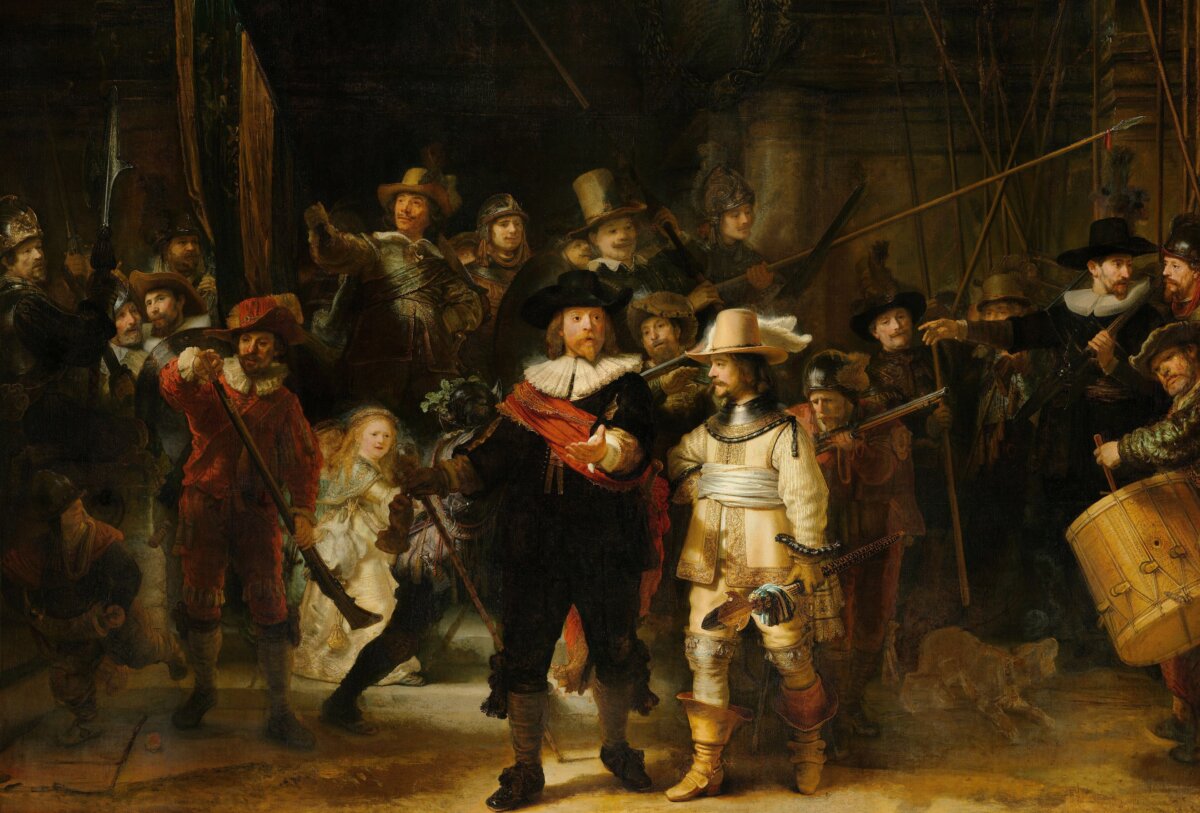
Of all Dutch paintings, the single most highly revered work has also been the most attacked, damaged, and misunderstood. Trimmed significantly from its original size, damaged three times by art vandals, and misnamed because dirt and decayed varnish darkened its colors, Rembrandt’s “The Night Watch” survives today as one of the art world’s most celebrated comeback stories.
The painting’s many cutting-edge restorations have, 350 years later, granted its millions of annual visitors a fresh look at its original conception. Despite centuries of analysis and scrutiny, some of the mysteries and contested interpretations behind his enigmatic design have also survived.
A New Age and Empire
In 1602, the merging of several rival trading companies resulted in Amsterdam quickly becoming the financial capital of the world. This legal monopoly allowed not just merchants but all Dutch citizens to invest and share in the merger’s profits, creating the world’s first stock market. It was the birth of the Dutch East Indies Trading Company (Vereenigde Oostindische Compagnie, VOC) which fueled Amsterdam’s population explosion from 50,000 to 175,000 over the next 50 years.
With the rapid influx of trade and resources, the city bloomed not only economically but culturally. No other city in Europe could match Amsterdam’s growing consumerism. Even modest households were decorated with oil paintings, prints, and copperplate etchings. This newfound prosperity spread rapidly throughout the northern Netherlands and granted its newly affluent society the means to foster a new generation of artists poised to embrace the growing demand. Four years after the launch of the VOC, in the dawn of what became the Dutch Golden Age, Rembrandt van Rijn was born.
From Dropout to Magician
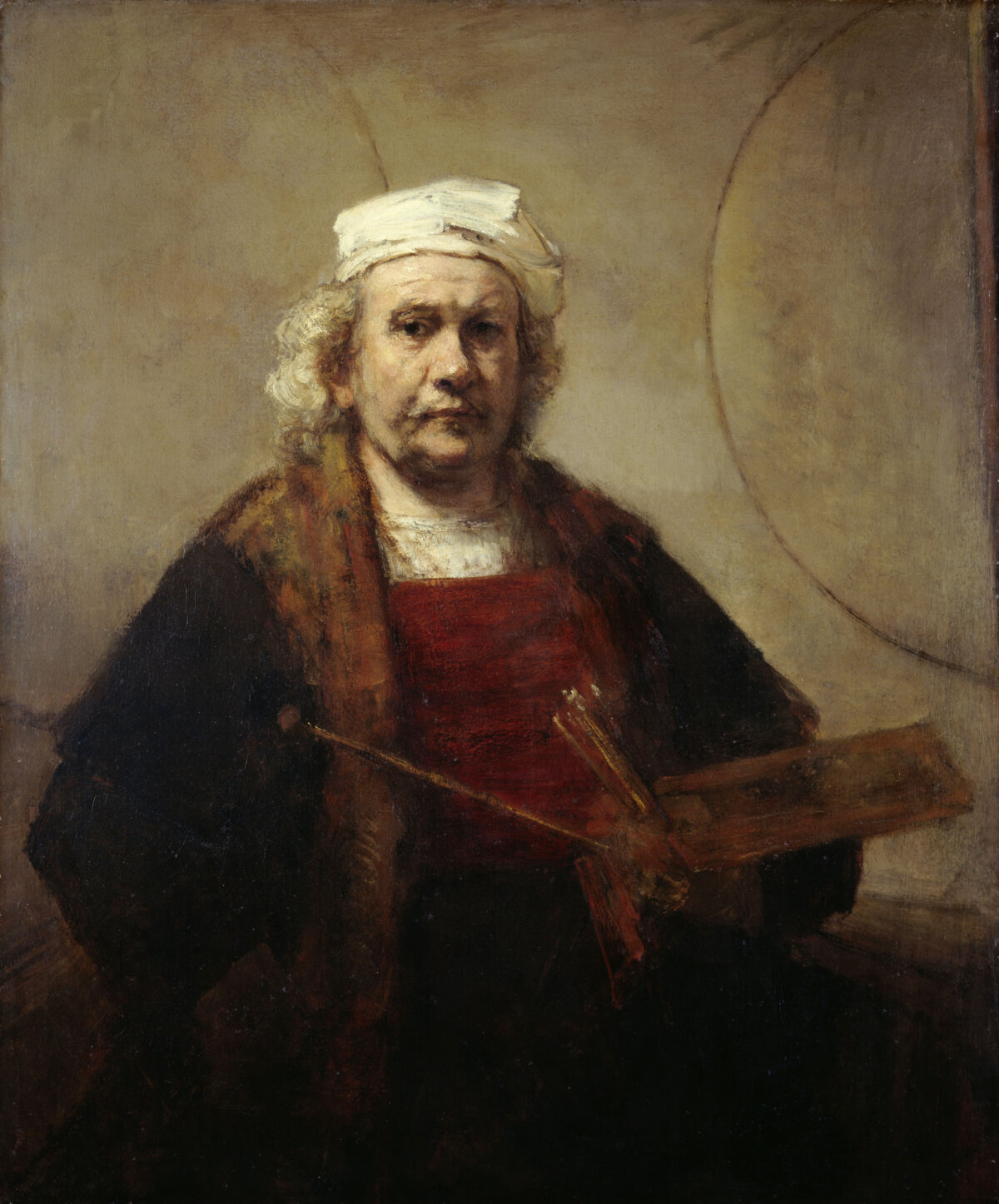
Growing up in Leiden, just 25 miles outside of Amsterdam, Rembrandt (1606–1669) quit his studies at the Latin School prematurely and began training with Dutch Italianate painter and art dealer Jacob van Swanenburg (1571–1638). After completing this three-year apprenticeship, he was not yet satisfied with his skills and pursued several additional apprenticeships, most notably a six-month stay in Amsterdam with Pieter Lastman (1583–1633) a well-known history painter.
Despite Rembrandt’s reputation among his patrons for being abrasive and arrogant, his initiative to continue learning from different masters reveals an undeniable discipline and self-awareness behind his confidence.
In place of signing his paintings with his initials, he added a “d” to the spelling of his name, “Rembrant,” making a play on the Dutch words, “rem” meaning obstruct and “brandt” meaning light.
His gradual shift away from vibrant, colorful palettes towards a more limited, monochromatic aesthetic permitted his ingenious experimentation with light and shadow to create narrative tension between his subjects. His fascination with light prompted him to cover his windows with oiled paper in order to diffuse and soften the sunlight over his subjects.
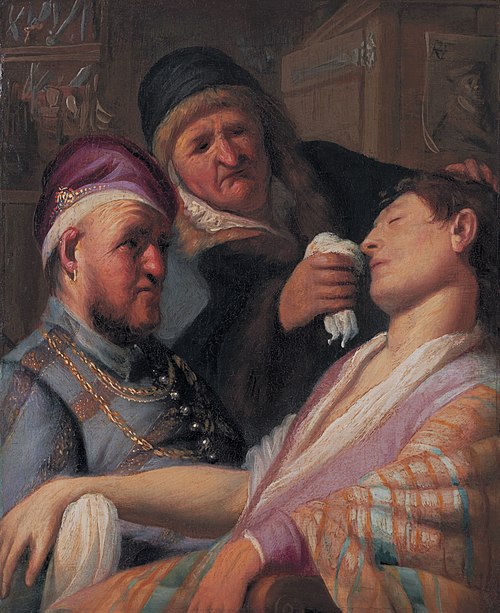
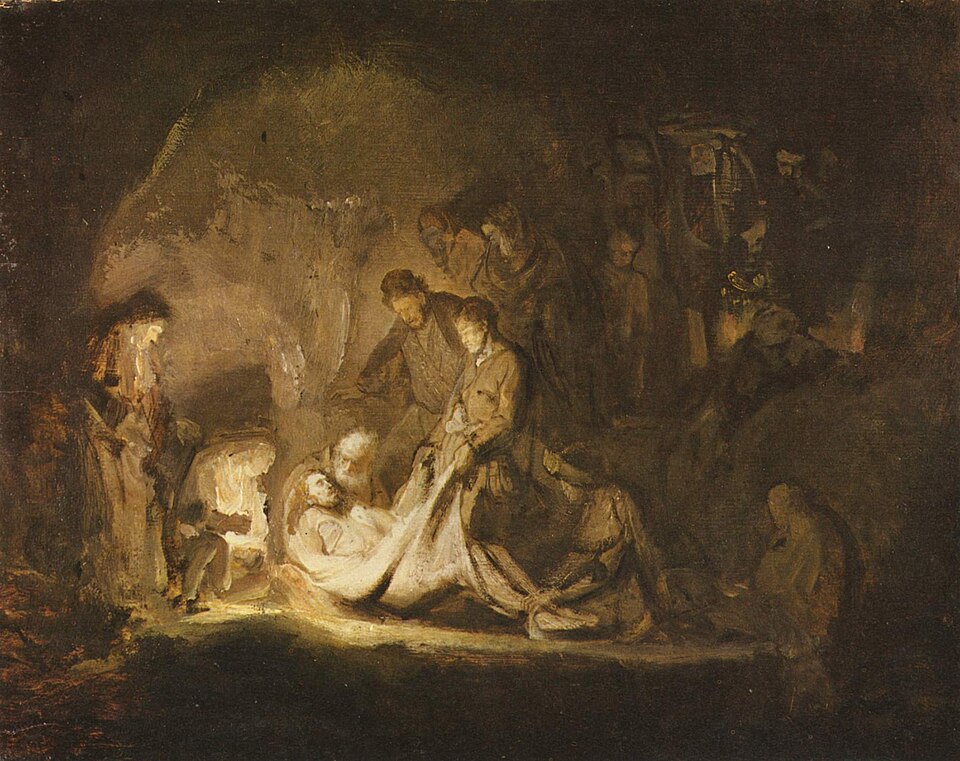
Comparing his earliest surviving works in the “Allegory of the Senses” (1625) with “The Entombment” (circa 1633) demonstrates his clear departure from a language of color to one of dramatic contrast. Capitalizing on the baroque tradition of “chiaroscuro” he would cultivate this technique for the next decade and in what would be the most important commission of his life.
Group Portrait or Tableau Vivant
In the final phase of the Eighty Years’ War, Amsterdam’s militia groups had long been retired from combat. One way they managed to maintain their prominent social status was by commissioning large group portraits to immortalize their glory days in battle. These portraits were typically formal, static depictions clearly showing each member’s face. When Amsterdam’s Kloveniers approached Rembrandt with such a commission in 1640, his response was decidedly atypical.
Though the Kloveniers consisted of only 18 members, Rembrandt’s finished painting contained 32 men, two women, and a dog. Assembled in a chaotic scene of movement and noise before a triumphal arch, with a gun firing, a drum beating, a banner waving, and every figure looking or pointing in different directions, the scene has evaded any consensus of interpretation since its unveiling.
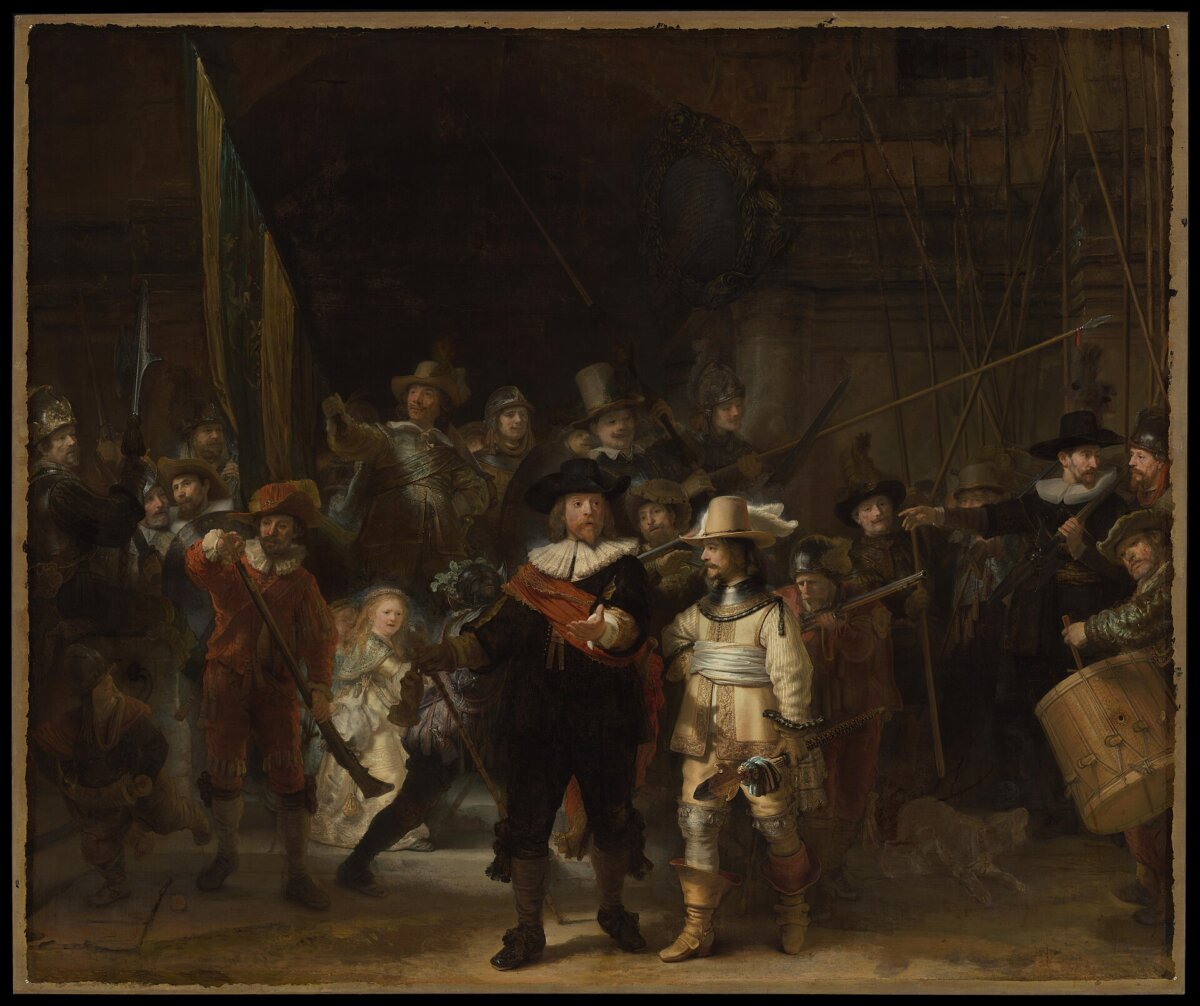
The two central figures are Capt. Frans Banninck Cocq and his lieutenant, Willem van Ruytenburch, for whom the painting was originally titled. The captain has removed his glove and extends his left hand toward the viewer, casting a deliberate, contrasting shadow over the brightly lit and lavish costume of his lieutenant and down toward his spear. Behind the captain’s dangling glove, a woman in a bright golden dress carries a chicken on her belt, presumably a symbol of the Kloveniers’ bird-claw emblem and a wordplay on the captain’s name. A musket misfires inches from the lieutenant’s head, framing his plumed hat in a cloud of smoke.
Rembrandt’s masterful lighting dissipates throughout the figures, leaving a few spotlit, and the rest heavily shadowed. Every intricate detail is a deliberate and likely satirical choice. And for what reason? Peeking from the center of the clambering figures is a barely visible, single observing eye that scholars have identified as Rembrandt himself—another provocative signature of the artist inserting himself in the drama.
A Mystery Wrapped in an Enigma
The possible theories attempting to decipher Rembrandt’s layers of subtext continue long after his brushstrokes stopped. In 1715, the painting was moved from the Kloveniers’ headquarters to the Amsterdam Town Hall. To fit its new location, it was reduced in both height and width, removing two figures from the left side.
Film director Peter Greenway has suggested these figures were Floris and Clement Cocq and that their removal diminished Rembrandt’s implications of the militia’s involvement in a murder plot. These removed sections were never recovered. It has also been suggested that such perceived slights against influential families contributed to Rembrandt’s subsequent dwindling of major commissions after 1642 and his eventual bankruptcy.
Thrilling as this hypothesis might be, and provocative as Rembrandt’s depictions are clearly meant to be, the militia did not reject the painting or refuse to pay him. It remained proudly on display at Kloveniers Hall for the next 73 years before being moved to the Amsterdam Town Hall and finally to the Rijksmuseum. It is only thanks to a smaller copy, likely commissioned by Frans Banninck Cocq, that the removed sections could be recreated with AI analysis in 2021.
Despite the painting’s restored size and brightness, it is still fondly known as “The Night Watch.” Rembrandt’s financial struggles were undeniably fueled by his obsessive collecting of antiques and oddities, and his refusal to deviate from his striking sense of style even as Dutch tastes were trending elsewhere. But his stubborn confidence still won him the last laugh.
In 1915, film director Cecil B. DeMille pioneered a new lighting style for his film “The Warrens of Virginia.” His striking innovation profoundly influenced 20th-century directors and photographers. He called this new style “Rembrandt Lighting.”
What arts and culture topics would you like us to cover? Please email ideas or feedback to features@epochtimes.nyc
