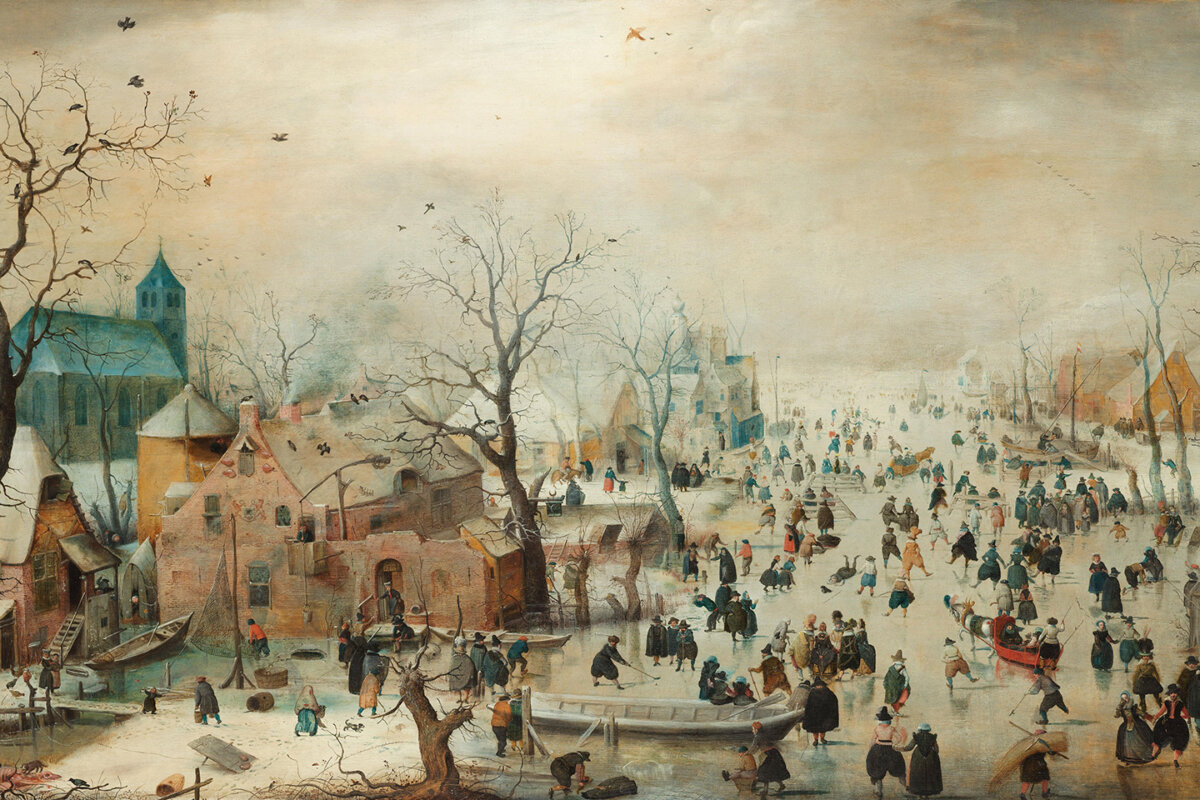
During the 17th century, Northern Europe endured the Little Ice Age, marked by unusually frigid winters and cool summers. The Arctic cold was especially pronounced in Holland. A famously watery region, its rivers and canals froze over. In response, the Dutch hit the ice, partaking in sport, leisure, and work. Hendrick Avercamp (1585–1634) immortalized these daily activities in paintings.
Avercamp was the first Dutch artist to specialize in the portrayal of “wintertjes,” or winter scenes. At the time, Calvinist Dutch art patrons preferred landscapes, portraits, and genre works over religious pictures. Avercamp’s animated winter landscapes were in such demand that he even painted them in summer.
Standardizing the Genre

Avercamp, the son of an apothecary, was born in Amsterdam. His family soon moved to Kampen, a small, remote town northeast of Amsterdam. There is limited information about Avercamp’s artistic training in Amsterdam or of his personal life. It is known that he was nonverbal, and scholars believe that he was likely deaf. His early pictures reflect a strong Flemish influence, especially the work of Pieter Bruegel the Elder (circa 1525–1569). Bruegel painted arguably the first major panoramic winter landscapes. Avercamp, however, established the subject as a standard genre.
Avercamp’s format is known for being centered around an icy river receding into the distance. His palette captures the grey light of winter with its brown tonalities, as well as orange and pink skies. His figures, even those that are no bigger than a fingernail burst with distinct personality, telling stories even if their backs are to the viewer.
Some of his artworks depict Kampen, where he spent most of his career. Others portray an imaginary town, like the tondo “A Winter Scene With Skaters Near a Castle” from about 1608 to 1609 at London’s National Gallery.
Staging a Composition
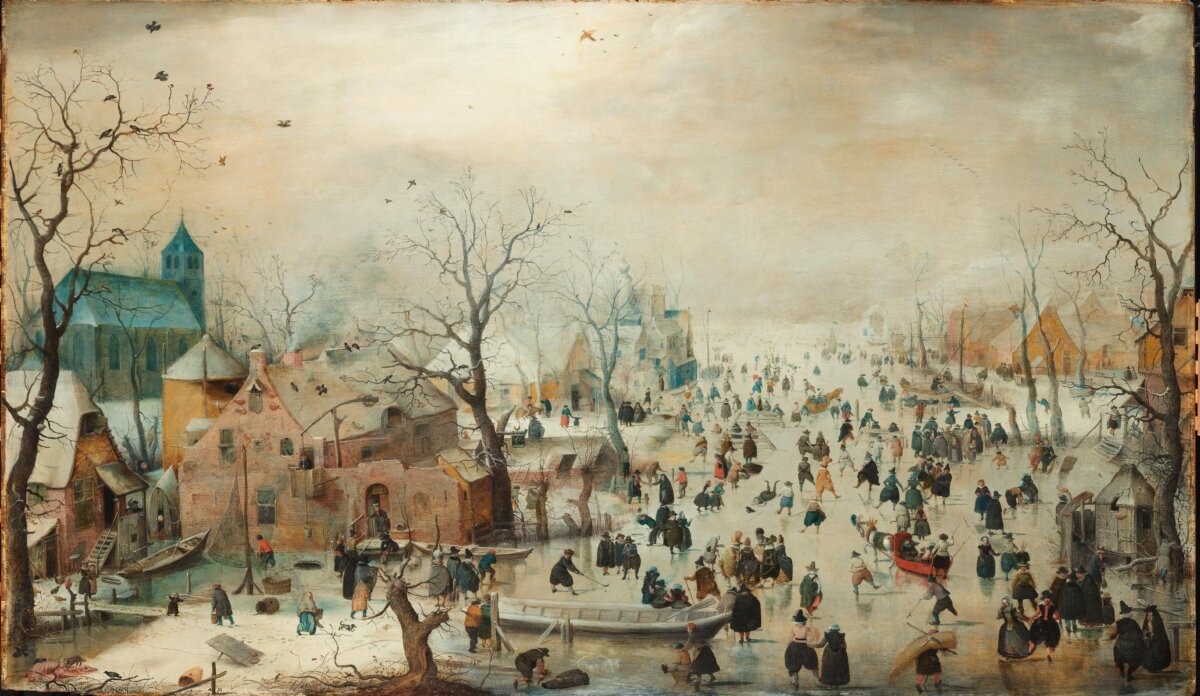
One of Avercamp’s masterpieces is the circa 1608 “Winter Landscape With Ice Skaters,” which is now at Amsterdam’s Rijksmuseum. He was only about 23 years old when he painted this oil on panel, but it ranks as his largest and one of his most impressive works. As is typical of Avercamp’s early paintings, it employs a high horizon line. This element shows the Flemish influence, but as Avercamp’s career progressed, his horizon lines lowered and his perspective became more natural. These later sky-heavy compositions are more open without crowds of people, and they highlight the famed flatness of the Netherlandish landscape.
“Winter Landscape With Ice Skaters” is arranged like a theatrical set: Tall trees on both the left and right side of the foreground serve in effect as stage flats. They draw the eye into a scene teeming with almost 200 figures. Avercamp employed techniques to suggest depth, including using more muted colors toward the background. The procession of village buildings along the frozen river supports this aim, too, and the architecture is rendered with sophisticated skill.
In “wintertjes” like this, a cross-section of Dutch society—rich and poor, old and young—are depicted side-by-side on the frozen waterways. Everyone, from fishermen and wealthy burghers to workers and playing children, even animals, are depicted meticulously with narrative detail, showcasing Avercamp’s keen powers of observation. Indeed, one can discover a new aspect with every viewing of the picture.

Amidst merrymaking vignettes, Avercamp included often more sobering details that speak to the dangers of ice accidents as well as the fragility and brevity of life. In the left foreground, Avercamp depicts a bird trap. This motif derives from Brueghel’s “Winter Landscape With Bird Trap,” of which many copies were made. Brueghel places the contraption at the bottom right. A bird trap is a sloping board with food underneath it and an attached rope or wooden stake. When a bird goes to feed, the attachment can be pulled so that the board falls onto the bird.

Audible Artistry
In general, in Avercamp’s artwork, the action is so lively that one can imagine hearing audible noises, which is especially poignant given that the artist never heard such sounds. There are figures partaking in familiar recreational activities to today’s viewer, such as ice skating—the most popular winter activity in Holland at the time—and riding in sleighs. Avercamp shows ice boats, which are sailing boats fitted with iron blades, and often depicts the game of colf.
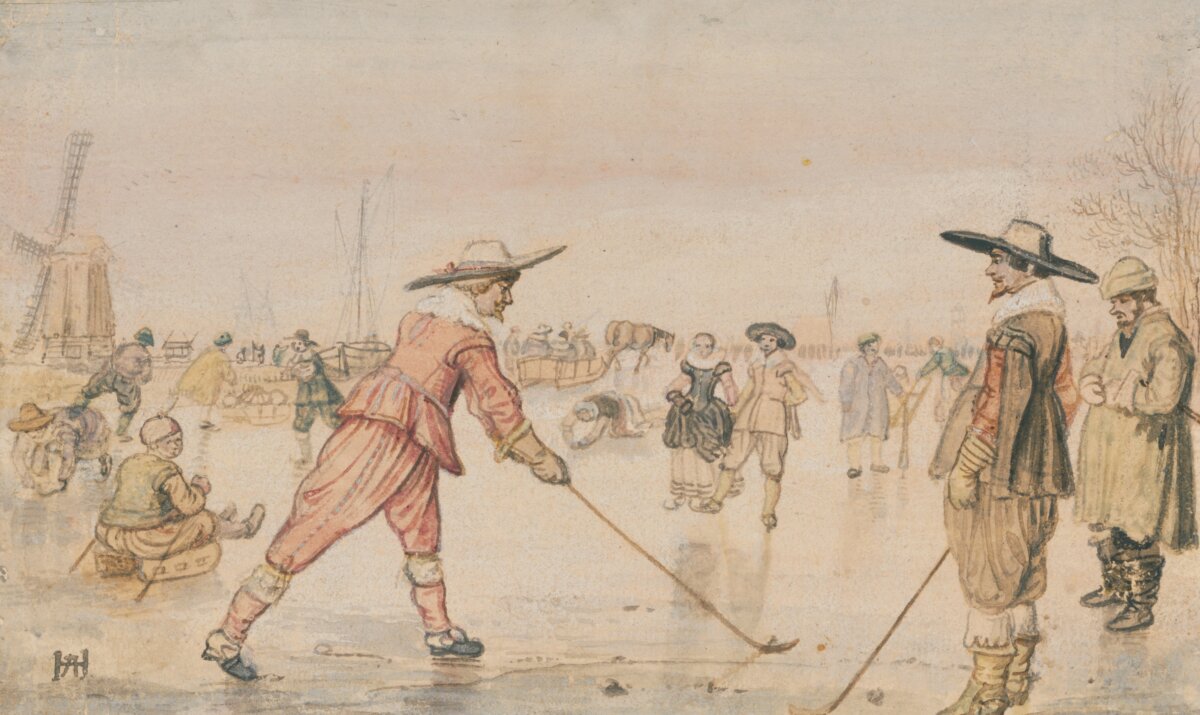
Colf was a precursor of the modern era’s golf and ice hockey. The game was to hit a ball, either made of wood or sheepskin, with a wooden stick into a goal with the fewest strokes possible. This pastime takes center stage in Avercamp’s circa 1615 to 1620 work on paper “A Winter Scene With Two Gentlemen Playing Colf” at the Los Angeles Getty Center.
In addition to being a consummate painter, Avercamp was a prolific draftsman, working primarily in pen, chalk, and watercolor. Some of these works were preliminary sketches and studies drawn from life to be used for paintings, but others were as carefully finished as his oils. Avercamp was the first Dutch artist with a large output of elaborate colored drawings that were elevated to the status of paintings and probably intended for sale.
The Getty Center writes that Avercamp’s “imagery reflects the flush of creativity, optimism, and sense of Dutch identity issuing from Holland’s achievement of independence from Spain during the early seventeenth century, which gave rise to the Golden Age of Dutch art and culture.” The red, white, and blue flag of the Dutch Republic features in many of his works, such as the NG’s circa 1615 “A Scene on the Ice Near a Town.”
Such a nod to the nation’s patriotism and civic pride appealed to buyers of his art. In this painting, the old man seated on a chair at right is thought by art historians to personify winter, a fitting inclusion in the work of the pioneering Avercamp. His vivid winter scenes make for enchanting viewing in all four seasons.

What arts and culture topics would you like us to cover? Please email ideas or feedback to features@epochtimes.nyc