



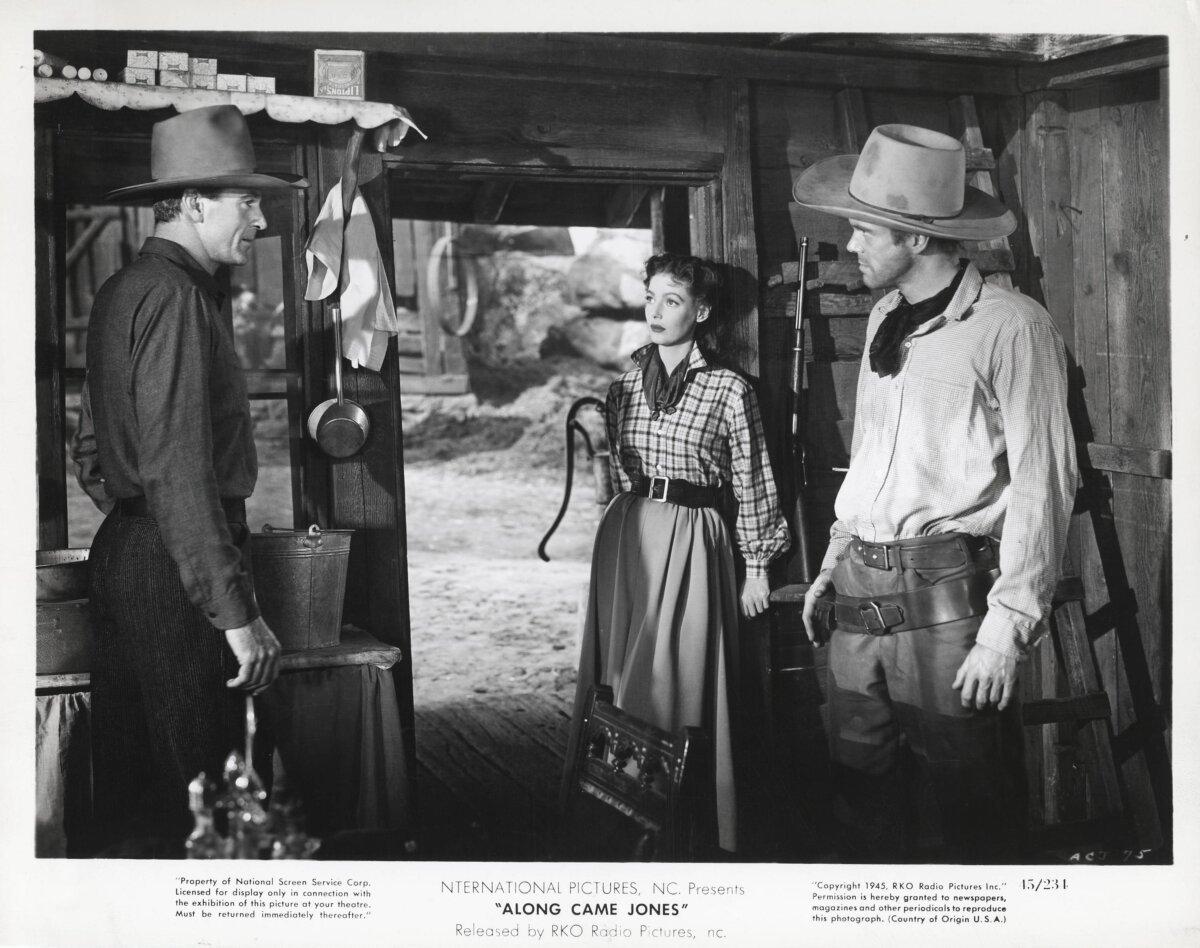
NR | 1 h 30 min | Comedy, Western | 1945
Warning: “Along Came Jones” is (strictly) for fans of Gary Cooper. Well, it might be fun for fans of Loretta Young, too.
Simpleton cowboy Melody Jones (Gary Cooper) and his less simple partner, old man George Fury (William Demarest), ride into the simple town of Payneville. However, Jones is about to get the simplicity shot out of his life.
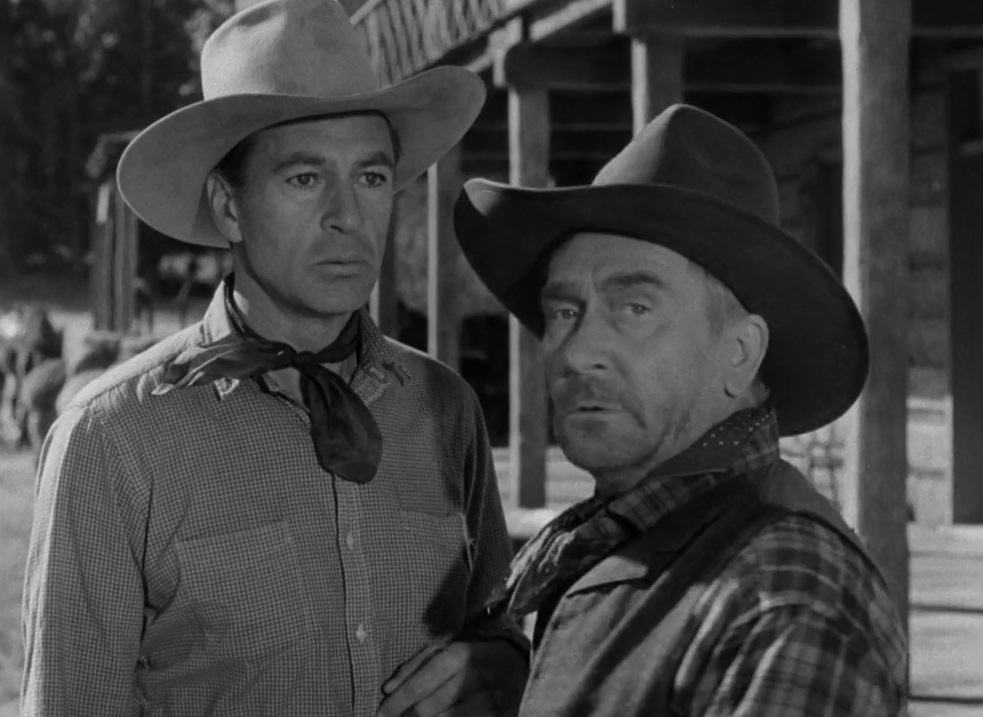
Payneville mistakes mild-mannered, melody-humming Jones for dreaded outlaw Monte Jarrad (Dan Duryea). Jones’s saddle bears the initials MJ. He also fits the description in “wanted” posters promising a $1000 reward for anyone who turns Jarrad in. Like Jarrad, he’s “tall and skinny.”
Mistaken Identity
Payneville treats Jones with the fear and favor reserved for Jarrad, who’s wounded and in hiding. What flummoxes Fury, though, is that the posters also describe Jarrad as mean-tempered and quick on the draw.
As Fury knows and tells Jones, “You couldn’t hit the hind end of your horse with a handful of buckshot.” Besides, Jones is amiable to the point of annoyance. Worse, particularly for Fury, those posters say that Jarrad’s traveling with a “half-wit” uncle.
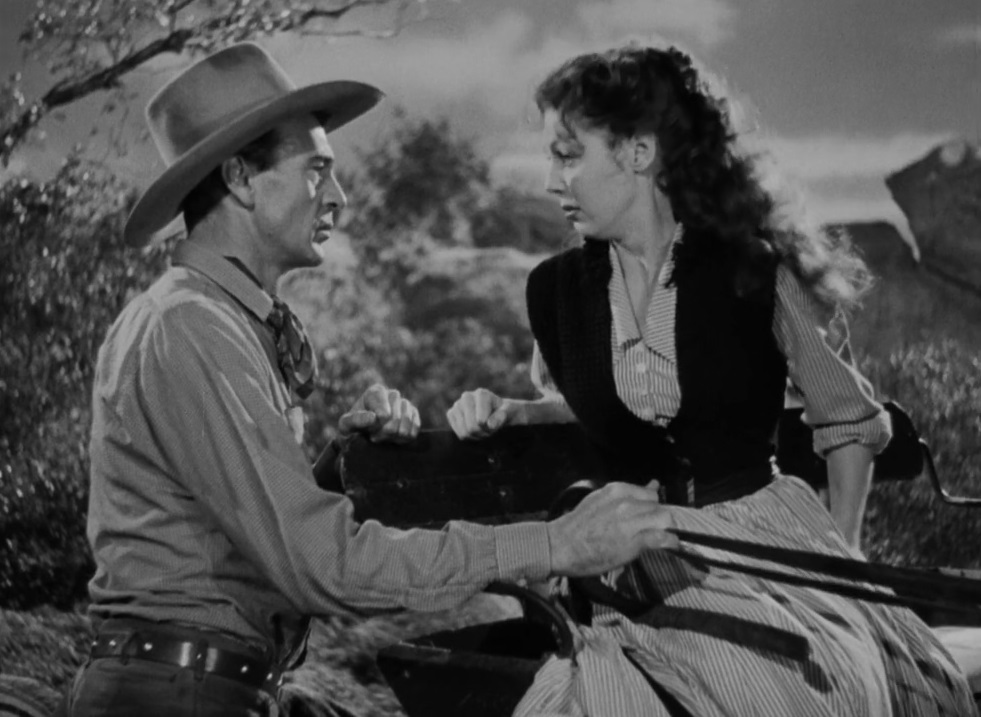
At the slightest mention of the money bag which Jarrad stole from the express company and stashed somewhere, everyone’s hunting for Jones, er, Jarrad. Enter the pretty Cherry de Longpre (Loretta Young), who’s long idolized the tough-talking, sharp-shooting wild side of her childhood sweetheart, Jarrad.
As Jarrad emerges from hiding, though, she wonders whether she should get back with him and overlook his newfound mean-spiritedness. Maybe she could fall into the arms of his sweet-natured counterpart, Jones.
Silly and Light-Hearted
Director Stuart Heisler draws on Alan Le May’s novel and Nunnally Johnson’s screenplay to make it all light-hearted without veering into outright silliness, although at times that’s hard to vouch for. Consider Jones and Fury nearing Payneville’s saloon on horseback. A wide-eyed ol’timer is sweeping the porch.
Fury, all friendly: “Where are we, ol’timer?”
Ol’timer: “This here’s Payneville.”
Fury, still some distance away and still on horseback: “Painful? What’s painful?”
Ol’timer: “This here is.”
Fury leans forward, cocking his head conspiratorially: “You mean generally, or is this personal?”
Cooper, 44 years old here, is wise enough to play it straight, as though fully serious about every line he delivers and every move he makes. He’s so tall that he nearly loses his hat each time he walks through a doorway. Watch him humming when his character is nervous, even in the middle of a stick-up.
Young manages not to crack up while Cooper’s at his goofiest. Watch Cherry call Jones a butter-fingered gun-juggler.
Duryea was, of course, nothing like the unpleasant characters he played on screen. Married for 35 years until his wife Helen’s death, he spent most of his offscreen time gardening, boating, and working with his community’s parent-teacher association.
The song Cooper sings, “I’m a Poor Lonesome Cowboy,” would become the signature song for the popular “Lucky Luke” comic series that came out a year after the film. However, in the comics, it’s Luke’s horse that’s slow on the uptake. Cowboy Luke is the smart and lucky one, and he shoots straight. In some ways at least, Jones, like Luke, is an affectionate parody of the sure-footed, steady-handed cowboy.
No matter how silly it appears, “Along Came Jones” somehow seemed an important enough creative project to Cooper that he donned the role of producer as well as actor. The notion of a public persona that misrepresents a man’s true nature appealed so strongly to him that he played such a role repeatedly.
Moviegoers saw this most notably in “Mr. Deeds Goes to Town” (1936) and “Meet John Doe” (1941). In “Along Came Jones,” Cooper takes things even further. It’s not just his nature that’s mistaken; his very identity is. Given how comical Jones is here in expressing his innermost thoughts and feelings, you half expect Cooper to break the fourth wall and confess that his name’s Frank, not Gary.
When Jones musters enough guts to face down Jarrad, he’s in a sense facing himself and his fears. Years later, in “High Noon” (1952), Cooper would, albeit in all seriousness, revisit the idea that what you see needn’t always be what you get.
Here Cherry, like Amy (Grace Kelly) in “High Noon,” is forced to confront which kind of masculinity she prefers. Bravery isn’t always about being able to shoot first, fast, or straight. Often, it isn’t even about shooting or not shooting. Sometimes, it’s about stepping forward and standing up for what’s right against what’s wrong. Then, the shooting, if and when it happens, takes care of itself.
You can watch “Along Came Jones” on Apple TV, Prime Video, and ScreenPix.
‘Along Came Jones’
Director: Stuart Heisler
Starring: Loretta Young, Gary Cooper
Not Rated
Running Time: 1 hour, 30 minutes
Release Date: June 22, 1945
Rated: 3 stars out of 5
What arts and culture topics would you like us to cover? Please email ideas or feedback to features@epochtimes.nyc
