Many people around the world revere St. George for his faith, courage, and fortitude. On April 23, they celebrate St. George’s Day, the day of his martyrdom. He’s the patron saint of many countries, including England, Georgia, and Ethiopia, and he’s also the patron of professional bodies and institutions, from merchants’ guilds to the military.
The U.S Cavalry and Armor Association (USCAA) awards the Order of St. George Medallion to the country’s top cavalry. “[St. George] is a common thread among the Armor and Cavalry forces of most of the NATO nations,” notes the USCAA website. “His memory lives on today in the spirit of the armored knight who helps soldiers in need, who is the epitome of selfless service, and who is the archetypal mounted warrior.”
The Soldiers’ St. George
Although George was never a knight, many artistic renderings of the saint from the medieval era onward depict him in shining armor slaying a dragon—often the Christian symbol of evil, Satan, or paganism.
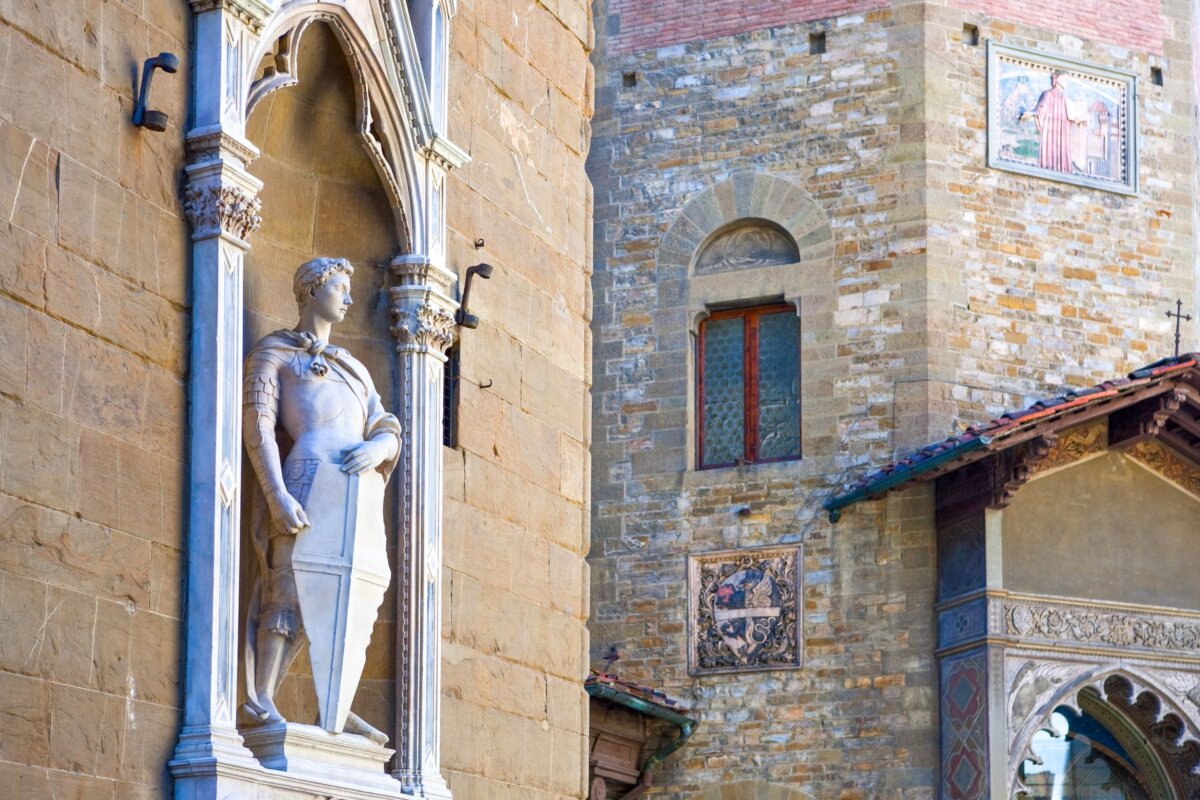
On the façade of Florence’s Orsanmichele Church, Donatello’s marble St. George seems about to step out of his niche into battle. He stands firm in armor and holds his shield. One hand once wielded a sword or spear, and holes on the statue’s head suggest that he once wore a wreath or helmet. This valiant George furrows his brow and gazes into the distance, as if surveying every inch of the battlefield.
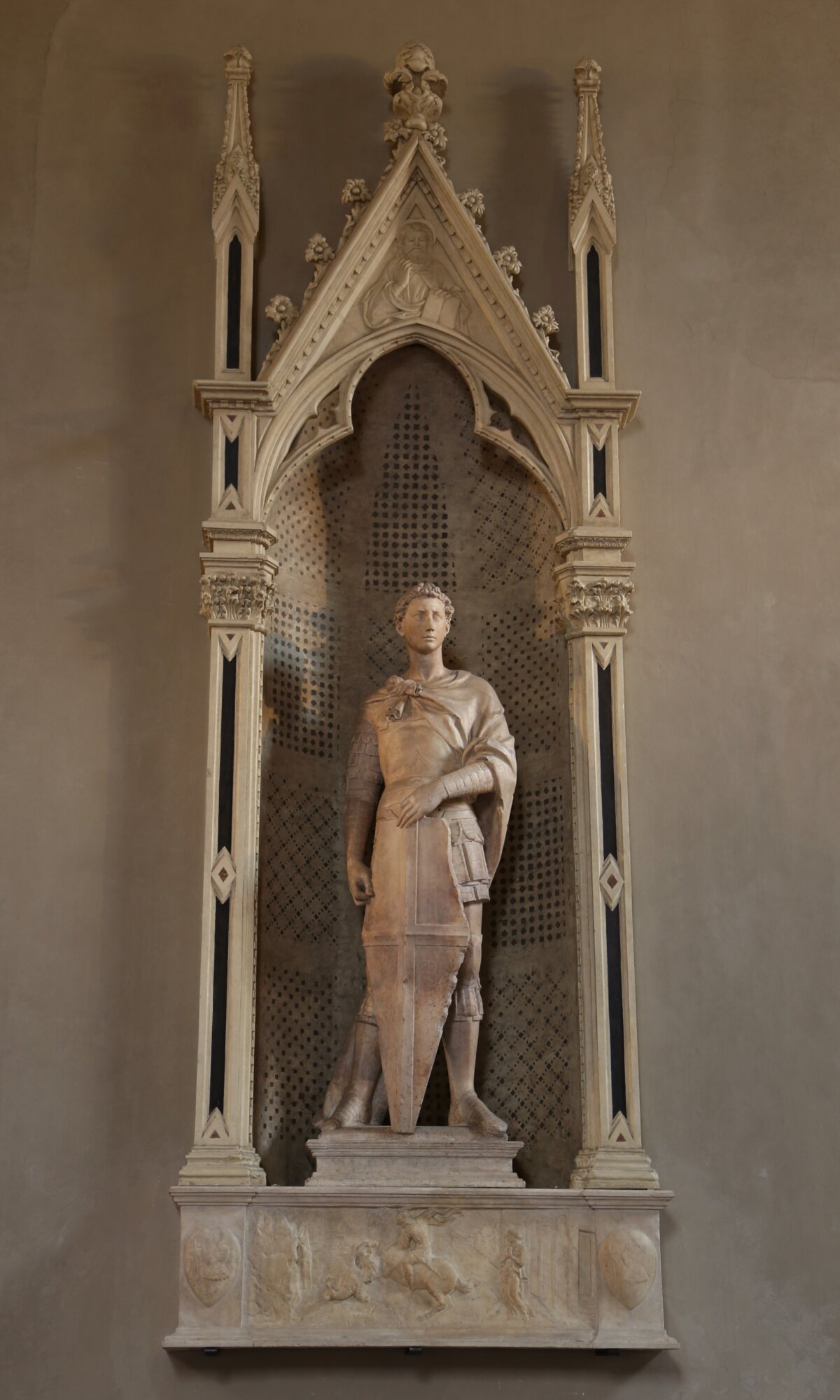
Donatello’s St. George is one of the 14 patron saints that peer from ornate niches on all four façades of Orsanmichele. Each saint represents a Florentine guild that commissioned the statue and tabernacle from eminent 15th- and 16th-century sculptors, including Nanni di Banco, Lorenzo Ghiberti (Donatello’s master), and Giambologna. The Guild of Armorers and Swordmakers (Arte dei Corazzai e Spadai) commissioned Donatello to carve a tabernacle of St. George, including a predella (a panel across the bottom of the tabernacle) that contains a contextual narrative scene.
George and the Dragon
Donatello‘s deft carving of “St. George Slaying the Dragon” yielded an expressive low-relief that, in some spots, barely scratched the marble predella. Donatello carved the scene using “stiacciato,” a technique he invented for carving shallow reliefs in depths ranging from around a pencil tip to a peanut half. These delicate impressions often look more like drawings than low-relief carvings.
In “Lives of the Most Excellent Painters, Sculptors, and Architects,” 16th-century artist and art historian Giorgio Vasari wrote of stiacciato: “[It] is challenging to create gracefulness by contours alone.” Yet Donatello overcame that challenge in his graceful predella “St. George Slaying the Dragon.”

Donatello traced the marble landscape of the dragon’s lair to the left and a tree-lined hillock and colonnade to the right. In the center, George sits astride his rearing battle horse as he lances the dragon. The pair lock eyes, but George doesn’t falter. Nearby, the princess watches with her hands clasped in panic and prayer.
Donatello captured the brute force and fearlessness of George and his charging horse. He also carved marble into cloth that falls featherlike over the princess’s body, and skims her bare feet. Few artists attempted the difficult stiacciato technique after Donatello.
The predella is one of the first sculptures to use single-point perspective, where the artist ensures that parallel lines converge on one point on the picture plane to make the work appear three-dimensional.
A Renaissance Master
As a sculptor, Donatello’s inventive, artistic brilliance paved the road for the artists who came about a century later, during the High Renaissance. He was one of many who founded the Renaissance style in Florence, which include notables such as the painter Masaccio and architect Brunelleschi.
As a true Renaissance man, Donatello darted from one material and technique to another. He mastered both the subtraction (wood and stone carving) and addition (clay, goldsmithing) methods of sculpture, an exceptional feat.
Donatello’s fine statue of St. George with its predella of “St. George Slaying the Dragon” epitomizes the skill and spiritual ideals of high art—highlighting the eternal battle between good and evil.
Visit Donatello’s St. George at the Bargello National Museum in Florence, Italy. To find out more, visit BargelloMusei.it
What arts and culture topics would you like us to cover? Please email ideas or feedback to features@epochtimes.nyc