



NR | 1h 40m | Documentary, Science | 2026
From the dawn of mankind, people have questioned their origins. There are those who believe in creationism, some others lean toward “intelligent design,” and more than a few subscribe to evolution (or Darwinism).
To their credit, the filmmakers and interviewees involved with “The Story of Everything” (“Everything”) avoid alienating anyone. They don’t favor any of these theories, at least not directly.
“Everything” deliberately and pragmatically presents scientific evidence rooted to some degree in theology. Up until now, mixing science and theology was thought impossible, mostly because no one considered their coexistence possible.
“Everything” is based on the book “Return of the God Hypothesis” by Stephen C. Meyer, who is also interviewed here. The film is divided into four chapters and is spread over 100 streamlined minutes under the direction of coproducer Eric Esau.
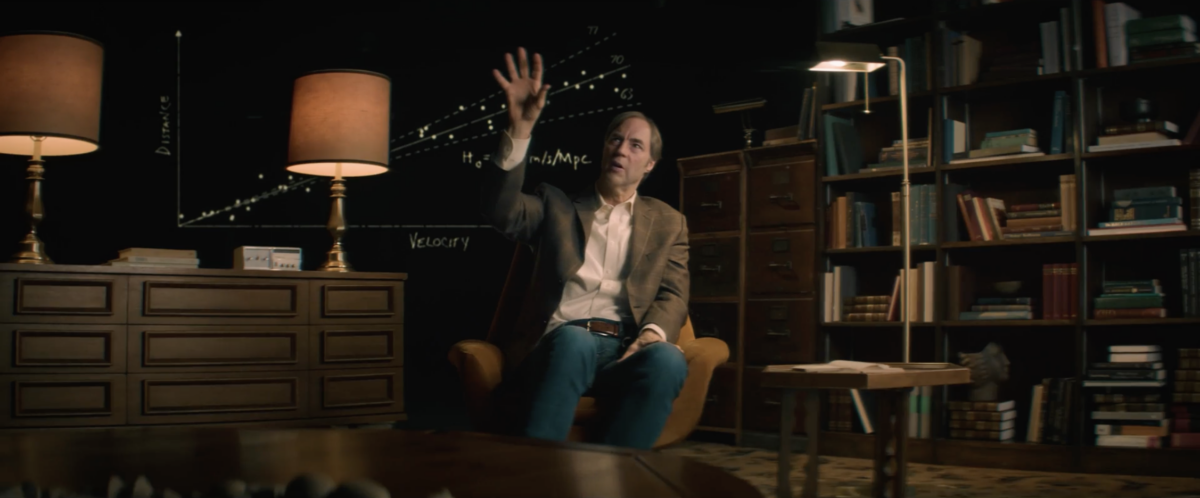
As someone who never gravitated toward or understood much in the way of scientific principles, I see the content of “Everything” as confusing and overwhelming. This isn’t to say that what Esau presents is sloppy or overbroad. In fact, it’s very tight and concise. For anyone with a background in quantum physics, or any other technical discipline that escapes the grasp of the common man, the movie will be far more appreciated.
In looking over my notes while watching “Everything,” there are a handful of words and terms accompanied by question marks. These include “singularity,” “entropy,” “multiverse” (which has nothing to do with Spider-Man), and “materialism” (which has nothing to do with a shallow character trait). Then there is “simulation theory,” which suggests that there are people who believe Earth and everything we know about the surrounding universe is merely part of a computer program.
No Beginning
The first chapter’s title, “The Beginning,” is the most telling and sounds the least science-based of any other part of the film. According to quite a few “informed” smart people, the universe had no beginning. It’s always been. Time, as we know it, doesn’t apply. It has no origin. It just exists.
As a layman, I find this not only makes no sense but also sounds more theological than scientific. My understanding of science is that things can be explained with facts and figures, whereas theology is dependent on faith, theory, and a deep belief in the unknown.

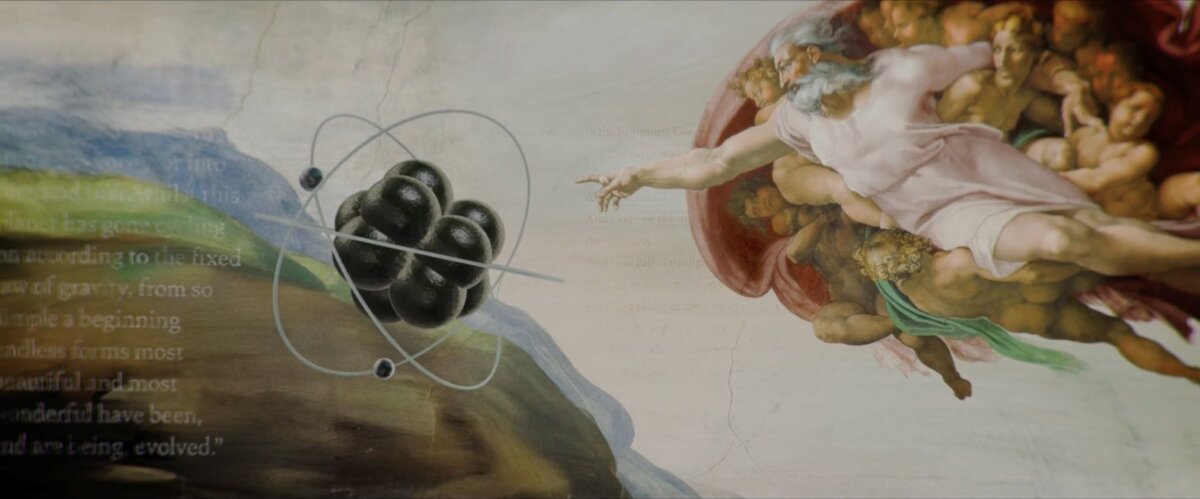
The main point of this chapter is that there was a period when there was no universe. Then there was. It was started by an entity displaying “intelligent design.” In simpler terms, the universe hasn’t always existed; it was created. The word “God” isn’t uttered but it is implied, hence the title of Meyer’s book. This is the basis for the Big Bang theory.
Again, to a layman, this is far more plausible than “there was no beginning.” Theology and science are flipped. In order to prove science, the likelihood of a superior being can’t be ignored or explained away.
This philosophy is given further credence in the second chapter, “The Goldilocks Universe.” This section explains why Earth is regarded as the “privileged planet.” The only planet in our solar system that supports life, it’s close enough to the sun to sustain animals and vegetation. It isn’t too hot or too cold—it’s “just right.” According to the film, this can’t be by chance, accident, or dumb luck. It has to have been predestined.
Human Fingerprint
The third chapter, “The Design of Life,” finds the film doing a major 180 by talking about places 900,000 light years away from us to biology and microscopic objects, specifically DNA.
This is where Esau and the commentators examine the ultimate evidence of a possible superior entity. In the late 1960s, an American and an English scientist, with no interest in biology, stumbled upon the discovery of an amino acid that was an extension of DNA, the human fingerprint.
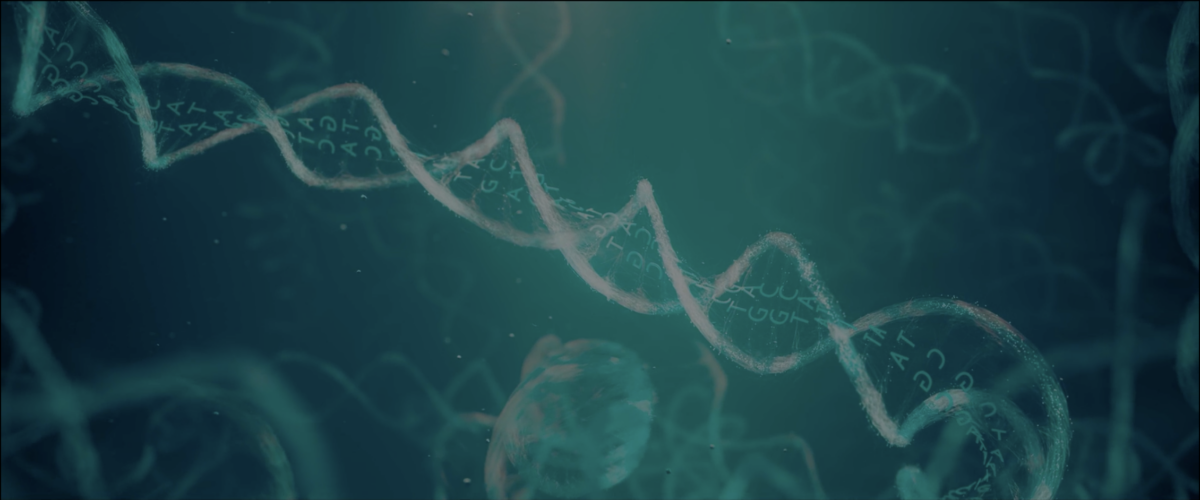
Present in blood, skin, hair, saliva, and every other bodily substance, DNA became the ultimate watershed in singular identification. Essentially infallible, DNA could identify every human (or animal) based on a series of particularly connected enzymes. This discovery led to the solving of multiple cold-case crimes that stood up to the most inscrutable objections. DNA was and remains absolutely foolproof.
Esau’s greatest achievement is in presenting all of these extremely dense and overtly eggheaded concepts alongside viewer-friendly CGI animation and graphics. It almost makes “Everything” easier to watch.
Even with the brilliant visuals, the ultimate point of the film is still too intimidating for general audiences. This is a movie that needs to be a four- or five-part miniseries. There is simply too much information to be fully absorbed in 100 minutes. Making the movie less eggheaded and maybe reformatting it as a three-hour, four-part docuseries would have rendered it far more mainstream friendly.
The film is now playing in select theaters.
‘The Story of Everything’
Documentary
Director: Eric Esau
Running Time: 1 hour, 40 minutes
MPAA Rating: Not Rated
Release Date: April 30, 2026
Rating: 3 1/2 stars out of 5
What arts and culture topics would you like us to cover? Please email ideas or feedback to features@epochtimes.nyc
