



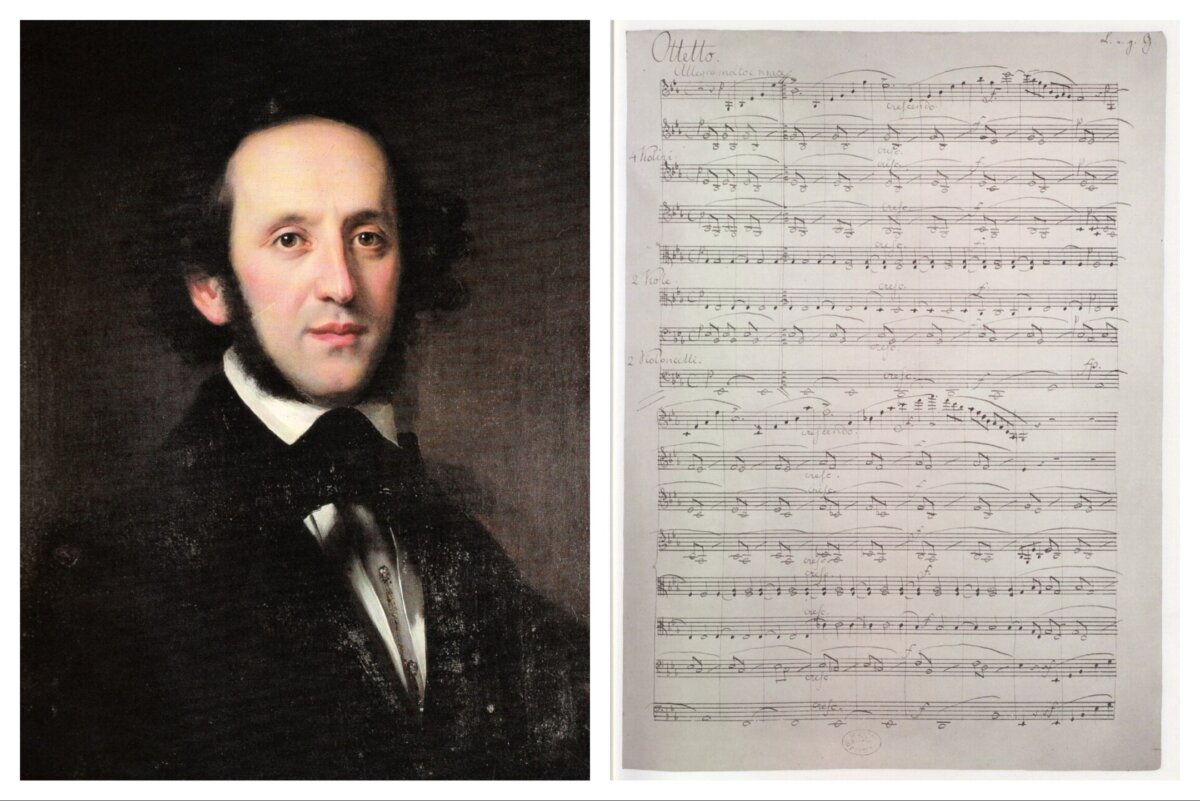
Felix Mendelssohn (1809–1847) was one of the great composers of the early Romantic period. From his “Midsummer Night’s Dream” to his “Hebrides” Overture, his music is characterized by elegance and lyricism. An accomplished conductor, he notably led the Leipzig Gewandhaus Orchestra and championed the music of Johann Sebastian Bach.
Most remarkably, Mendelssohn accomplished all these feats before his mid-20s. Music critic Charles Rosen in “The Romantic Generation” called him “the greatest child prodigy after Mozart.” By the age of 13, Mendelssohn had already published his first work, a piano quartet. By 15, he’d written his first symphony.
Yet nowhere is the essence of Mendelssohn’s youth better captured than in his String Octet in E-flat major, a masterpiece that defines his early style. Written for eight string players—essentially a doubled string quartet—the work reimagines the possibilities of chamber music. Blending the boundaries of chamber and orchestral music, the work is strikingly original, balancing richness in texture with transparent part writing.
A Musical Marvel
Today’s recording of the first movement, Allegro moderato ma con fuoco, of Mendelssohn’s Octet in E-flat major is by the Emerson String Quartet.
What makes this recording unique is that instead of employing eight separate players, the Emerson Quartet performs all eight parts through overdubbing. What’s more, the parts were performed with a mix of both Stradivarius instruments and modern instruments.
In the film “Recording Mendelssohn: The Octet,” the players recorded one full take of the piece, listened to the recording, then played the other four parts, all while carefully matching the dynamics and articulations of the first take. The documentary raises questions about the nature of chamber music, and provides an interesting perspective on the nature of live collaboration in a recording setting.
The movement begins with a rising arpeggio figure by the first violin, a youthful, upward-bound melody accompanied by syncopated figures in the accompaniment. Around 0:39, the unique interplay between instruments creates a playful atmosphere, with half of the ensemble playing a sprightly 16th-note run upwards while the other half responds with a contrasting legato line.
Now reaching the second subject, the beautiful lyricism Mendelssohn is known for comes fully into view. At 2:00, listen to how different instruments respond with their respective motifs, with a variety of colors created from combinations not possible in a string quartet.
At 7:40 we reach the development section. Different harmonic regions are explored here, from the dominant B-flat to more distant keys such as C minor and F minor. After a stormy region based off the 16th-note run from the beginning, we enter a hushed and muted section. Now the familiar lyrical melody is repeated in minor before the mood suddenly shifts. At 9:50, we hear the return of the syncopated rhythm in the distance, steadily approaching before a flurry of 16th notes lead to an exuberant return of the opening of the movement.
What arts and culture topics would you like us to cover? Please email ideas or feedback to features@epochtimes.nyc
