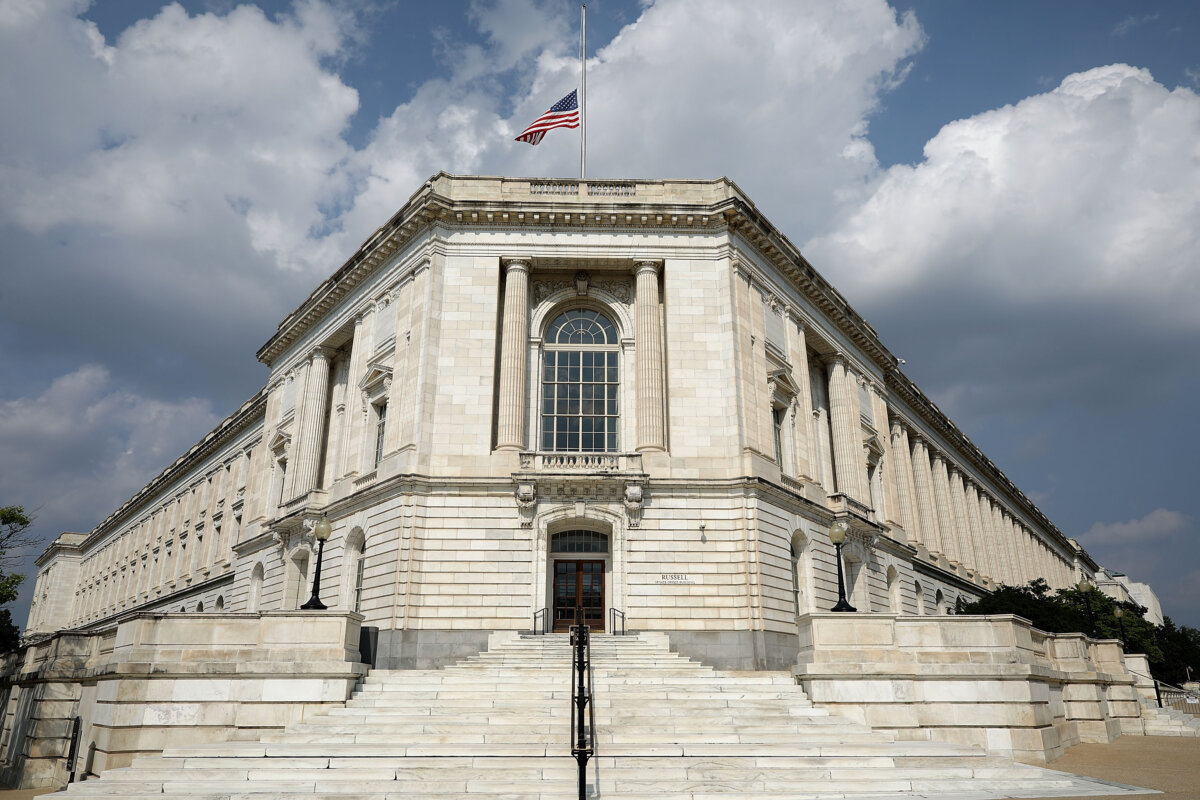
The classical architectural features that give many Washington structures their dignified presence are on display at the Russell Senate Office Building. Majestic columns, arched windows, pediments, corbels, keystones, and dentils are exhibited in marble and granite on the building’s exterior. (Chip Somodevilla/Getty Images)
When the White House and the Capitol were built in the late 1700s, they solidified Washington as the country’s anchor. What better architectural styles to emulate than those of ancient Rome and Greece? Consequently, classical architectural features predominate in the city’s 18th- to early 20th-century structures.
However, some of the “youngest” designed and constructed D.C. buildings (built from the late 1800s to early 1900s) also emphasize Renaissance and baroque characteristics to achieve what is known as beaux arts style. The École des Beaux-Arts in Paris taught and promoted this design to noteworthy gilded age architects such as Richard Morris Hunt and John Carrère.
Carrère’s New York firm, Carrère and Hastings, designed the Russell Senate Office Building. The nearly 700,000-square-foot behemoth has a square footprint and a corner entrance facing Constitution Avenue. When completed in 1909, the building featured only three sides; a fourth side was added in 1933.
The Russell Senate Office Building has a granite foundation, with its terrace and façade covered in marble and limestone. Down the easternmost side runs a grand colonnade of 34 Doric columns facing the Capitol. The side facing Delaware Avenue exhibits an extensive row of pilasters between two levels of windows.
In March 1905, architect Carrère said, “I think that these two sides and the Capitol are part and parcel with each other and of each other, and should be in harmony as to design material and purpose and in every other element that enters into the conception.”
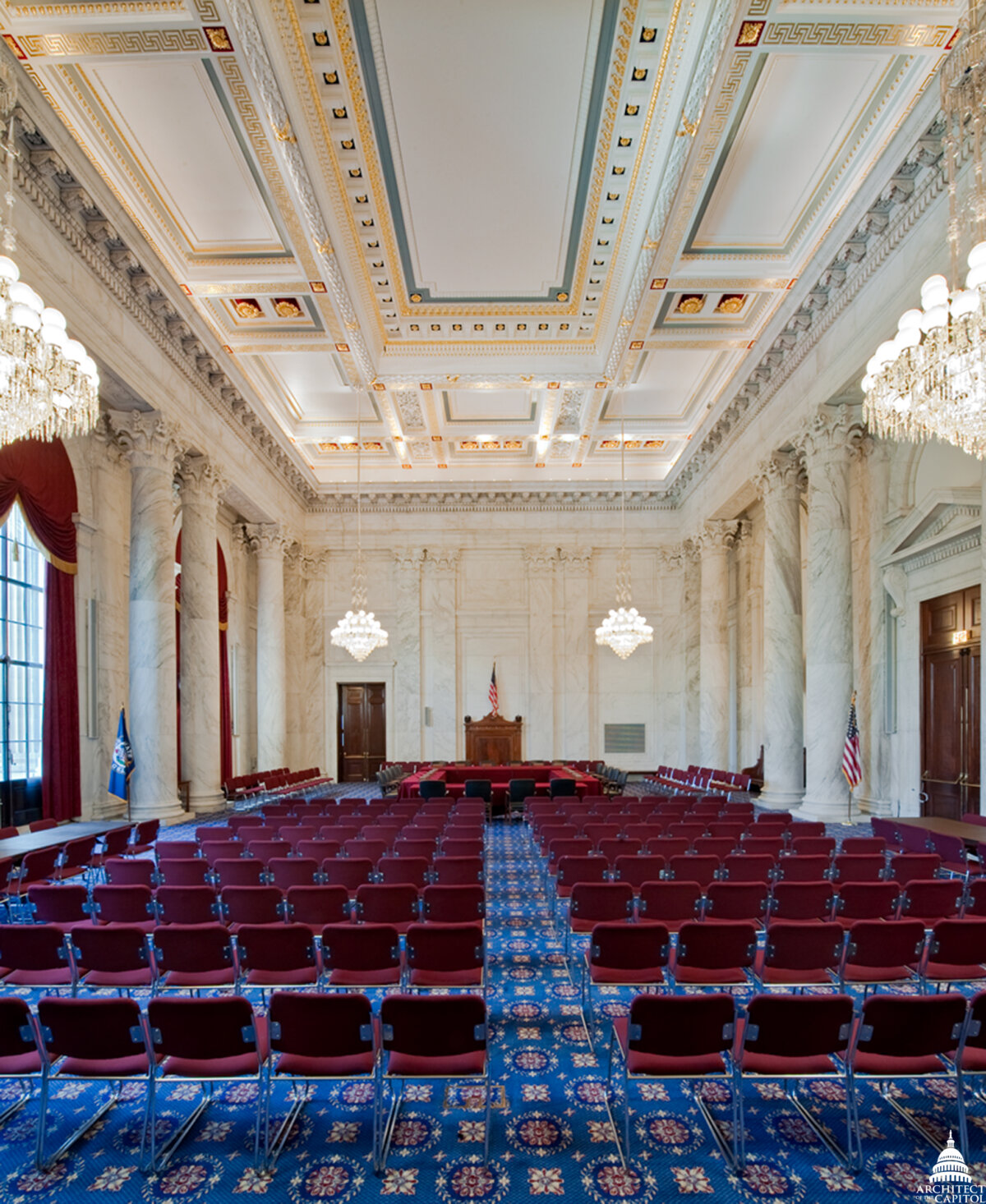
The Russell Senate Office Building has multiple offices and suites, but its focal-point is the Kennedy Caucus Room. It was there that such noteworthy, historic Senate investigations took place, including the 1912 inquiry into the sinking of the Titanic and the 1973 Watergate hearings.
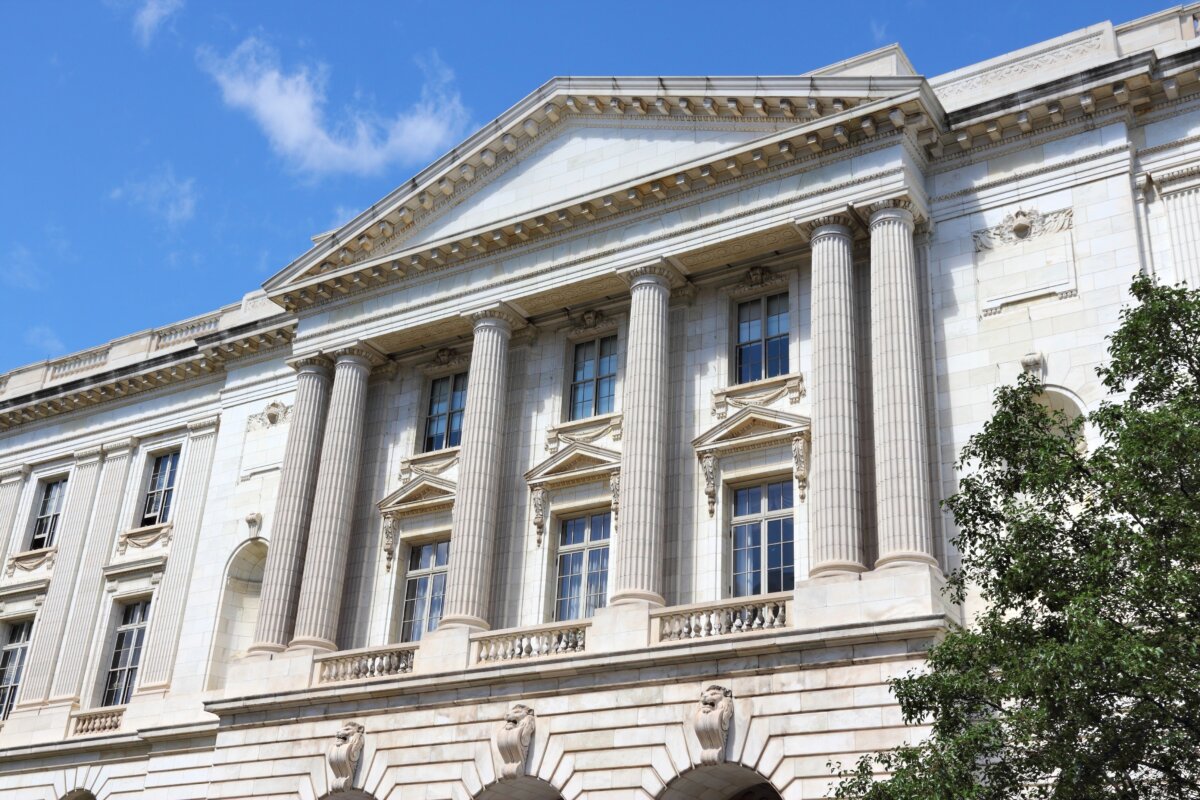
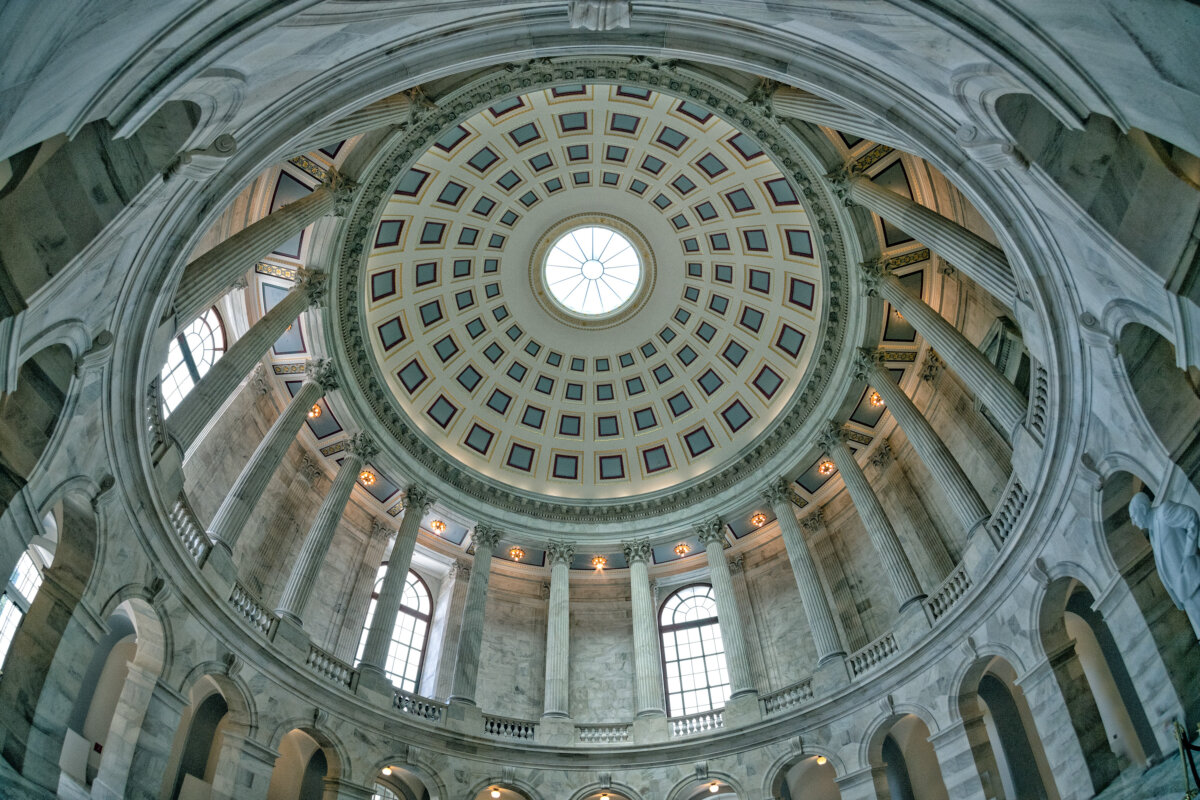
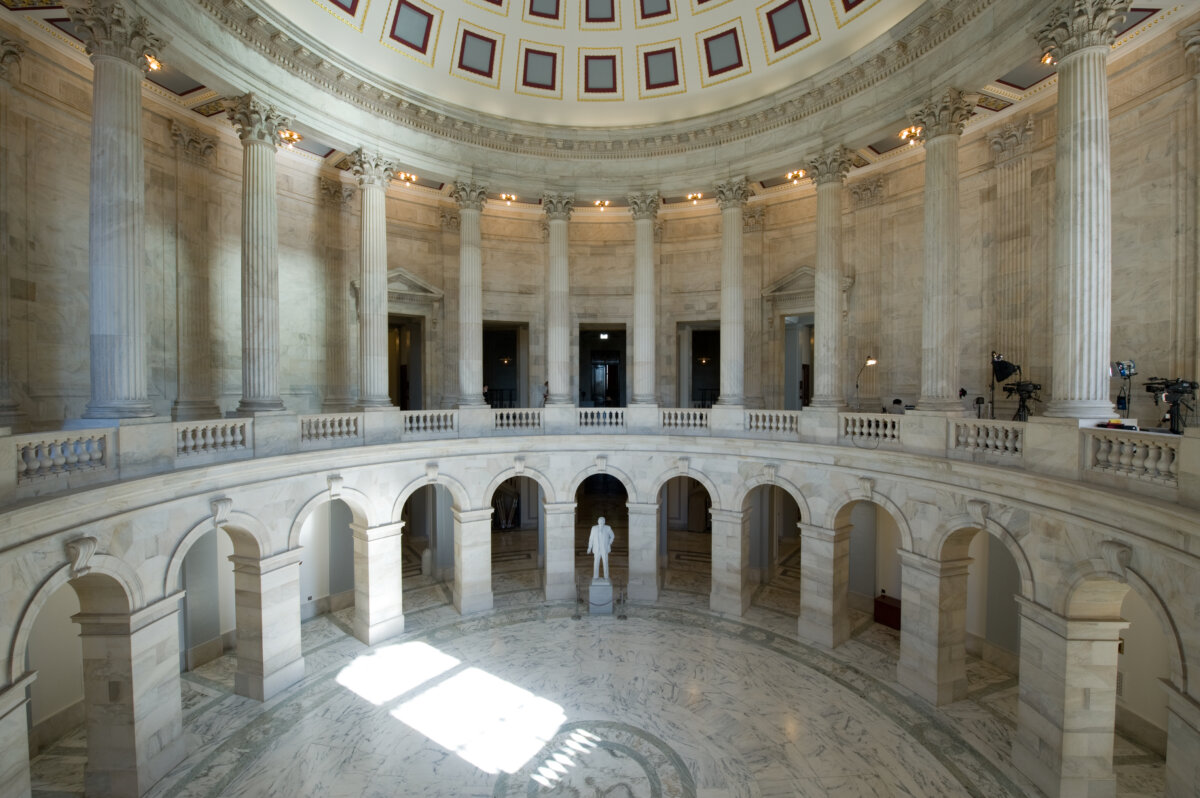
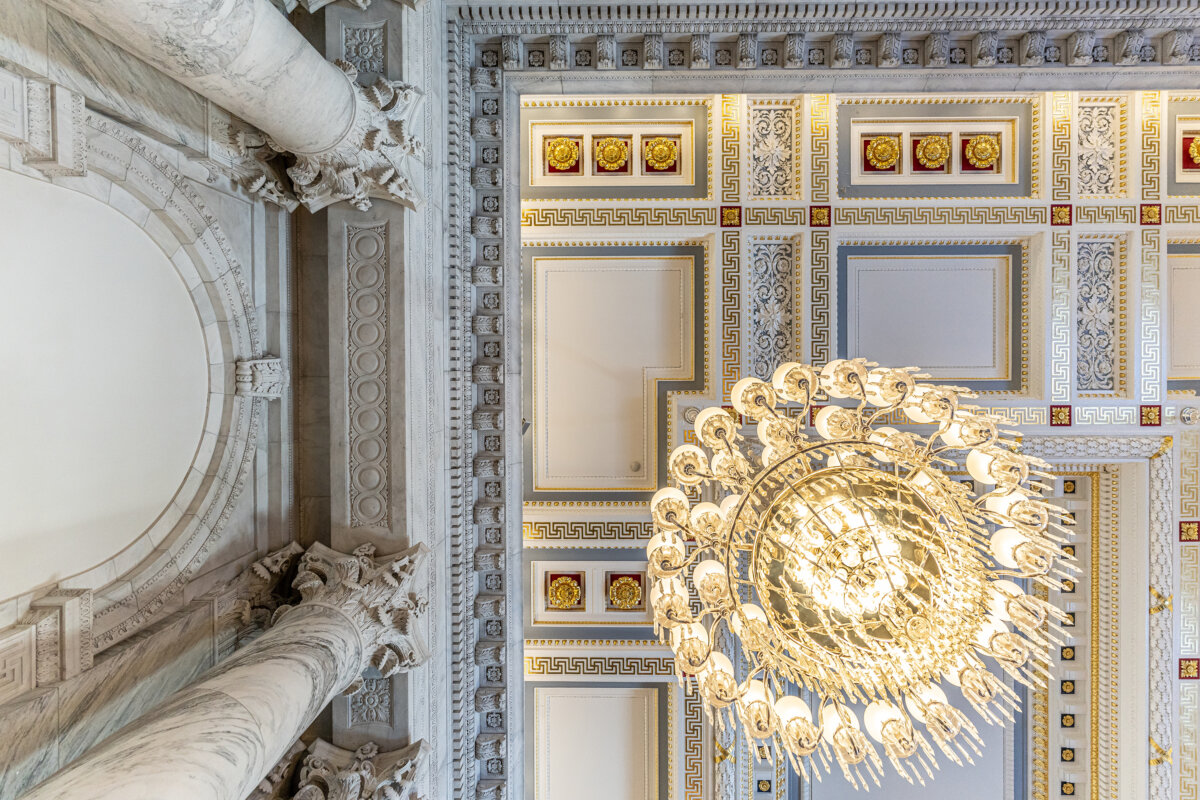
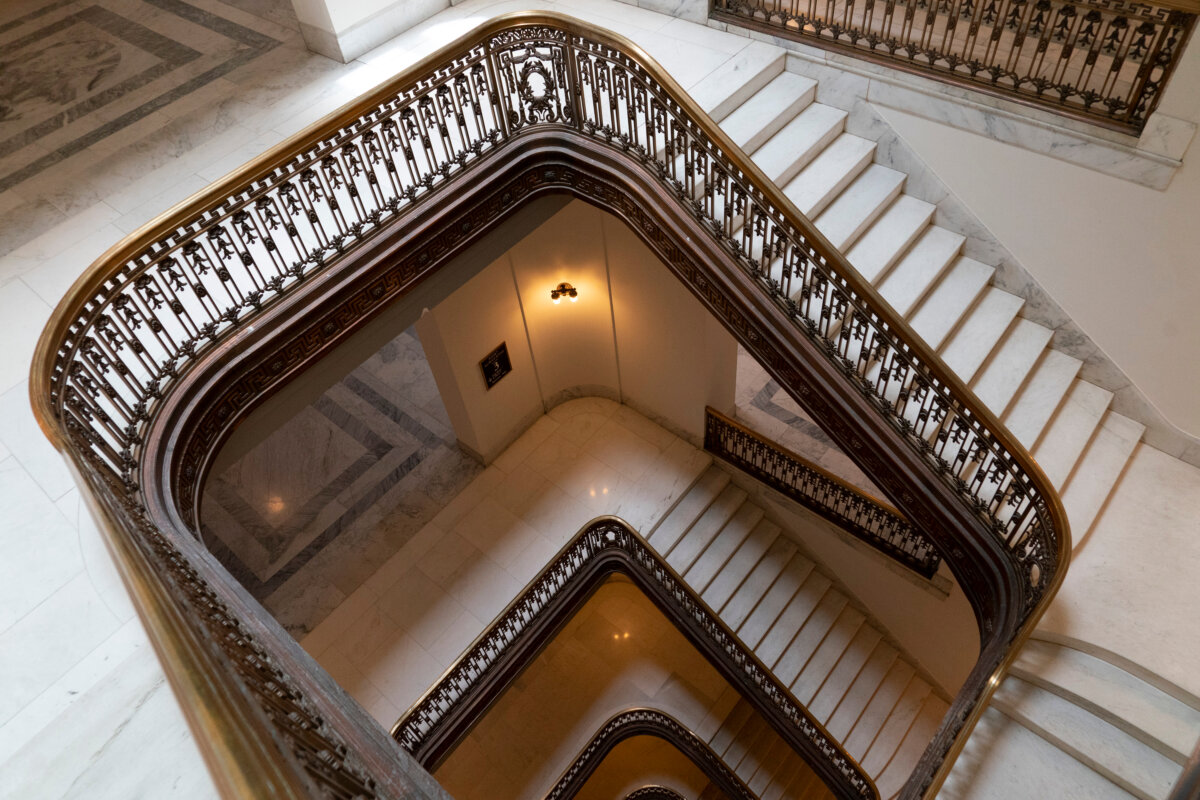
Facing Delaware Avenue on the northeastern side is a grand pediment and entablature showcasing six, symmetrically positioned fluted columns, two floors of symmetrically stacked windows—three of which are decorated with pediments and corbels, and a narrow portico with a balcony of carved balusters. (Tupungato/Shutterstock) Supported by 18 commanding Corinthian columns is a coffered-style dome. Its core oculus, with a geometric, sun-like glass design, allows light into the immense rotunda. Under the dome’s balconied base is a series of arches garnished with keystones. (Andrea Izzotti/Shutterstock) The southwest entrance of the Russell Senate Office Building opens into a three-story rotunda topped with a coffered dome. The room’s diameter is a little over 57 feet. Inlaid into the marble floor, directly in line with the dome’s oculus, is a simple design of an inner and outer circle. (Public Domain) While there is so much to admire in the Kennedy Caucus Room, its ceiling is a key architectural achievement. The elegant coffered ceiling is bordered with a frame of carved acanthus leaves. The design is outfitted with such telltale beaux arts designs, such as gilded rosettes and a band of the classic, interlocking Greek key pattern. Some of the ceiling spaces are trimmed in blue to coordinate with the gilded accents. (Public Domain) Bronze railings with uniquely embellished balusters adorn the square-shaped marble staircases that lead from the main rotunda floor to the elaborate Kennedy Caucus Room. Corner, curvature sections of each level of the staircase features a wreath and swag design. (Andrea Izzotti/Shutterstock) With a nod toward France’s Versailles, the grandiose Kennedy Caucus Room showcases beaux arts styling at its best. Some standout elements include 27-foot, white Vermont Corinthian columns on two sides, as well as pilasters. Visually, they support a massive architrave, a frieze, and an elaborate tray ceiling. The frieze presents classical design motifs such as dentil and egg-and-dart as well as brackets. The room’s prominent chandeliers marry glass globes with crystal prisms. (Public Domain)
What arts and culture topics would you like us to cover? Please email ideas or feedback to features@epochtimes.nyc.
A 30-plus-year writer-journalist, Deena C. Bouknight works from her Western North Carolina mountain cottage and has contributed articles on food culture, travel, people, and more to local, regional, national, and international publications. She has written three novels, including the only historical fiction about the East Coast’s worst earthquake. Her website is DeenaBouknightWriting.com