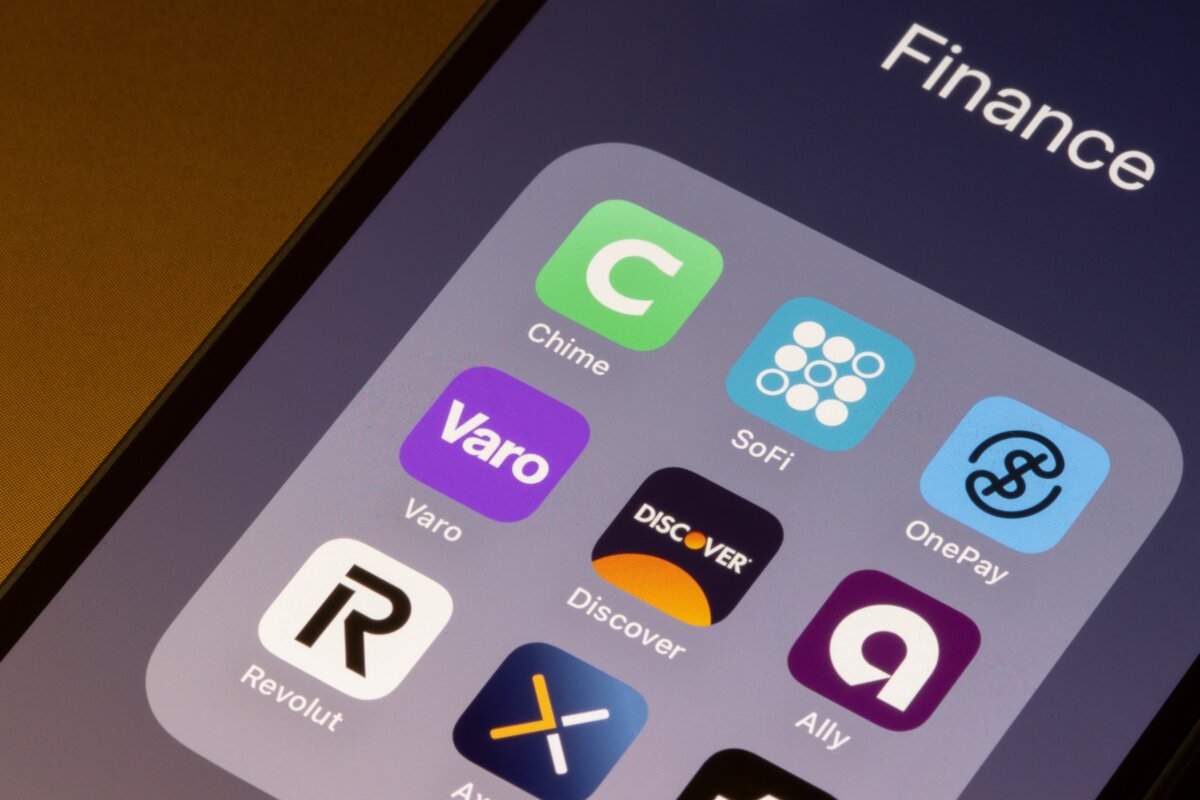
Neobanks like Chime and SoFi can offer lower fees, sleeker app designs, and tools that traditional banks rarely match. However, there are tradeoff areas to consider: deposit protection structure, customer service, and lending access, to name a few.
Which one is better for your money? That depends entirely on how you use banking day-to-day.
What Is a Neobank, Exactly?
A neobank is a financial technology, or fintech, company that offers banking services entirely through a mobile app or website—no branches, no teller window. Everything happens on your phone.
Neobanks aren’t technically banks. Most do not hold a banking charter, so they must partner with a licensed, chartered bank to offer deposit accounts and Federal Deposit Insurance Corporation (FDIC) insurance. That distinction matters more than most people realize, and we’ll come back to it.
Well-known neobanks include Chime, SoFi, Varo, Current, and Wealthfront. Traditional banks like Chase, Bank of America, Wells Fargo, and your local community bank operate under direct federal or state charters and are subject to a broader set of regulations.
How the Fees Compare
Fees are where neobanks make their strongest case.
Here’s a comparison to help (standard fees apply unless you meet waiver conditions):
Traditional banks (standard checking, as of May 2026):
- Chase (Total Checking): $15 per month fee, $34 overdraft fee, and $3 to $5 fees for withdrawing from a non-Chase ATM
- Bank of America (Advantage Plus): $12 per month fee, $10 overdraft fee, $2.50 for withdrawing from a non-Bank of America ATM
- Wells Fargo (Everyday Checking): $15 per month fee, $35 overdraft fee, $3 for withdrawing from a non-Wells Fargo ATM
Neobanks:
- Chime: No monthly fee, no overdraft fee (SpotMe overdraft coverage up to $200 with a minimum direct deposit of $200 monthly and active Chime Card), 47,000+ fee-free ATM locations
- SoFi: No monthly fee, no overdraft fee, (up to $50 overdraft coverage with a monthly direct deposit of at least $1,000); 55,000+ fee-free ATM locations
- Varo: No monthly fee, no overdraft fee (Varo Advance overdraft coverage up to $250 with a minimum direct deposit of $800 monthly), 40,000+ fee-free ATM locations
All three neobanks above have no monthly fees with no waiver conditions required. However, the overdraft coverage at neobanks, while fee-free, generally requires a qualifying direct deposit and carries a spending limit.
The FDIC Insurance Distinction You Need to Understand
When your money is at a traditional bank, that bank is a direct FDIC member. Your deposits are insured up to $250,000 per depositor, per institution.
When your money is at a neobank, the structure is different.
In the United States, the FDIC offers “pass-through” deposit insurance—a method of insuring depositors’ funds held at an FDIC-insured bank through a third party (provided certain requirements are met).
In plain terms: Your money may sit at a partner bank, not at the neobank itself. The FDIC does not insure the neobank; it insures the chartered bank holding your funds on the back end.
Funds you deposit in a neobank may not be protected while they are in transit to the insured bank account. If the neobank fails before your money reaches the partner bank, that gap suddenly becomes crucial.
Before opening a neobank account, look for the FDIC logo and verify which partner bank holds your deposits. Most reputable neobanks make this information available, but you have to look for it.
Customer Service: A Real Gap
Neobanks typically win on the app, lose on the phone.
Being unable to reach customer service representatives at neobanks is a commonly reported complaint. This makes it tough to get answers to questions or resolve problems in a timely manner. Have a disputed transaction, a frozen account, or a fraud claim? In examples like those and others, not being able to talk to a human can cost you money and time.
Traditional banks, particularly larger ones, offer branch access, dedicated fraud lines, and in-person dispute resolution. If you regularly deal with complex transactions, large wire transfers, or cash deposits, that access has real value.
Credit Building and Lending Access
Neobanks have made meaningful strides in credit-building tools. Many offer:
- Secured credit cards tied to your deposit balance
- Credit-builder loans that report to all three bureaus
- Real-time credit score monitoring inside the app
The wide range of financial products offered by traditional banks (home loans, car loans, mortgages, etc.) will vary with neobanks. What’s more, a traditional bank or credit union generally provides direct access with more underwriting flexibility.
Using a neobank as your primary account while applying for a mortgage elsewhere is common and shouldn’t affect your application—lenders look at your credit profile, not your banking app. If you want everything under one roof, traditional banks still hold the advantage.
What Happens When Something Goes Wrong
Any banking system can have problems. The real stress test is often in the way they’re handled.
Traditional banks operate under formal dispute-resolution rules and timelines, especially for debit-card and electronic-transfer disputes. You can walk into a branch. You can escalate to a manager if necessary.
In the past, account freezes have been a concern with neobanks, sometimes triggered by automated fraud detection or middleman tech issues, with customers reporting they’ve been locked out of funds for days without clear recourse.
This goes to show how, even if you’ve checked for FDIC coverage on your neobank’s website, the guarantee differences versus traditional banks can matter.
Before switching, search the Consumer Financial Protection Bureau’s complaint database for your neobank of choice. App store ratings can also give you insights into the interface.
FAQs About Neobanks Versus Traditional Banks
Are Neobanks Safe to Use as a Primary Bank Account?
Most neobanks are safe for everyday use, but you need to verify that your deposits are covered by FDIC pass-through insurance through a licensed partner bank. Check the neobank’s website for the name of the partner institution and confirm it is FDIC-insured before depositing significant funds.
What Is the Difference Between a Neobank and an Online Bank?
An online bank typically holds its own banking charter and is a direct FDIC member, just like a brick-and-mortar bank. A neobank is usually a financial technology company without its own charter that partners with a chartered bank to offer deposit accounts. Online banks tend to have slightly stronger regulatory standing than neobanks.
Can I Get a Mortgage if My Primary Account Is With a Neobank?
Yes, your choice of deposit account generally does not affect mortgage eligibility. Lenders evaluate your credit score, income, debt-to-income ratio, and employment history. Which app you use for checking won’t likely factor at all. For the mortgage itself, however, you will likely go through a traditional lender.
What Should I Do if My Neobank Freezes My Account?
Contact customer support immediately through the app and by phone if a number is available. Document everything in writing. If you cannot resolve the issue within a reasonable time frame, you can file a complaint with the Consumer Financial Protection Bureau at consumerfinance.gov. Keep an emergency fund at a separate institution to protect against access disruptions.
The Epoch Times copyright © 2026. The views and opinions expressed are those of the authors. They are meant for general informational purposes only and should not be construed or interpreted as a recommendation or solicitation. The Epoch Times does not provide investment, tax, legal, financial planning, estate planning, or any other personal finance advice. The Epoch Times holds no liability for the accuracy or timeliness of the information provided.