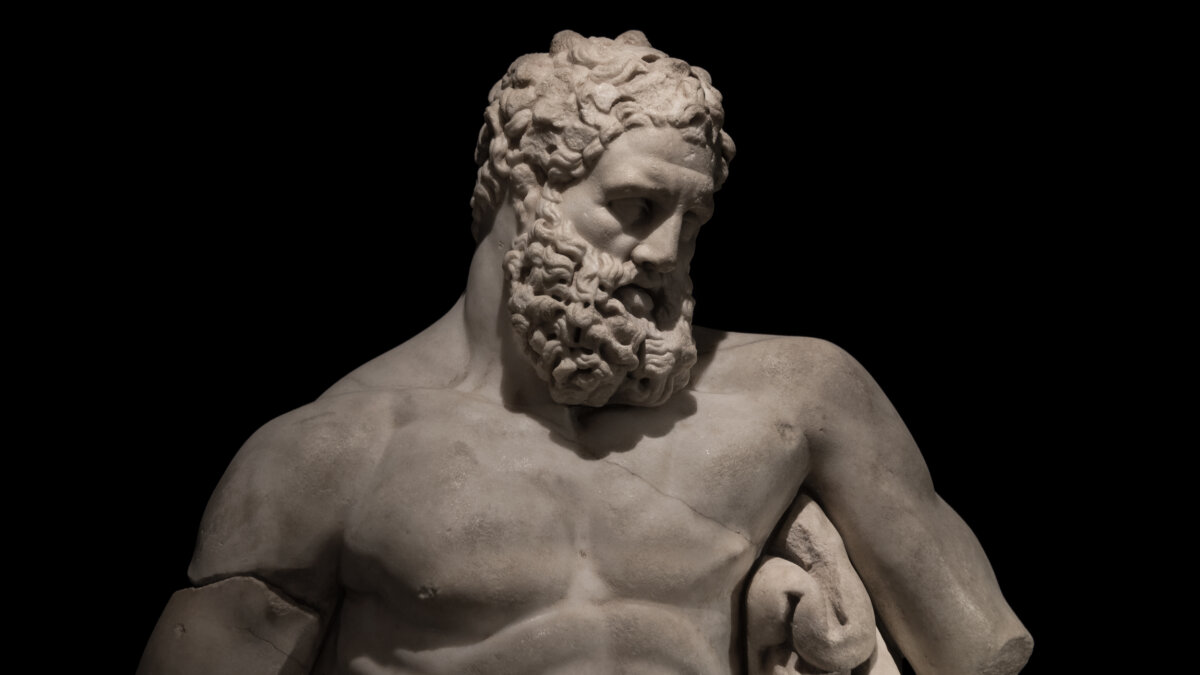
We have reached Labor number 10 in Herakles’ cycle of challenges, and the scale of these challenges now expands dramatically: It will culminate in his final and most difficult Labor. Earlier tasks drew him into struggles with fear, chaos, appetite, and distrust, but now the hero is driven beyond the familiar boundaries of the Greek world itself. The Labor no longer concerns merely the mastery of self or the restoration of civic order. Instead, Herakles must travel to the very limits of the known earth.
A Journey Beyond the Known World
The 10th task imposed upon him is deceptively simple: to seize the famous red cattle of Geryon and bring them back to Eurystheus. Yet, as so often in Greek myth, simplicity conceals a fiendish complexity. Geryon does not dwell nearby, nor even within the ordinary sphere of human civilization. He lives on the distant island of Erytheia, literally “the Red Land,” situated at the far western edge of the world, beyond Oceanus, where the sun descends each evening into darkness.
Already, the symbolism is unmistakable. Herakles is no longer merely confronting monsters within the world; he is journeying toward the border where the known world dissolves into mystery. The Labor belongs symbolically to Capricorn, the earth sign associated with endurance, responsibility, burden-bearing, and difficult ascent; significantly, Capricorn rises in the heart of winter—even Christmas Day itself falls beneath its sign. Capricorn energy is patient, disciplined, and willing to travel immense distances in pursuit of a necessary goal. It is the sign of the mountain climber, the lawgiver, and the solitary traveler who continues long after others would have turned back.
This is precisely the character of the 10th Labor. Unlike the explosive confrontations of the Lion or the Hydra, the struggle with Geryon unfolds through distance, fatigue, and perseverance. The hero must cross deserts, mountains, seas, and unknown territories before he can even begin the task.
The ancient Greeks understood journeys westward as symbolically profound. The West was the region of sunset, decline, mortality, and endings. To travel westward was, in a sense, to approach the frontier between life and death. In his final and 12th Labor, Herakles will descend literally into Hades, but already this western journey anticipates that movement toward the margins of existence.
The obstacles he encounters reinforce the impression. In some versions of the myth, Herakles becomes so exhausted by the heat during his travels that he aims an arrow at the sun. Astonishingly, the sun god Helios does not punish him for his audacity but admires his courage, lending him instead a great golden cup or vessel in which he may sail across Oceanus. The episode is striking because it marks one of the rare moments in Greek myth where divine power recognizes and rewards heroic endurance rather than punishing human presumption. Herakles’s anger at the blazing sun reflects the extremity of mortal suffering, yet his persistence earns him assistance rather than destruction.
Symbolically, the golden vessel carries enormous weight. The hero enters the domain of cosmic forces. No longer confined to ordinary geography, he traverses the waters that encircle the world. The Labor begins to assume an almost spiritual dimension: Herakles is crossing not merely physical distance, but existential boundaries.
Geryon and the Symbolism of Fragmented Power
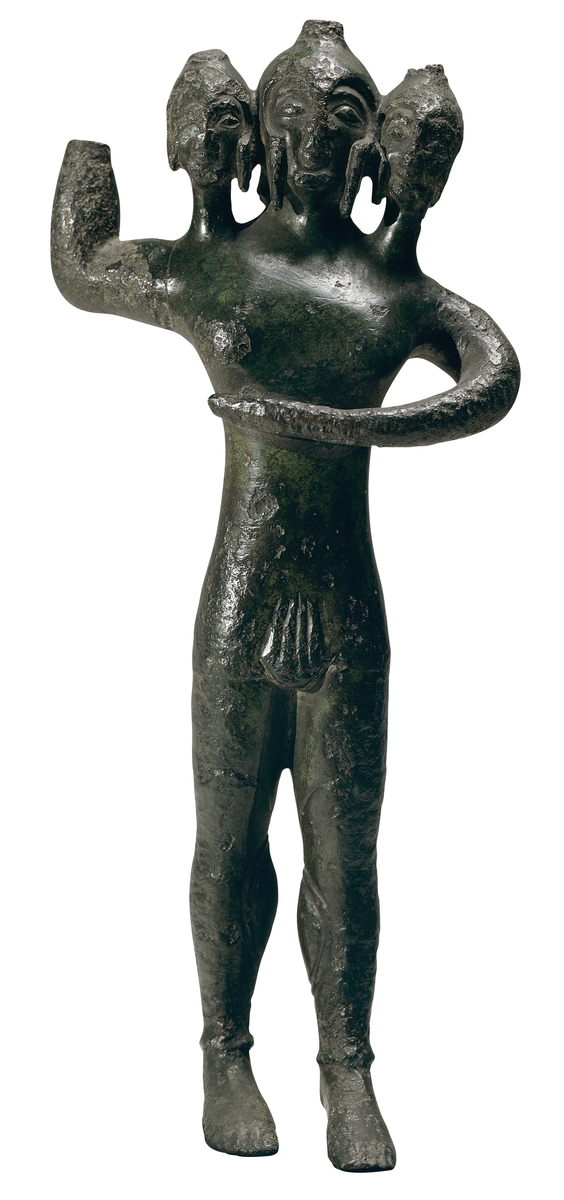
Geryon is among the strangest figures in all the labors. His name means the “loud” or “roaring” one. Traditionally, he is described as three-headed, with six hands and three bodies joined at the waist, a being of multiplied form, reckoned to be the strongest man alive.
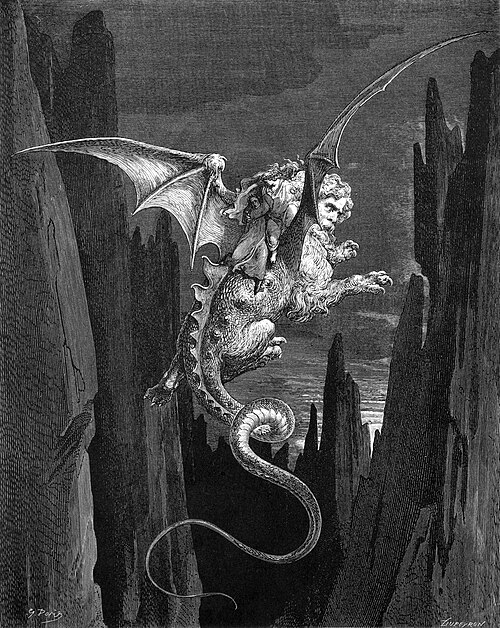
But being three-headed gives us pause for thought: Cerberus, the dog of Hades and topic of Herakles’s final Labor also has three heads; interestingly, so too does Satan as depicted by Dante in the last canto of the Inferno. There is, then, something infernal about Geryon. The Labor anticipates Herakles’s final descent into the underworld.
Ancient interpreters understood this multiplicity in various ways. At the most practical level, it magnifies Geryon’s power, but symbolically, it suggests fragmentation, excess, or force extended unnaturally beyond proper limits.
Whereas Herakles increasingly moves toward integration and disciplined purpose, Geryon represents divided strength: formidable, but disunified. Put another way, the “roaring” of Geryon is a primal sound: loud and magnified, but not ordered; whereas Herakles increasingly comes to represent something closer to the Greek idea of “logos”: rational order, disciplined speech, and meaningful articulation.
The cattle, too, are significant. In ancient cultures, cattle symbolized wealth, fertility, nourishment, and social stability. To possess cattle was to prosper. Geryon’s red cattle, therefore, represent not merely property but concentrated material abundance at the edge of the world.
The ancient Greek word for red is “erythros,” from which we derive “erythrocyte,” meaning a red blood cell. We are reminded of Leviticus (17:11): “For the life of the flesh is in the blood.” In some profound sense, Herakles’s task is to retrieve “life” from the West, from the realm of death, sunset, and darkness, by bringing back the red vitality contained in the blood. It should not surprise us, therefore, that earlier, even the sun god Helios, the very image of light, aided him in this endeavor.
Yet the cattle are guarded obsessively. The Eurytion herdsman and the monstrous two-headed dog Orthrus. The dog is a sibling of Cerberus and the Hydra, born of Typhon and Echidna, those primordial parents of chaos whose offspring repeatedly threaten the order of the cosmos. Orthrus attacks Herakles immediately and is dispatched with arrows tipped in the Hydra’s blood.
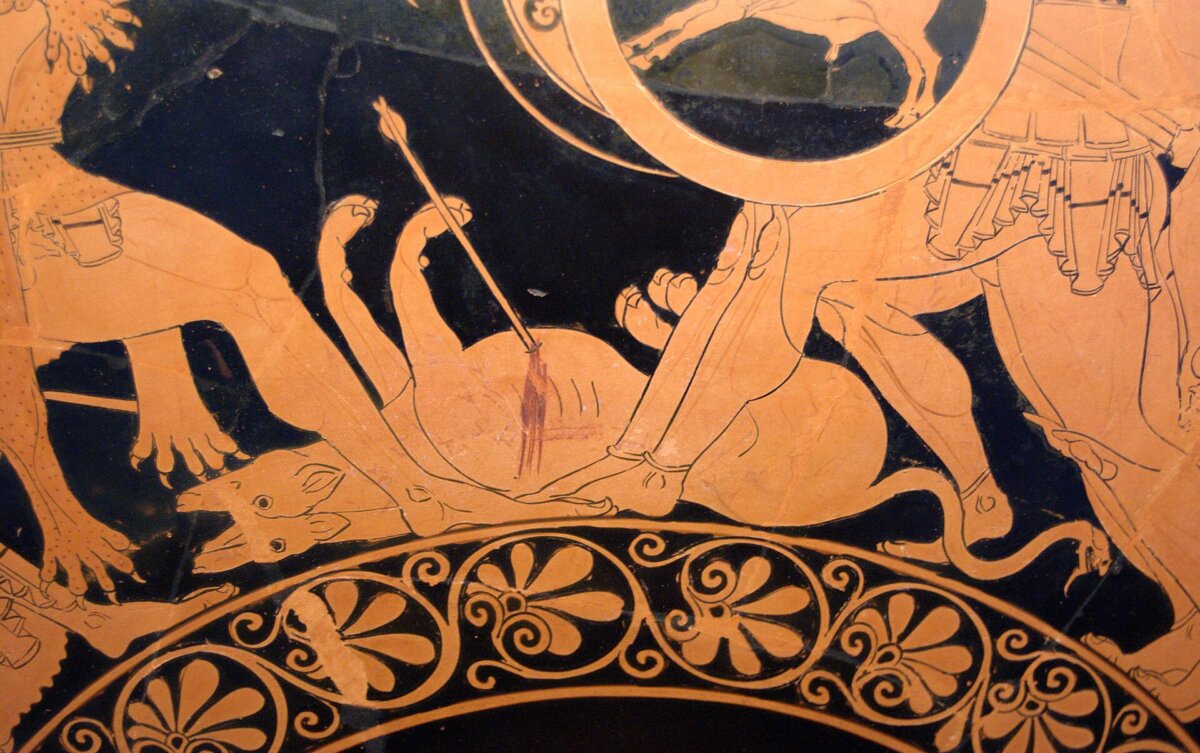
In other words, we find a kind of homeopathic principle at work: like counters like. The blood of one monstrous sibling destroys another. Readers of Labor 6, The Stymphalian Birds, may remember a similar pattern there: Noise disperses noise, Gemini overcoming Gemini, as the higher twin masters the lower.
Even at the furthest reaches of the earth, the forces opposing order remain active. Herakles’s mission, as son of Zeus, is not merely personal glory but the extension of civilization against the encroachment of chaos. An enraged Eurytion, the dog’s master, now appears to exact revenge on Herakles, and he, too, is swiftly dispatched.
Finally, Geryon himself emerges, armed and formidable, only to be struck down by one of Herakles’s arrows. The confrontations have been surprisingly swift and decisive. This distinguishes the 10th Labor from many earlier ones. The enemy is dangerous, certainly, but the deeper challenge lies in endurance, in maintaining purpose across immense distance, isolation, and fatigue.
Capricorn symbolism emerges clearly here; greatness is achieved not through sudden brilliance, but through sustained perseverance. As English writer and polymath Samuel Johnson’s wrote: “Great works are performed not by strength but by perseverance.” This, perhaps, is a less well-known aspect of Herakles’s achievements: We are all fully aware of his strength, but here another quality comes into view entirely.
After securing the cattle, Herakles’s difficulties are far from over. The return journey proves almost as arduous as the outward one. Hera sends gadflies to scatter the herd; rivers obstruct the hero’s path; hostile rulers attempt theft. Again and again, Herakles must regather, redirect, and continue.
The pattern is recognizable to anyone who has attempted difficult work over long periods of time. Achievement rarely consists in a single triumph. More often, it requires repeated recovery of order from disruption. Progress is lost, regained, and lost again. Endurance becomes more important than force.
Endurance, Order, and the Modern World
For modern readers, the relevance of the Labor lies partly here. Ours is a culture often fascinated by immediate success, dramatic transformation, and rapid achievement. Yet most meaningful accomplishments, whether personal, political, artistic, or spiritual, resemble Herakles’s western journey far more closely. They demand sustained commitment over time, often in conditions of exhaustion and uncertainty.
The Labor also speaks to the temptation of extremes. Geryon’s cattle exist at the edge of the world, concentrated in isolation and guarded possessively. Material abundance detached from the wider moral order becomes something dangerous, disconnected from human flourishing. Herakles does not seize the cattle merely as spoils; he reintegrates them into the wider world.
In this sense, the 10th Labor marks another stage in the hero’s development. Earlier tasks required courage or ingenuity; later ones demanded restraint and moral insight. But here Herakles learns something quieter and perhaps more difficult: endurance.
If the Girdle of Hippolyta revealed how fragile harmony can be, the Cattle of Geryon reveal how difficult true order is to sustain across time, distance, and adversity.
And that, perhaps, is the enduring lesson of the tale: that civilization itself is not secured through isolated victories, but through the long and exhausting labor of carrying order through a resistant world.
What arts and culture topics would you like us to cover? Please email ideas or feedback to features@epochtimes.nyc