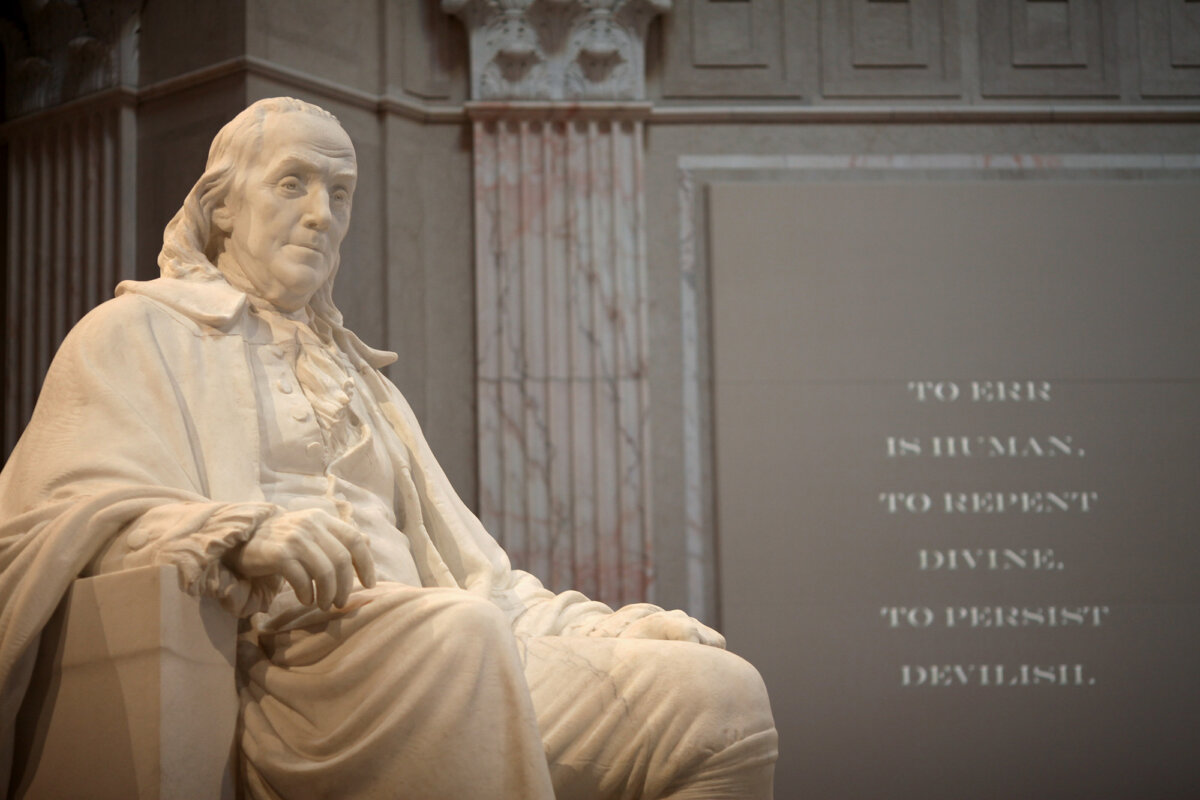
Benjamin Franklin developed an eccentric habit as part of his daily routine: air baths. Cold baths were the latest health trend in Franklin’s time, something like the 18th-century equivalent of red-light therapy, but he preferred to “bathe” simply in the cold morning air. As he explained in a letter, quoted by Mason Currey in “Daily Rituals: How Artists Work”:
“I have found it much more agreeable to my constitution, to bathe in another element, I mean cold air. With this view I rise early almost every morning, and sit in my chamber, without any clothes whatever, half an hour or an hour, according to the season, either reading or writing.”
Franklin was a creature of habit, though not all of them were as eccentric as this one was. He is well-known for the discipline and intentionality with which he approached life, career, and the formation of his own character. His daily routine was simple yet structured, and it’s no doubt part of what allowed him to accomplish so much in so many different fields, including science, diplomacy, education, and politics. The bespectacled polymath began as a printer and went on to become a prominent writer, invent bifocals and the lightning rod, correctly theorize the existence of high and low pressure, chart the Gulf Stream, and help draft the Declaration of Independence—among other accomplishments.
Franklin’s routine has also become a favorite model for imitation, with many articles and videos floating online that run something like, “I Tried Ben Franklin’s Schedule for a Month.” Despite its simplicity, Franklin’s schedule can, apparently, be a struggle to adjust to. His early mornings might have something to do with it.
The daily schedule, which Franklin included in his autobiography, ran as follows:
- 5 a.m. – 7 a.m. Rise, wash, and address Powerful Goodness! Contrive day’s business, and take the resolution of the day; prosecute the present study, and breakfast.
- 8 a.m. – 12 p.m. Work.
- Noon. Read, or overlook my accounts, and dine.
- 2 p.m. – 6 p.m. Work.
- 6 p.m. – Put things in their places. Supper. Music or diversion, or conversation. Examination of the day.
- 10 p.m. – 5 a.m. Sleep.
With only six time blocks, the “scheme” has an elegant simplicity to it, and enough space to allow for some flexibility while retaining a general structure for the day.
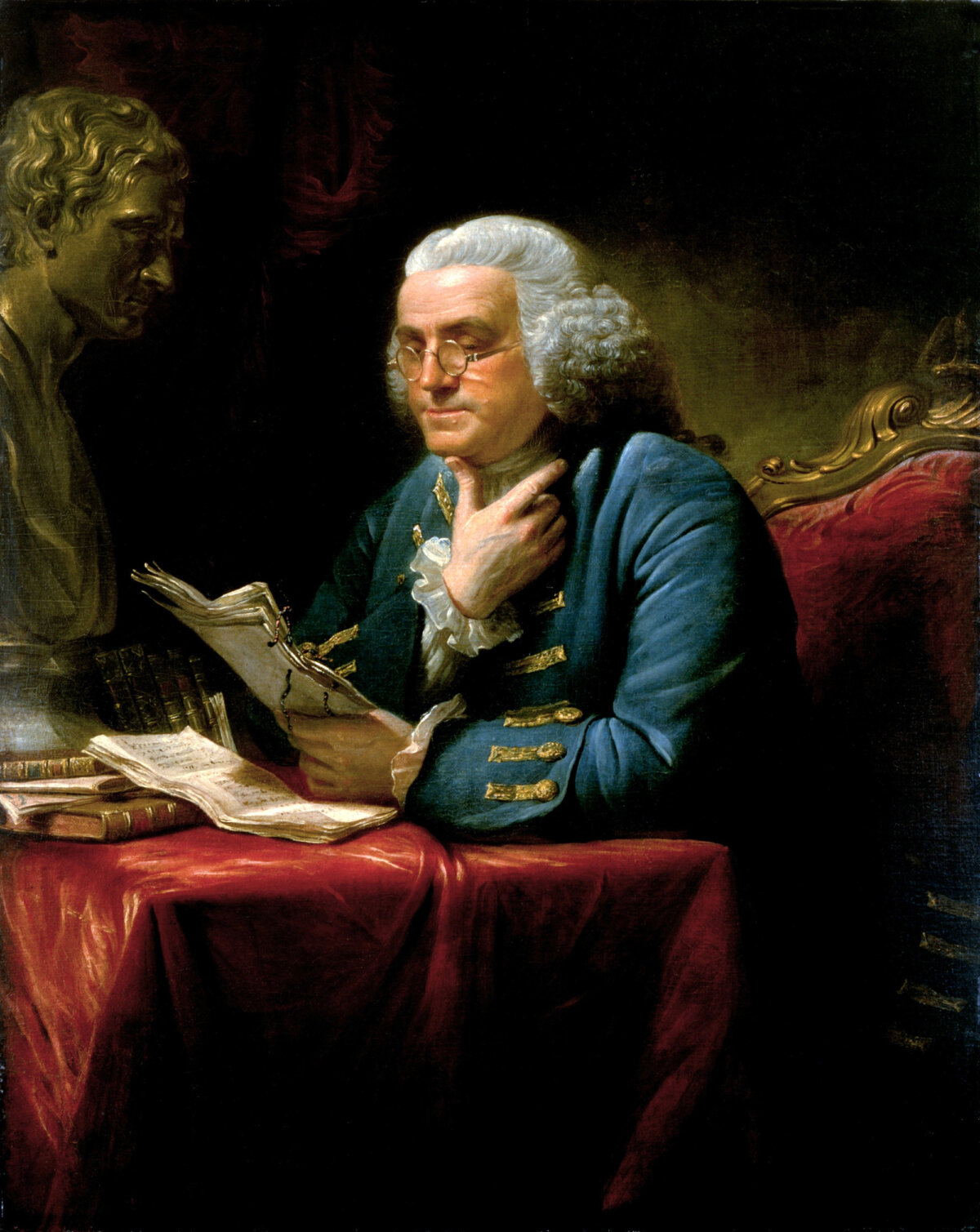
Franklin also began each day with the question “What good shall I do this day?” And he concluded each day with the question “What good have I done today?” Indeed, interwoven with Franklin’s daily routine was his attempt to master various virtues. Like Leo Tolstoy, he carefully tracked his own moral successes and failures from a young age and even wrote a list of 13 virtues and a set plan to acquire all of them through a 13-week regimen. These virtues were temperance, silence, order, resolution, frugality, industry, sincerity, justice, moderation, cleanliness, tranquility, chastity, and humility.
Each week, Franklin would focus on a different virtue, marking on a calendar every time he committed an offense against it. He theorized that a week of intense focus would establish the virtue as a habit, and he could move on to the next virtue the following week. The sequence would start over again after 13 weeks, with Franklin hoping he’d commit fewer infringements each time.
Mason Currey notes in his book “Daily Rituals: How Artists Work”: “The plan worked, up to a point. After following the course several times in a row, he found it necessary to go through just one course in a year, and then one every few years.”
However, one virtue seems to have permanently eluded him: order. According to Currey, Franklin wasn’t naturally orderly when it came to documents and other possessions—despite the orderliness with which he structured his time—and he found the attempt at neatness endlessly frustrating.
Franklin ruefully observed in his autobiography, “This article [of order], therefore, cost me so much painful attention, and my faults in it vexed me so much, and I made so little progress in amendment, and had such frequent relapses, that I was almost ready to give up the attempt, and content myself with a faulty character in that respect.”
Franklin’s daily examination of his conduct helped keep him accountable—although it wasn’t always a pleasant experience.
“I enter’d upon the execution of this plan for self-examination, and continu’d it with occasional intermissions for some time,” he wrote. “I was surpris’d to find myself so much fuller of faults than I had imagined; but I had the satisfaction of seeing them diminish.”
Like many great men and women of history, Franklin understood the importance of living with intentionality, focus, and dedication. Although he did not always live up to his moral imperatives or stick exactly to his schedule, he insisted on holding himself to a high standard, forming his days on a structured mold, and unrelentingly pursuing his objectives.
In his own words, “Diligence is the mother of good luck.”