



“Is it bad that we never did this for our own children?” my wife, Briana, asked as she mounted our old baby monitor to a barn post.
I replied: “Probably. But they didn’t sleep in a barn.”
We had never bothered to hang the baby monitor over the crib to keep watch on the children when they were newborns. The top of the dresser gave us a decent enough view of the crib. However, now, on the eve of our ewe’s due date, we were in the barn, hanging the baby monitor properly for the very first time. With a bird’s-eye view of the sheep pen, the only thing to do was wait.
2 Pregnant Ewes
Our two older Shetland ewes, Peach and Butterfly, had been bred under our purchase agreement. They’d each been marked by their rams sometime in early December, giving them an approximate due date of April 23. In February, our vet confirmed that the ewes were actually pregnant. Over the next two months, we watched as our girls got bigger, steadily ticking off the days until April 23.
I arrived home from a writer’s conference two days before the lambs were scheduled to arrive. Briana immediately put me to work building lambing stalls for the pregnant ladies. These would separate the mamas from the other sheep, giving them safe spaces to bond with their babies. We sequestered them at night and kept watch via the baby monitor.
The due date came and went without lambs, making Briana anxious. Although we both knew that there was some wiggle room as to when the lambs would actually arrive, having a due date notched up the anticipation. My wife is, self-admittedly, not a patient person. Since the sheep arrived, she’d been dreaming about the day when we would welcome our very first homestead babies. There was a collection of homesteading milestones we’d already committed to memory: first eggs, first butchering, first garden harvest, and so on. But welcoming the first new life onto the farm definitely carried the biggest significance. Despite our impatience, we were both very excited.
The Lambs Arrive
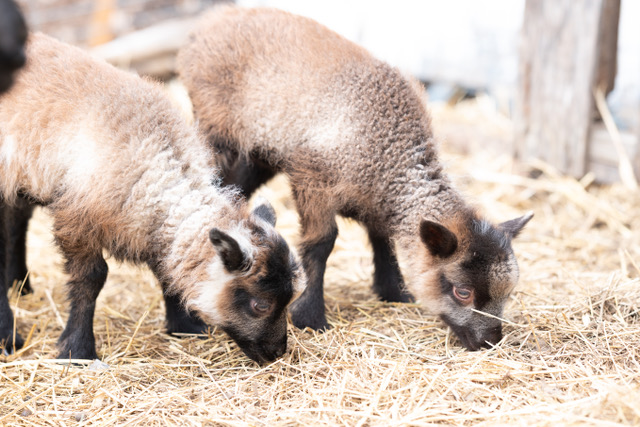
The next day dawned, and Briana went out early to check on the ewes. She came running back to the house almost immediately, shouting: “This is not a drill! We have active lambing!” We all rushed to the barn. A small nose and two hooves were visible as Butterfly pushed the lamb onto the straw-covered floor. My children, completely unfazed by the messy birthing process, offered Butterfly plenty of encouragement. Butterfly promptly got to work cleaning the amniotic fluid away from her new baby, whose wool was cinnamon brown with a small collar of white framing a little face.
The second lamb arrived 10 minutes later. Save for a few moments when she paused to push, Butterfly never stopped working on her first baby and made no notice of the second lamb hitting the floor. The birthing sack hadn’t broken with this one, so Briana jumped into the stall to help. Using a handful of straw, she broke the sack and wiped the thick fluid away from the lamb’s nose to create an airway. After a tense seven seconds, the baby coughed to life and began bleating. Briana stepped out of the pen. A cheek-to-cheek grin had broken across her face, and there was a sparkle of tears in her eyes.
In a year when nearly every fellow shepherd we knew was getting ram after ram, Butterfly had given us two beautiful ewes. We’d decided earlier to use America’s 250th anniversary as our naming inspiration. Thus, our new arrivals were christened Liberty and Independence, Libby and Penny for short.
I don’t think that the full weight of welcoming these first babies onto the homestead really hit us, mostly because we were having too much fun watching Penny and Libby bop around their pen. The births had gone as well as we could have hoped. All told, it was a smooth first rodeo.
And with our new charges settled, our eyes turned to Peach, who was determined to test our patience. But more on that next time.
Notes from Owl Hill is a homesteading column written by longtime Epoch Times lifestyle and features writer Ryan Cashman. Follow along as he and his family tap maple trees, plant gardens, tends to a growing flock of sheep, fix up their historic farmhouse, and ruminate on the challenges and rewards of homesteading on a small, rocky hillside in rural New Hampshire.
