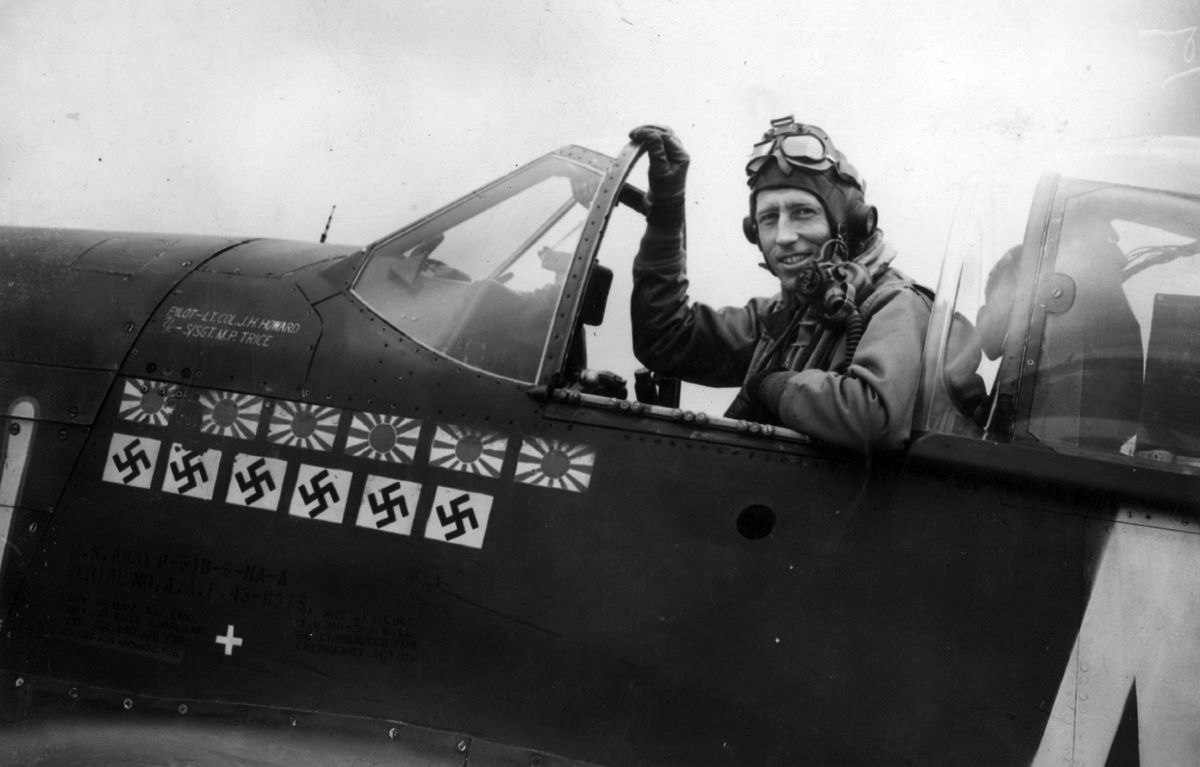
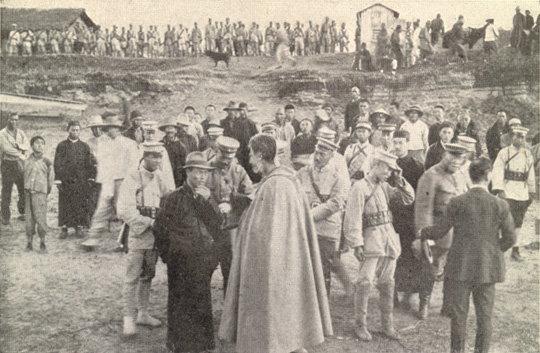
At 11 years old, James Howell Howard found himself in a very dangerous situation. He had joined his father, Harvey Howard, at an American-owned ranch in Manchuria. Bandits, bent on resisting Chinese government troops, were entrenched in a small village along the Sungari River, close to the ranch. Morgan Palmer, the ranch’s owner, decided to make a stand against the bandits, fearing they were planning an attack. On July 20, 1925, a brief standoff ended with Palmer dead and Harvey Howard kidnapped. Young James had narrowly escaped with several others.
Fortunately for Harvey Howard, he could speak fluent Chinese; was acquainted with hardship, having been a U.S. Army captain in World War I; and was an ophthalmologist. While being held for ransom, his multiple skills proved useful by being able to communicate with his captors and giving medical aid to wounded and sick bandits. For 10 weeks, he was held in captivity until he made his escape. His book “Ten Weeks With Chinese Bandits” quickly became a bestseller.
From Medicine to Aviation
By 1927, the family had moved to St. Louis, where the elder Howard became chair of the Department of Ophthalmology at Washington University School of Medicine and eventually the Medical Director for the Missouri Commission for the Blind. Meanwhile, young Howard completed his secondary education.
James Howard moved to California, where he earned his bachelor’s degree from Pomona College in 1937. He had planned to follow in his father’s medical footsteps, but he decided to join the U.S. Navy instead and become an aviator. It was a decision that would have a major impact personally, militarily, nationally, and even internationally.
A Return to China
The world was again on the brink of war. In July 1937, a clash between Japanese and Chinese soldiers at Marco Polo Bridge outside of Peking (now Beijing) began the Second Sino-Japanese War. Japanese forces pushed into China as part of its ongoing and ruthless imperial ambitions.
The next year, Howard began his flight training at the Naval Air Station in Pensacola, earning his wings in 1939. He was shipped to Pearl Harbor to serve as a Navy pilot aboard the carrier USS Enterprise.
In April 1941, as Japan continued to sweep further into China, President Franklin D. Roosevelt signed a secret executive order allowing 100 pilots and 200 ground control personnel from the Army Air Corps, Navy, and Marines to briefly resign (without losing their rank) and volunteer for a year to help the Chinese Nationalist government keep its vital supply route, the Burma Road, open.
“I couldn’t have been in a better position at a better time,” Howard recalled. “The nostalgia of going to China would be a strong incentive, but the overpowering reason was my yearning for adventure and action. It didn’t take me long to decide to sign up.”
Two months after the executive order was issued and about six months before the Japanese attack on Pearl Harbor, Howard resigned from the Navy to join the newly created group of aviators called the American Volunteer Group (AVG), or more famously known as the Flying Tigers.
A Moment Over Germany
By the end of his year of volunteering as a fighter pilot, Howard, flying a P-40 Warhawk, was an ace with six kills (only five are needed to be an ace). In the summer of 1942, Howard returned to the U.S. military as a captain in the Army Air Corps. The following year, having been promoted to major, he was given command of the Air Corps’s 356th Fighter Squadron connected to the 354th Fighter Group. He was stationed in England and his squadron were flying the upgraded P-51B Mustangs, arguably the best fighter plane of the war.
Howard named his P-51 “Ding Hao!” (“The Best!”). The American-made fighter plane powered by a British Rolls-Royce engine and sporting a Chinese name, took to the skies over Germany. On Jan. 11, 1944, Howard led his squadron of fighters to escort a formation of B-17 bombers into Germany.
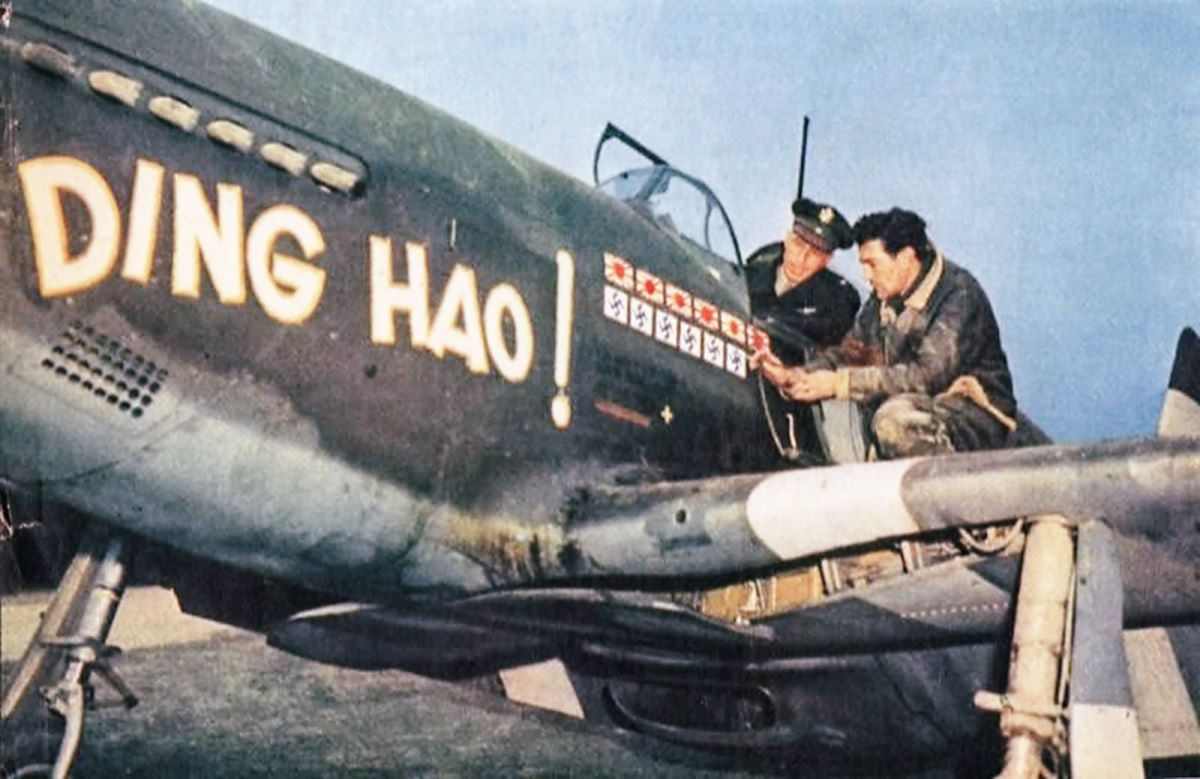
As the P-51s and B-17s neared the city of Oschersleben, a number of German fighters flew toward the bombers. The 356th engaged the Luftwaffe’s Messerschmitts (ME), leading Howard to shoot down an ME-110. When Howard returned to the U.S. bomber formation, he saw the bombers were under renewed attack, but he realized he was the only American fighter plane left to escort the bombers. There were more than 30 German planes attacking the bombers. Disregarding his personal safety and the fact that he was heavily outnumbered, Howard swooped in to fight off the Luftwaffe attackers.
For approximately half an hour, Howard took on the German fighters, shooting down three and damaging (and possibly destroying) numerous others. Three of his guns went out, and he was practically running on fumes by the end of the action, but he nonetheless stayed the course and he and his plane survived the day. It was the definition of an odds-defying military moment.
‘Conspicuous Gallantry and Intrepidity’
On June 5, 1944, the War Department issued orders, stating that “the President of the United States of America, in the name of Congress, takes pleasure in presenting the Medal of Honor to Lieutenant Colonel (Air Corps) James Howell Howard … United States Army Air Forces, for conspicuous gallantry and intrepidity above and beyond the call of duty. … His skill, courage, and intrepidity on this occasion set an example of heroism which will be an inspiration to the U.S. Armed Forces.”
A day after this War Department announcement, D-Day took place in which the Allies invaded Normandy, an operation which Howard played a vital role by helping direct air coverage.
Three weeks later on June 27, 1944, the Medal of Honor, the only one awarded to a pilot fighting in the European theater, was presented to Howard in London by Lt. Gen. Carl Spaatz, commander of the U.S. Strategic Air Forces in Europe.
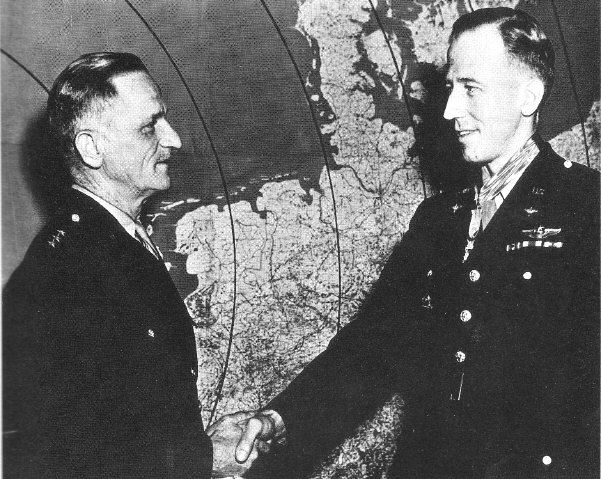
Along with being awarded the nation’s highest military honor, Howard was awarded two Distinguished Flying Crosses, a Bronze Star, and 10 Air Medals.
In early 1945, Howard was promoted to colonel, and, by the time the war in Europe was over, Howard was an ace of the European theater. Howard returned to the state where he earned his wings and finished his military career as commander of Pinellas Army Air Field in Florida, retiring with the rank of brigadier general.
Just as his father had written a successful book about his harrowing adventure, Howard wrote of his adventures in Asia and Europe in “Roar of the Tiger: From Flying Tigers to Mustangs.” Howard died in 1995 and was buried at Arlington National Cemetery.
What arts and culture topics would you like us to cover? Please email ideas or feedback to features@epochtimes.nyc.