There’s one subject everyone should be an expert on: themselves. But how many of us are? For something so close and immediate to us, our own minds and characters remain mysteriously obscure.
“Why is it a lifelong project for me to gain insight into my own thoughts, habits, impulses, reasons for acting, or the nature of the mind itself?” wondered philosophy professor Therese Cory. “This is called the ‘problem of self-opacity,’ and we’re not the only ones to puzzle over it.” Cory explains that philosophers as far back as ancient Greece and medieval Europe weighed and wondered at the mystery of the self—and the challenges of grasping it.
“It’s a common scholarly myth that early modern philosophers (starting with Descartes) invented the idea of the human being as a ‘self’ or ‘subject,’” Cory noted. “Like philosophers and neuroscientists today, medieval thinkers were just as curious about why the mind is so intimately familiar, and yet so inaccessible, to itself. (In fact, long before Freud, medieval Latin and Islamic thinkers were speculating about a subconscious, inaccessible realm in the mind.)”
These traditional thinkers offer wisdom that helps us understand both why and how to gain greater self-knowledge. Their thought remains as applicable today as when they first contemplated the mysterious and elusive substance of the human soul.
Engage in Self-Reflection
Roman Emperor and philosopher Marcus Aurelius understood the link between self-knowledge and the rationality that defines us as human beings. “These are the characteristics of the rational soul: self-awareness, self-examination, and self-determination,” he wrote in his “Meditations.” The rational soul ought to engage in these practices of self-reflection, and when it does so, “It reaps its own harvest. … It succeeds in its own purpose.”
Marcus Aurelius knew something of success. When he wore the laurels of the Caesars, the Roman Empire was near its high-water mark. He ruled over some 55 to 70 million people. His words are worth consideration.
The person who does not understand his own strengths and weaknesses, his bad habits and his best impulses, will struggle to achieve greatness. He is forever thwarted by an invisible enemy. He cannot overcome that which he does not know, the character flaws that sabotage his achievements.

Observe How You Interact With the World
In order to change our habits, we must first be aware of them. The usefulness of this knowledge is obvious. For example, if your money evaporates as soon as it reaches your wallet, you won’t be able to address the problem until you know the careless spending habit that’s causing the trouble.
Yet, for medieval theologian Thomas Aquinas, self-knowledge is valuable for higher reasons as well, beyond the practicality of correcting obnoxious habits. According to Aquinas, all truth is good in and of itself, because it ennobles and perfects human nature, which is rational and therefore oriented toward the truth as one of its highest goods. Truth gives us greater access to reality, which is what our minds and hearts long to fasten on. And the higher or more noble the truth known, the more valuable it is in itself.
Since the human soul is one of the most precious entities we encounter, knowledge of the human soul is thus of immense value. One of the ways we acquire this knowledge of the soul is through the observation of ourselves, our “front-row seat” to the workings of human nature within us.
As Cory explains, all our self-knowledge begins with our awareness of how we interact with the world. By itself, the mind is dark, but when it acts or engages with the world, it is lit up from inside, and it “sees” itself in the act of thinking and knowing. “For Aquinas, we don’t encounter ourselves as isolated minds or selves, but rather always as agents interacting with our environment.”

However, even though we have a front-row seat to the activity of our own minds, sometimes the curtain remains drawn. Just experiencing something doesn’t always mean we fully understand what we’re experiencing. That’s where more critical and intentional self-awareness comes in. “The significance of those experiences—what they are, what they tell me about myself and the nature of the mind—requires further experience and reasoning,” Cory wrote. Self-knowledge requires inward reflection on what we’ve experienced, how we’ve reacted, and what it means.
This requires that we slow down, not allowing ourselves to be overwhelmed by impressions and emotions, but maintaining enough “distance” to perceive what is happening inside ourselves. As the second-century Greek Stoic philosopher Epictetus wrote in “Discourses” 2.18.24, “First off, don’t let the force of the impression carry you away. Say to it, ‘hold up a bit and let me see who you are and where you are from—let me put you to the test.’”
“At the same time,” Cory warned, “answering this question isn’t a matter of withdrawing from the world and turning in on ourselves. It’s a matter of becoming more aware of ourselves at the moment of engaging with reality, and drawing conclusions about what our activities towards other things ‘say’ about us. There’s Aquinas’s ‘prescription’ for a deeper sense of self.”
True Friends Are Mirrors
Another outward-looking means of deepening our sense of self comes to us from one of Aquinas’s favorite philosophers, Aristotle. According to philosophy professor Mavis Biss, Aristotle held that friendship can be a path to self-understanding. In Aristotle’s philosophy, friendship depends upon similarity between friends; we’re drawn toward those with similar traits, interests, and values. The best friendship, for Aristotle, is the friendship between virtuous people who help one another continue to grow in virtue.
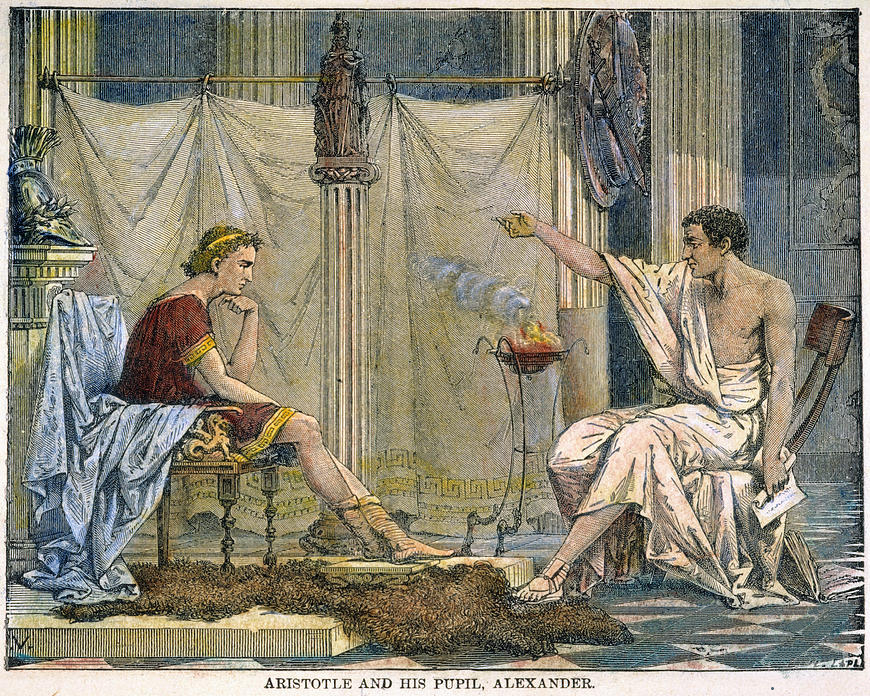
Because true friends bear similarities to one another, they can, to a degree, be mirrors for each other. “Aristotle’s argument centers on the similarity between friends’ characters, by virtue of which knowing the friend is ‘in a manner to perceive and in a manner to know oneself,’” Biss explained. “Because the friend can be observed with greater objectivity than the self, knowledge of the friend’s character combined with ‘intuitively felt’ knowledge of one’s similarity to the friend serve as a ‘bridge’ to self-knowledge. In this way, self-knowledge mediated through friendship provides protection against self-deception.”
In the best friendships, too, the friends can look to one another for honest evaluations. If we really trust a friend, we shouldn’t be afraid to ask them to tell us about ourselves, our strengths, and our weaknesses. This can give the friend an opportunity for a beautiful act of love: Helping someone grow in self-understanding is a gift that allows them to mature and draw nearer to their full potential as a human being.
Finally, as sociologist Sherry Turkle has suggested, developing a deeper sense of self also allows us to give more of ourselves. When we understand who we are—when we feel grounded and tranquilly aware of our identity—we can be more truly available to others and form deeper relationships with them. Thus, we might say friendship is both one of the means and one of the final goals of self-knowledge.