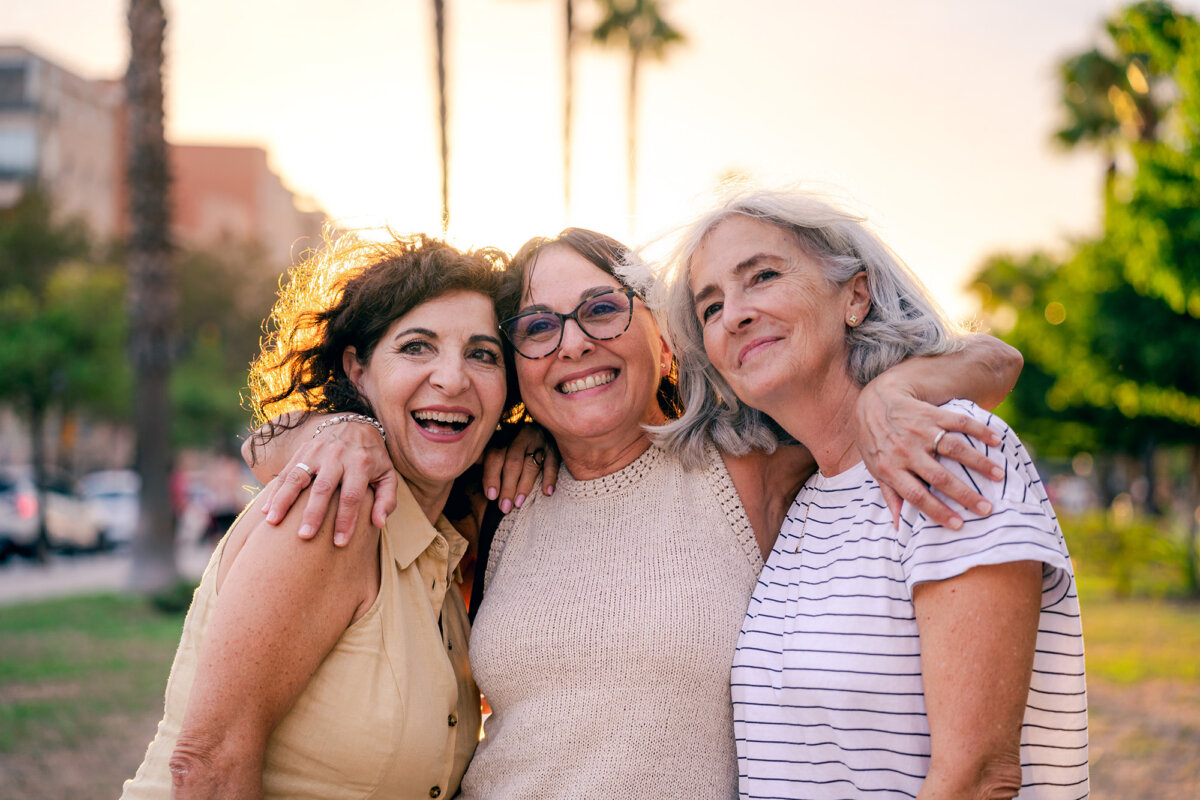
Over the past several years, I’ve been cutting my hair shorter as it becomes thinner. Some day soon, I’ll have to shave it completely. As a teenager, I had thick, dark curls. Those days feel like yesterday, but it’s actually been a decade.
The loss of my hair came as a surprise to me; I figured I wouldn’t have to worry about that until I was in my forties or fifties. No such luck, as it turns out. And yet, in a weird way (and in my better moments), I’m grateful. Because it has forced me to recognize that life passes quickly and I need to appreciate each moment. I now have a memento mori every time I look in the mirror.
Of course, I am by no means old. But the opening chapter of my life has already concluded, and it went much faster than I expected. Those who are older and wiser tell me that all of life is like that—it passes faster than we can imagine.
What to make of this?
It seems to me that aging—and we’re all aging all the time—requires a constant adaptation of perspective. As I leave early adulthood behind, I’m having to think about what my role in life is now. With two little daughters, I sense that my attention needs to shift to them.
When you’re in your teens or early twenties, it’s easy to feel like the protagonist of the story. But now I realize that, as a father, I need to focus on facilitating someone else’s story. And there’s arguably a deeper joy in that than in the self-centeredness of youth. If giving is more fulfilling than receiving, then the older I am, and the more wisdom and resources I have to give to others, the more fulfilled I ought to be.
Modern Culture on Aging
Growing in wisdom and age brings many blessings and benefits—they’re just not the ones we typically laud in popular culture. Our culture does not particularly value aging. If we take our cues from most mainstream music and movies, the thing is to be young and attractive (and wealthy, preferably) for as long as you can—forever if possible. At the top of the billboard charts are songs with themes linked largely to youth: partying, drinking, falling in love, breaking up.
In this world of pop music, everything of interest, it would seem, happens between the ages of about 15 and 35. If a song mentions someone’s body, it’s rarely to discuss its wrinkles. There are not a lot of songs about peaceful, fruitful marriages or couples who are neither falling in love nor breaking up nor getting smashed every weekend, but rather progressing, hand-in-hand, into the broad vistas of middle or even old age.
This pop music image of youth isn’t all that accurate, either. With the possible exception of a few years in college, most of us can’t live perpetual lives of partying and passionate romances. But even if this were an accurate picture of youth, it would only offer us an image of one rather brief stage of life—as though the culmination of the human experience occurs somewhere around the age of 20, with the rest of life a kind of disappointing afterthought. Much of pop culture exists in a world like Neverland, where no one ever gets older or takes thought of the meaning of aging.
The Transformation of Years
Of course, Neverland doesn’t exist. Father Time is undefeated. No one stays young forever. “All fires burn out sooner or later,” as Sigrid Undset writes toward the end of “Kristin Lavransdatter”—a trilogy about the consequences of youthful passion and how it must, inevitably, either devolve into bitterness and regret or transform into something altogether different and more transcendent.
At the beginning of Plato’s “Republic,” Socrates and an old man named Cephalus discuss old age. Socrates, being a wise man, has respect for the elderly. So he says, “There is nothing which for my part I like better, Cephalus, than conversing with aged men; for I regard them as travellers who have gone [on] a journey which I too may have to go [on], and of whom I ought to enquire, whether the way is smooth and easy, or rugged and difficult. … Is life harder towards the end, or what report do you give of it?”
Cephalus has an unexpected perspective. He replies that he has discovered a newfound freedom in old age because the desires and passions that tormented him in youth have subsided. “Old age has a great sense of calm and freedom; when the passions relax their hold, then, as Sophocles says, we are freed from the grasp not of one mad master only, but of many.”
Beautiful Stories, Beautiful Soul
That peace goes hand-in-hand with the diminishment of physical powers. As we age, the comeliness will fade from the body like a dying evening glow. This is no easy loss. There will always be something ghastly about aging. It will always bring with it the whiff of the grave. It is heartbreaking to see the principle of decay at work in our own bodies and the bodies of those we love.
And yet there’s an inverse relationship between the decline of the body and the growth of the soul. And therein lies a hope that, just maybe, can overcome decay. The comeliness of the body fades, yes. But the beauty is not gone. It’s as if it recedes inward, like the germ of life in winter, hidden in the earth. If a man or woman has lived well, their exterior beauty internalizes, perfecting the heart.
It’s also not entirely true that an old body has no beauty, though, admittedly, it’s a different kind of beauty. The lines of the face, the stoop of the back, the spots on the skin—what is all this if not the testimony of a full life, written on the body? The elderly body bears the marks of all the burdens borne, sufferings undergone, losses sustained, and joys embraced. In a life well-lived, that’s a beautiful thing.
My 2010 Toyota Corolla has several hail dents on the hood and roof. I will never get those repaired, nor will I ever sell that car. They occurred when a freak storm swept up from the plains in western South Dakota when my wife and I were on our honeymoon. Those marks have meaning; they’re a part of our story, a unique sign that no other vehicle has or could have, just as wrinkles or thinning hair are the visible signs of a living story. They are carriers of meaning, and, as such, when we see them in ourselves or our loved ones, they can become objects of love rather than hatred because of what they signify, which is everything you’ve been through together. Those marks are specks within the larger tapestry of a life being woven on the loom of time.
Old houses have crooked lines, weathered paint, sloping floors, and dented woodwork—but we call this “character.” The house isn’t as sleek and pristine as the new build, but it has something the new house doesn’t: memories, history, endurance, meaning etched into its very surfaces. Each flaw makes the house more irreplaceable. This is true of the elderly human as well. A life well-lived—it is to be hoped—culminates in an old man or woman of character. He or she possesses deep wells of experience, wisdom, and virtue that they lacked in youth.
The World Comes Alive
There are the changes of the body, and then there are the changes of the mind, and it’s even easier to see these in a positive light. Of course, there’s the proverbial growth in wisdom that takes place. But more than that, there is, according to G.K. Chesterton, at least, a shift in perspective: the world comes even more alive as one ages. In “On the Pleasures of No Longer Being Very Young,” he wrote:
“One pleasure attached to growing older is that many things seem to be growing younger; growing fresher and more lively than we once supposed them to be. … It is something to come to live in a world of living and significant things instead of dead and unmeaning things. And it is youth in revolt, even in righteous revolt, which sees its surroundings as dead and unmeaning. It is old age, and even second childhood, that has come to see that everything means something and that life itself has never died.”
This makes me think of my grandfather, who was a busy, highly productive man in his youth and middle age, much to his credit. But now he finds joy in watching the birds from his patio. I suspect he wouldn’t have had much interest in that when he was young, but now, maybe, he sees more meaning in even the smallest things.
Hope Grows
I want to conclude by addressing the subject of hope. Does hope fade with age? Actually, it’s the opposite according to Chesterton. He wrote:
“It is currently said that hope goes with youth, and lends to youth its wings of a butterfly; but I fancy that hope is the last gift given to man, and the only gift not given to youth. Youth is pre-eminently the period in which a man can be lyric, fanatical, poetic; but youth is the period in which a man can be hopeless. The end of every episode is the end of the world. But the power of hoping through everything, the knowledge that the soul survives its adventures, that great inspiration comes to the middle-aged; God has kept that good wine until now. It is from the backs of the elderly gentlemen that the wings of the butterfly should burst.”
Plato agrees. Toward the end of the conversation cited above, Cephalus tells Socrates, “Sweet hope, as Pindar charmingly says, is the kind nurse of his age: Hope, he says, cherishes the soul of him who lives in justice and holiness and is the nurse of his age and the companion of his journey;—hope which is mightiest to sway the restless soul of man.”
And what greater source of hope is there than faithful love? It’s still true—whatever the breakup songs might suggest—that one of the most romantic things you can say to someone is “I want to grow old with you.” And one of the most romantic things you can accomplish is to actually do it. That’s where true love and hope are put to the test—not in the bright bloom of life’s springtime, but in the amber autumn of life, its long sunset, patiently endured, side by side, walking into twilight.
As a favorite song from my teenage years put it, “Even faces change—my heart stays the same.”