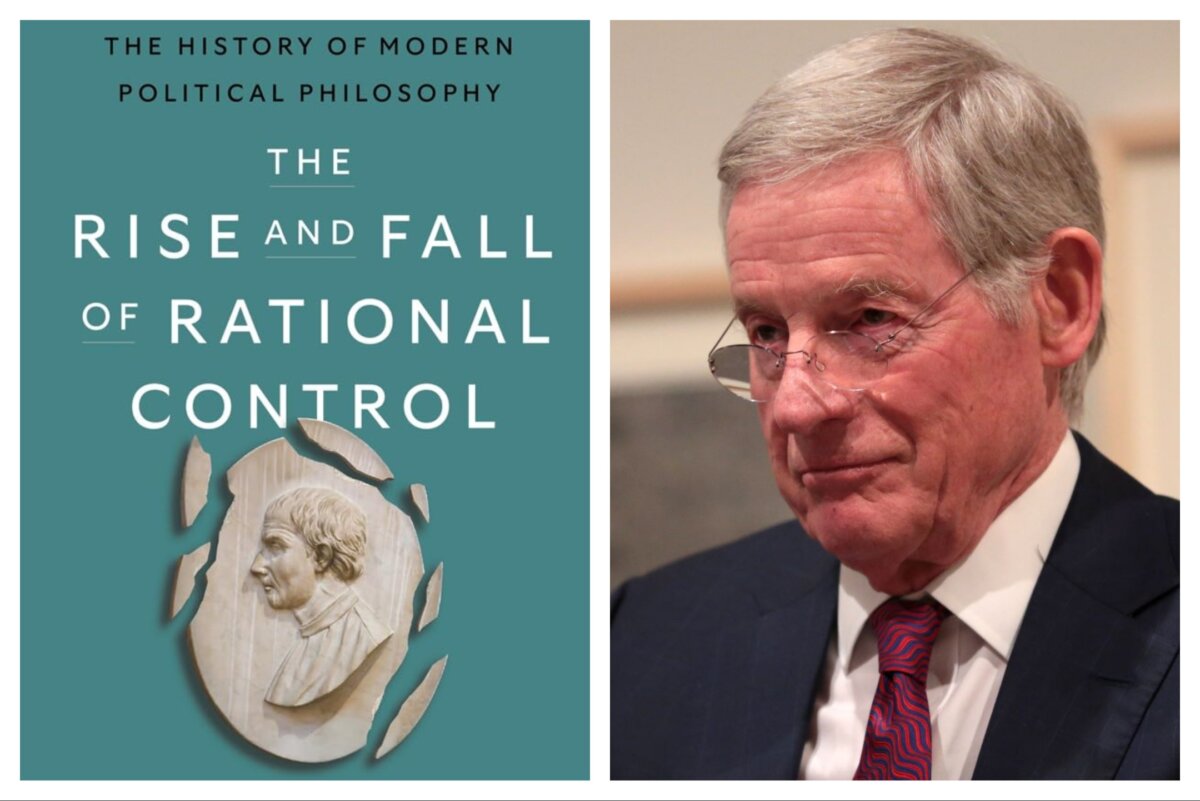
To understand the modern age, one must understand modern politics. According to Harvey C. Mansfield, in his new book “The Rise and Fall of Rational Control: The History of Modern Political Philosophy,” the modern age, and thus modern politics, began in the 16th century with Niccolo Machiavelli and it ended with Friedrich Nietzsche.
Modern politics centers around a multi-century effort toward what Mansfield identifies as “rational control.” It is the “idea of the application of reason to revolutionize the life of human beings as individuals and in politics in order to liberate them from the unreason of prejudice, tradition, and superstition.”
In the book, Machiavelli and Nietzsche are bookends for six other influential philosophers—Thomas Hobbes, John Locke, Jean-Jacques Rousseau, Immanuel Kant, Georg Hegel, and Karl Marx. But there is far more to this book than simply an outline or a chronology of politically focused philosophic thought.
Mansfield, who was a professor of government at Harvard University for more than 60 years, until his retirement in 2023, has long been one of America’s most influential thinkers on the idea of government, and all that this idea entails (that is, freedom, justice, economics, politics, and so on).
‘Machiavelli’s Modernity’
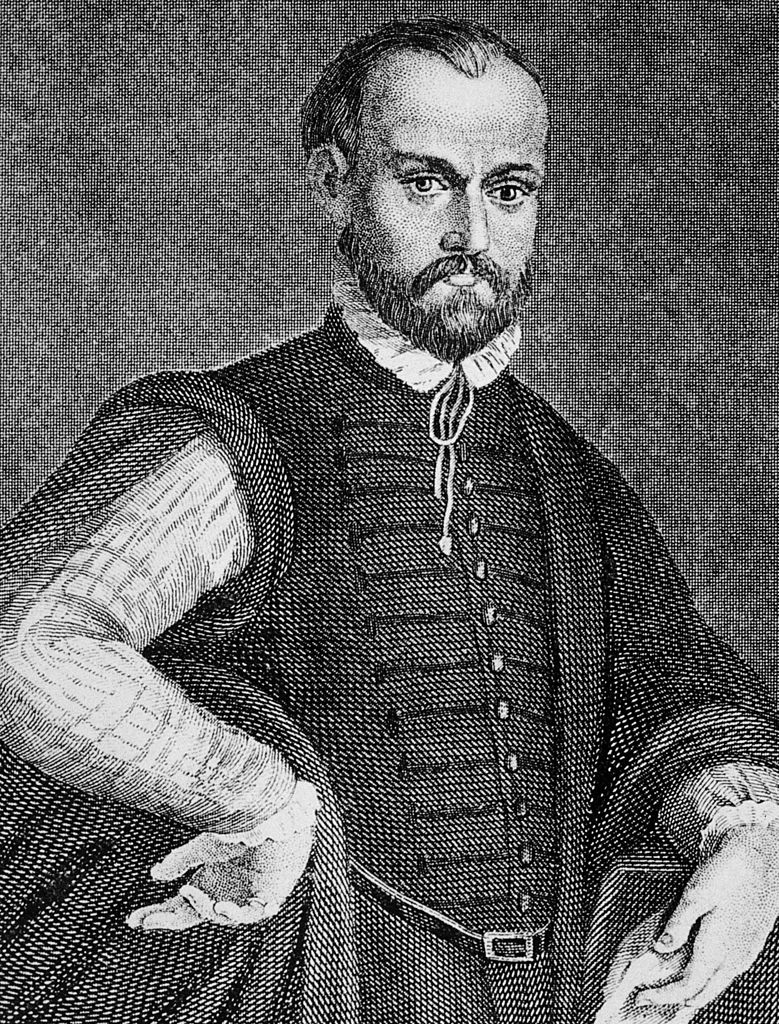
The book highlights those aforementioned eight philosophers, but there are many others mentioned (some more than others), including the ancient Greek philosophers, Socrates, Plato and Aristotle, as well as the philosophers of the specified modern era, like Francis Bacon, David Hume, René Descartes, and Montesquieu.
The book suggests that centuries-long movement began with the claim that “reason supports and enlivens humans, freeing them from slavery, constituting their very being … yet ending with the belief that reason deadens humans, stifling and enslaving them.”
As the book title indicates, the political philosophers, or political scientists, who followed Machiavelli either built upon his principles (principles that were often quite ruthless in theory and in practice), which culminated toward the middle period of better equality among individuals, or they began to dismantle those principles, creating greater inequality by heralding the individual (like with Nietzsche) or creating greater inequality along with extreme human misery by heralding the collective (like with Marx). Despite the changes, for better and for worse, this approximate 300 years of rational control is “Machiavelli’s modernity.”
Attack. Divide. Dismantle.

Mansfield does a masterful job of demonstrating just how these philosophers upended centuries, if not millennia, of accepted political thought and practice. Of course, how could a revolution in political thought not have taken place when one of the founding tenets of modern political philosophy was Machiavelli’s claim that, as phrased by Mansfield, “government is essentially conspiracy, rather than open, transparent rule for the sake of public principles.”
Machiavelli’s disruptive writings planted a seed. His most famous work is “The Prince,” though Mansfield chooses to focus on his other works, like his play “Mandragola,” which conveys this conspiratorial thought, and his “Discourse on Livy.”
Suggesting “government is essentially conspiracy” is unmistakably an attack on traditional government, even if that attack was, in many or at least in some cases, accurate. Attacking the traditional was a primary tactic for many of these philosophers, though some subtler than others. Machiavelli attacked elements of Christianity, though only enough to make modern historians wonder whether he was a Christian or not.
The same is true, to some degree, with other thinkers. Hobbes didn’t care for religion, though his attack was more directed toward ancient philosophers like Aristotle. He called for a stronger state, most famously in his work, “Leviathan,” while Locke promoted personal liberty, like in his “Two Treatises of Government” (even at the expense of the religious establishment). Rousseau attacked religion in worship of reason, while Nietzsche attacked reason while bemoaning the loss of religion. And Marx attacked seemingly every traditional establishment.
(Mis)Understanding Humanity
Mansfield identifies numerous strong points as well as weak points in each philosopher’s arguments. He notes that these apparent weaknesses were typically ignored by the philosopher and his followers—that is, until another philosopher pointed them out. Of course, this tendency demonstrates the inability to establish a perfect system. There will always be caveats, some more devastating to justice, liberty, and equality than others. These caveats, these weaknesses, therefore forced philosophers to attempt to better understand humanity by different means.
Hegel believed he could establish a scientific understanding of humanity by studying its history. His brilliant “Philosophy of History” was that attempt. Despite the brilliance, as Mansfield indicates, it didn’t work. There simply was too much to encompass, too much to know that couldn’t be known; additionally, the past is never an exact blueprint for the present.
This weakness, of course, did not stop Marx from taking up a piece of Hegel’s mantle (destroying it in the process) and simplifying his theory. He diminished Hegel’s complexity by stating that all of history was strictly a class struggle. Certainly, class struggle has been a primary mover in history, but such a philosophy ignored major nuances, and they were ignored at great peril.
Cyclical Political Philosophies
Mansfield makes a very poignant observation toward the end of his book regarding the last two philosophers he highlighted. “Marx and Nietzsche have in common a world revolution that looks to the past—Marx to original communism, Nietzsche to the Greeks—but with the understanding that the past cannot be recovered.”
This observation demonstrates one of Mansfield’s strongest points. He suggests that political philosophy becomes cyclical, much like history itself. In his opening pages on Machiavelli, he writes, “Since every act of construction presupposes an act of destruction, to act anew is to renovate the old.”
Mansfield highlights his own concerns about these constructive, and therefore destructive, political philosophies. In his final lines, he pinpoints the cyclical errors of the past several centuries.
“Throughout the history recorded here from Machiavelli to Nietzsche, freedom consists in an escape from God and nature, by which we are delivered into the bondage of human necessities. … Then we are obliged to understand freedom as the escape from human necessities, from the history we have made for ourselves, back into the arms of God and nature.”
Mansfield then finishes by asking and answering his own question:
“Isn’t there something dubious about an escape into our original prison? Perhaps the original mistake was to define an opposition between freedom and nature, which tried to compel us to escape what cannot be escaped. Perhaps we ought to suppose that our freedom comes from nature and begin our reasoning accordingly.”
“The Rise and Fall of Rational Control” is a complex work that is dense, though not exorbitantly long. It is complex and dense in the sense that each sentence is significant in attempting to understand not only the specified philosopher but also Mansfield’s discussion of that philosopher. I often found myself rereading sentences to ensure I understood his, or their, concepts.
The book is an absolute treasure when it comes to breaking down some of these philosophers’ most influential and impactful philosophies. We indeed remain in the shadow of the tree Machiavelli planted, which several others watered, and which the latter few chopped down. The question is whether we will witness a new era of political science or if we are experiencing a return to a pre-Machiavelli era. This is a great book to discover where we have been and, perhaps, where we are (or should be) headed.
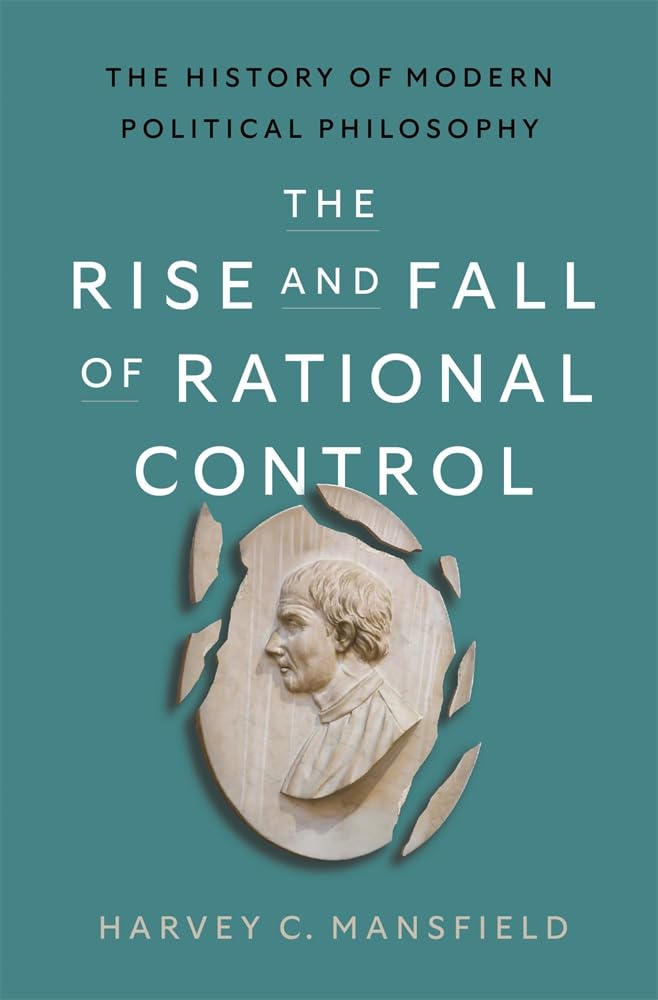
‘The Rise and Fall of Rational Control: The History of Modern Political Philosophy’
By Harvey C. Mansfield
Belknap Press: Jan. 20, 2026
Hardcover, 336 pages
What arts and culture topics would you like us to cover? Please email ideas or feedback to features@epochtimes.nyc.