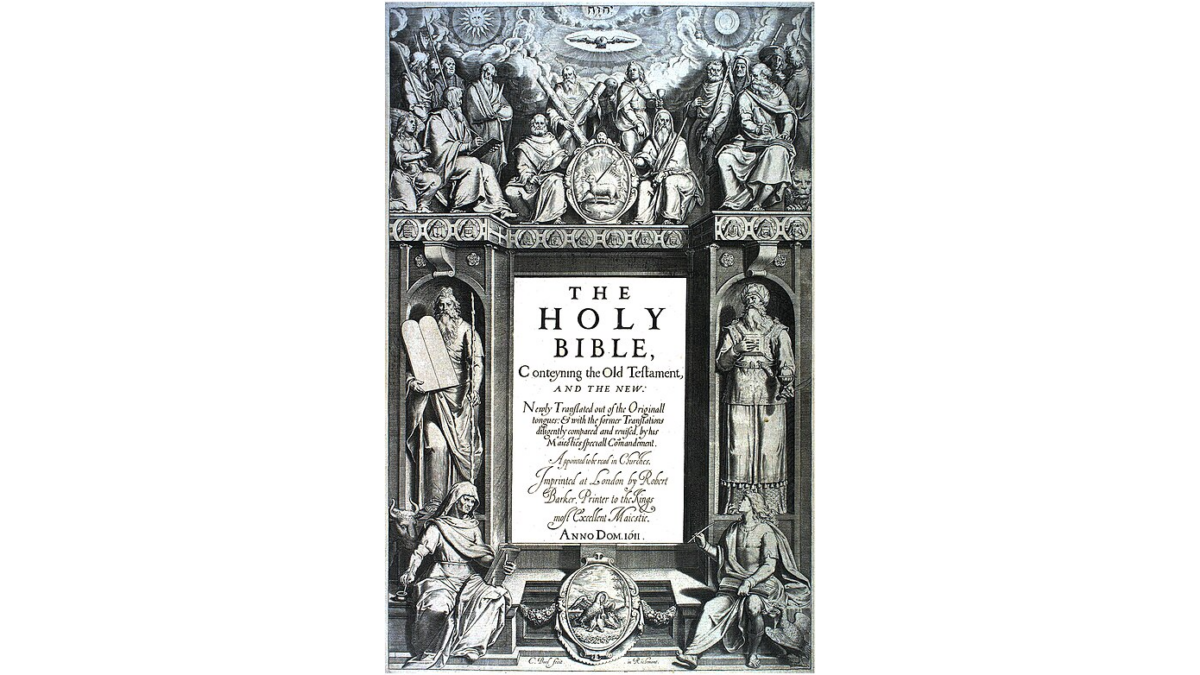
From a thrift shop within walking distance of my apartment, I recently purchased a King James Bible (KJB) in mint condition. The books there generally sell for a dollar apiece, but on this particular Saturday, the shop was running a 20 percent off sale, and so I walked away with the KJB for 80 cents plus tax.
It wasn’t the price that attracted me, however, nor the need for another Bible, but this treasure of print and paper reproduced the text of the 1611 KJB, that cornerstone of the English language translated over 400 years ago by a committee of scholars appointed by King James I. Here’s an example of their work, the first sentence from the “Dedicatorie”: “Great and manifold were the blessings (most dread Soueraigne) which Almighty God, the Father of all Mercies, bestowed upon vs the people of ENGLAND, when first he sent your Maiesties Royall person to rule and raigne ouer us.”
Despite the eccentricities of grammar and spelling, this word sample showcases rhythm and diction that have long influenced how Americans use their language. To his letters and speeches, for instance, Abraham Lincoln brought the cadences gleaned from a lifetime of reading the KJB and the roughly contemporaneous works of Shakespeare.
Yet this Bible, along with an earlier Protestant favorite, the 1560 Geneva Bible, read by the Pilgrims and other early colonists, influenced more than just our language. They served as foundation stones for our Declaration of Independence, our Constitution, and our republic.
Familiarity Breeds Unity
English common law, the works of Enlightenment writers like John Locke, and the histories and philosophical writings of classical authors like the Roman statesman Cicero are widely recognized as building blocks in the creation of this new American nation. Men like Thomas Jefferson, John Adams, and James Madison were all versed in the law. They’d read Locke, Montesquieu, and others, and had taken lessons in government and civics from the ancient Romans.
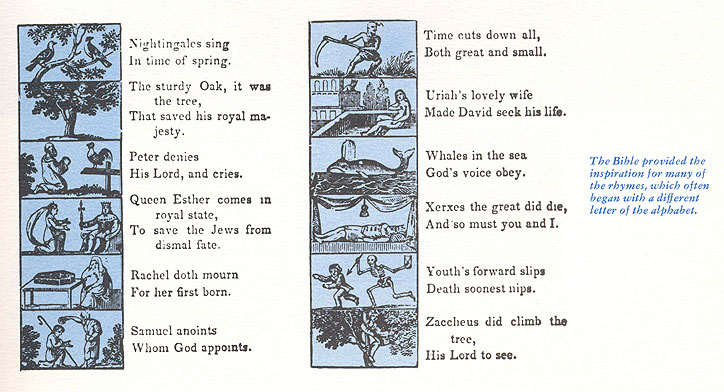
And like the vast majority of their fellow Americans, the Founding Fathers knew their Scripture. From the time of the first settlements, sojourners to the New World connected the importance of learning to read with the reading of the Bible. They founded schools with that end in mind and established America’s first colleges as vehicles for teaching Scripture and producing ministers. First published in 1686, “The New England Primer,” sometimes called “The Little Bible of New England,” became an 18th-century bestseller that taught children the basics of reading using the Psalms, religious texts, prayers, and lessons in morality. As many commentators have also noted, if a home in those days had just one book on the premises, it was likely to be a Bible.
Given this biblical literacy of their audiences, political leaders of the time found it only natural to use allusions, quotes, and stories from Scripture in their writings and speeches. These, and not Cicero or Locke, connected them to the common man.
Empirical evidence backs up this claim. A collection of articles edited by Wilfred McClay and Stuart Halpern in their book, “Jewish Roots of American Liberty,” includes a mention of a study by scholar Donald Lutz, who found that from 1760 to 1805 the Bible accounts for a third of all sources cited in American political literature. “Deuteronomy is the most frequently cited book,” wrote Lutz, “followed by Montesquieu’s ‘The Spirit of the Laws.’”
Why Deuteronomy?
Professor Daniel Dreisbach, author of the book “Reading the Bible With the Founding Fathers,” has written extensively online about the connections between the Bible and the founding of the American republic. In his essay for the McClay and Halpern collection, “The Hebrew Bible and the Political Culture of the American Founders,” Dreisbach quotes several Founders who wrote of the connection between Scripture and good government. For example, in a letter to Dr. Benjamin Rush, another signer of the Declaration of Independence, John Adams called the Bible “the most republican book in the world.” His contemporary John Dickinson agreed, writing, “The Bible is the most republican Book that ever was written.”
And it is Deuteronomy that most completely affirms these surprising declarations. Included in this last book of the Pentateuch (the first five books of the Bible) are the Ten Commandments, a summing up of the Exodus, the concept of covenant, and the framework of a republic. Dreisbach notes of “Deuteronomy’s prominence in this literature” that “it is a convenient digest of the Mosaic law and the providential history of the nation Israel.”
An American Covenant
Having fled religious persecution to a new land, New England Puritans and later arrivals to the New World identified with the Exodus of the Hebrews from Egypt. They also held, Dreisbach writes, that Deuteronomy and the rest of the Pentateuch “described God’s special, covenantal relationship not only with the Children of Israel but with them.” From the arrival of those early settlers to the break with Great Britain, many Americans came to believe that “the Book of Deuteronomy described the principles, offices, and processes of government useful in establishing a new political society.”
This idea of a covenant with God, particularly dear to followers of John Calvin, is an old and very American way of looking at the country and its special standing in the world. In a 1630 sermon, for example, Governor John Winthrop declared: “For we must consider that we shall be as a city upon a hill. The eyes of all people are upon us.” In his Farewell Address to the Nation, some 350 years later, President Ronald Reagan employed “shining city on a hill” as a metaphor for America with its hopes and dreams, a people set apart, a chosen people like the followers of Moses.
Virtue, Religion, and the Republic
The Commandments, which had served so long as a moral code for Christian Europe, undergirded this city on a hill. Adams and other Founding Fathers repeatedly said that a republic without virtue—and often they meant specifically Christian virtues—would soon fall into corruption, ruin, and tyranny. The virtues they referenced and promoted came not only from the Old Testament but from the New as well.
Dreisbach provides several examples of how Americans of the Revolutionary War period related the importance of Christian virtues to a successful republic. In a 1783 sermon, for instance, Ezra Stiles, president of Yale College, took his message from Deuteronomy 26:19, in which God promises to hold Israel in high esteem if it remains a “holy people.” Stiles declared that this promise was “allusively prophetic of the future prosperity and splendor of the United States—God’s American Israel.” Many others, including a good number of the Founding Fathers, connected the success of a republic to virtue, and virtue to religion. As Rush wrote:
“The only foundation for a useful education in a republic is to be laid in religion. Without this there can be no virtue, and without virtue there can be no liberty, and liberty is the object and life of all republican governments.”
America has become increasingly secularized over the last century. Whether it can long endure as a republic without religion is an important question deserving consideration, but our purpose here is to refute those who would say that America was founded as a secular nation without reference to biblical principles of governance and morality. Those who would deny these influences, which had far greater impact than students in our schools and the public in general are led to believe, are simply wrong. The evidence—and we have scarcely dented that evidence here—repudiates those arguments. Just as we have a mixed government, so too do we have a mixed bag of ideas and beliefs that brought that government and the recognition of our natural rights and freedoms into existence.
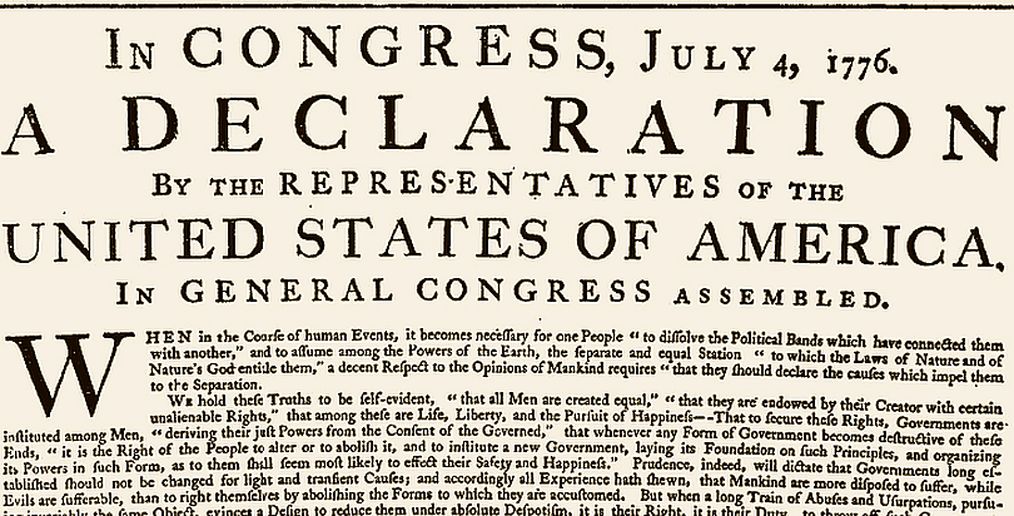
One idea from that bag is key to our survival both as free individuals and as a republic. In the Declaration, Jefferson wrote: “We hold these truths to be self-evident, that all men are created equal, that they are endowed by their Creator with certain unalienable Rights, that among these are Life, Liberty and the pursuit of Happiness.”
Six words in that sentence—“they are endowed by their Creator”—safeguard all our unalienable rights. Those liberties we enjoy come not from the whims of men, nor from the largesse of the state, but from a Creator whom the Founding Fathers and their contemporaries found in the Bible.
What arts and culture topics would you like us to cover? Please email ideas or feedback to features@epochtimes.nyc.