
You want to help fund your grandchild’s new Trump Account, but until late June, even tax professionals could not tell you whether that generosity would drag you into gift tax territory.
On June 29, the Treasury Department and the IRS settled the question with Revenue Procedure 2026-25, a safe harbor that lets most individual donors contribute without filing a gift tax return. The rules are genuinely friendly, but they come with conditions, a fine-print “trap,” so to speak, and a separate eligibility wrinkle that surprises many grandparents.
Here is the whole picture in plain language.
Quick Answer: Can Grandparents Contribute to a Trump Account?
Yes. Anyone, including grandparents, can contribute cash to a Trump Account that a parent has already opened, subject to the $5,000 combined annual cap per child. Under the new safe harbor, those contributions are treated as ordinary gifts covered by the annual gift tax exclusion, which is $19,000 per recipient for 2026, so no gift tax return is required as long as you meet the conditions below. Opening the account yourself and claiming the $1,000 federal seed money is a different matter, generally reserved for grandparents who can claim the grandchild as a tax dependent.
The Details: Why Gift Tax Was Even a Question
Trump account funds are locked until the child turns 18, with only narrow exceptions. Under gift tax rules, a gift the recipient cannot use yet can be classified as a “future interest,” and future interests do not qualify for the annual exclusion. That would have forced donors to file Form 709, the federal gift tax return, for even a $100 contribution.
The scale of that problem explains why the IRS moved. The agency received roughly 300,000 gift tax returns in fiscal 2025, while nearly 6 million Trump Account elections had already come in by early June 2026.
Without relief, gift tax filings could have jumped to several million per year, mostly from families who will never owe a dime of gift tax, since the lifetime exemption now sits at $15 million.
The Safe Harbor Conditions in Plain Language
Revenue Procedure 2026-25 solves this by treating qualifying contributions as completed, present-interest gifts eligible for the annual exclusion. To qualify for a given calendar year, all of the following must be true:
- You are an individual, not a trust, company, or other entity.
- You give currency, check, money order, or electronic transfer (gifts of stock or property are not covered).
- Each contribution is made before the year the child turns 18.
- Your total gifts to each grandchild stay beneath $19,000 for 2026—this counts Trump Account contributions plus anything else you give that same child, from birthday checks to 529 deposits.
- You are not otherwise required to file a gift tax return that year, and you do not file one for any other reason, such as gift-splitting with a spouse or estate planning elections.
Meet every above condition, and the IRS doesn’t require filing, but the agency does expect you to keep basic records showing you qualified, so hold onto contribution confirmations.
The $19,000 Trap in the Fine Print
The safe harbor is all or nothing, and the revenue procedure’s own example shows how it breaks. A donor gives $5,000 to each of three grandchildren’s Trump Accounts, plus $13,000 in other cash to one of them. Total gifts to that child come to $18,000, under the limit, so everything qualifies and no return is needed.
Change the extra gift to $14,500 and the total to that one child hits $19,500. Now the donor must file a gift tax return reporting all gifts for the year, and every Trump account contribution, including the ones to the other two grandchildren, gets reported as a future interest.
One oversized gift to one grandchild pulls the entire year’s contributions into paperwork. Before writing checks in December, add up everything you have already given each grandchild since January.
Opening an Account Is Different From Contributing to One
This is important: Contributing to an existing account and opening a new one are two separate lanes.
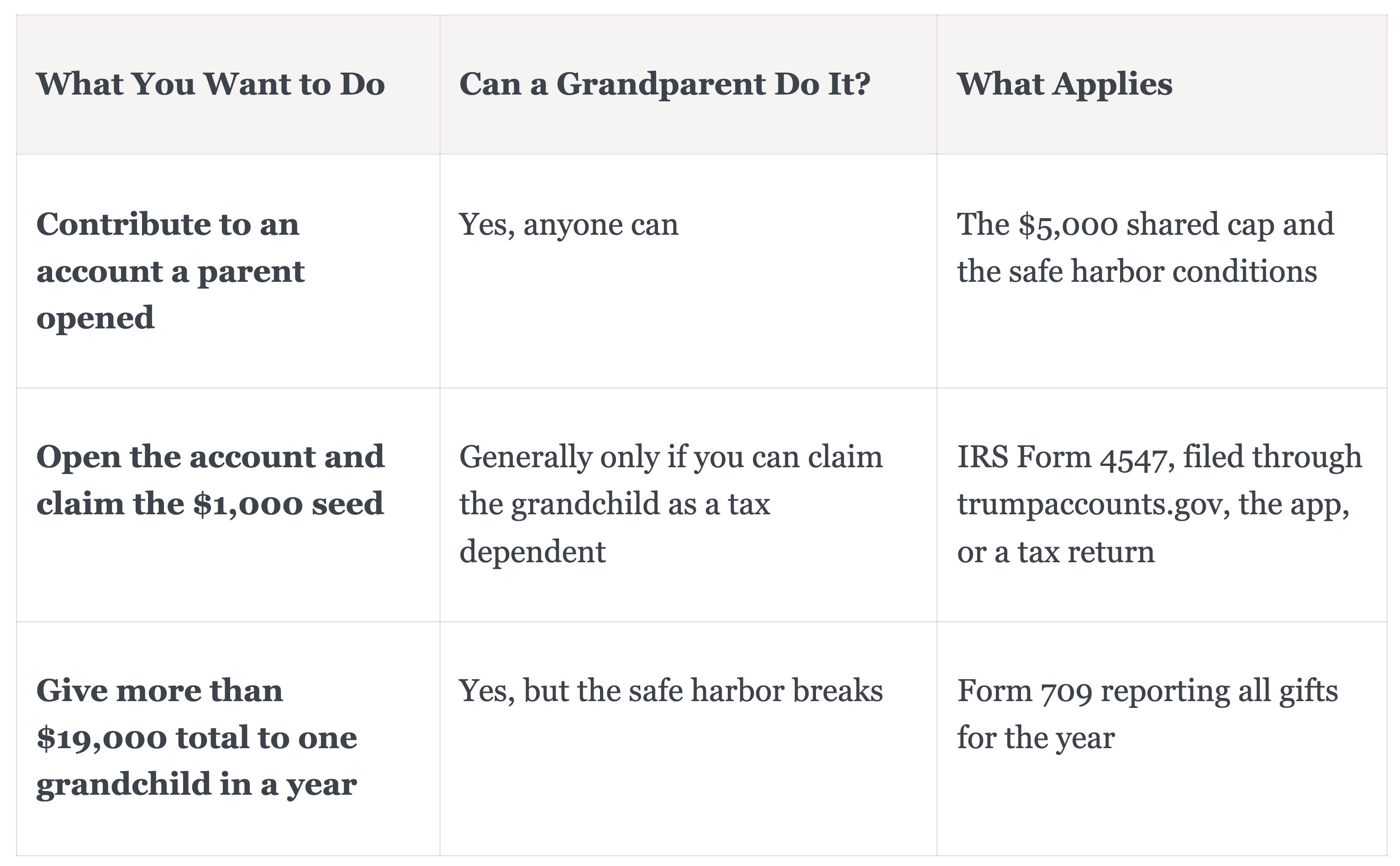
The initial account election runs through the tax system, and it generally belongs to the person who claims the child as a dependent, which is almost always a parent. The main exception is grandparents who claim grandchildren as dependents.
For everyone else, the practical path is simple: ask the parents to open the account and claim the seed, then coordinate your contribution. Coordination matters because the $5,000 cap is shared. A grandparent who fills the entire cap in January may crowd out an employer match worth another $1,000 or more.
FAQs About Trump Account Gift Tax
Do I Need to File Form 709 for Trump Account Contributions?
Not if you meet the safe harbor conditions of Revenue Procedure 2026-25. Qualifying cash contributions are treated as present-interest gifts covered by the $19,000 annual exclusion, so no gift tax return is required to report them. You lose that protection for all Trump account contributions if your total gifts to any one grandchild exceed $19,000 for 2026, or if you must file a gift tax return for any other reason that year. Keep contribution records either way.
What if I Gave My Grandchild Other Gifts in the Same Year?
Other gifts are fine, but they count toward the same $19,000 per-person limit as your Trump Account contributions. A $5,000 account contribution plus $13,000 in other cash gifts still qualifies. Push the combined total past $19,000 and the safe harbor fails for the entire year, which means filing Form 709 and reporting every Trump Account contribution you made, to every grandchild, as a future-interest gift.
Can I Open a Trump Account for My Grandchild Myself?
Generally not, unless you can claim the grandchild as a dependent on your tax return, which typically applies to grandparents who are raising grandchildren. The initial election and the $1,000 federal seed claim run through IRS Form 4547 and belong with the person who claims the child, usually a parent. The simpler route for most grandparents is asking the parents to open the account, then contributing to it directly.
Does the Safe Harbor Cover Gifts of Stock or Property?
No. The safe harbor applies only to cash contributions, defined as currency, checks, money orders, or electronic funds transfers. Contributions of securities or other property fall outside the protection, which means the future-interest question returns and gift tax reporting may be required. Married grandparents considering gift-splitting should also talk to a tax professional first, since electing to split gifts requires filing a return, which itself breaks the safe harbor.
The Epoch Times copyright © 2026. The views and opinions expressed are those of the authors. They are meant for general informational purposes only and should not be construed or interpreted as a recommendation or solicitation. The Epoch Times does not provide investment, tax, legal, financial planning, estate planning, or any other personal finance advice. The Epoch Times holds no liability for the accuracy or timeliness of the information provided.