If, on a certain day in 1956, you’d had a drone’s-eye view of the hills south of New Mexico’s Sangre de Cristo Mountains, you might have spotted two men on horseback riding from hill to hill, firing guns in the air.
This was not a pair of cowboys on a spree, but a conductor and an acoustician testing resonance in search of a sonic environment perfect for opera. (A less romantic version of the story puts the two in a Jeep firing yacht cannons. But what fun is that?)
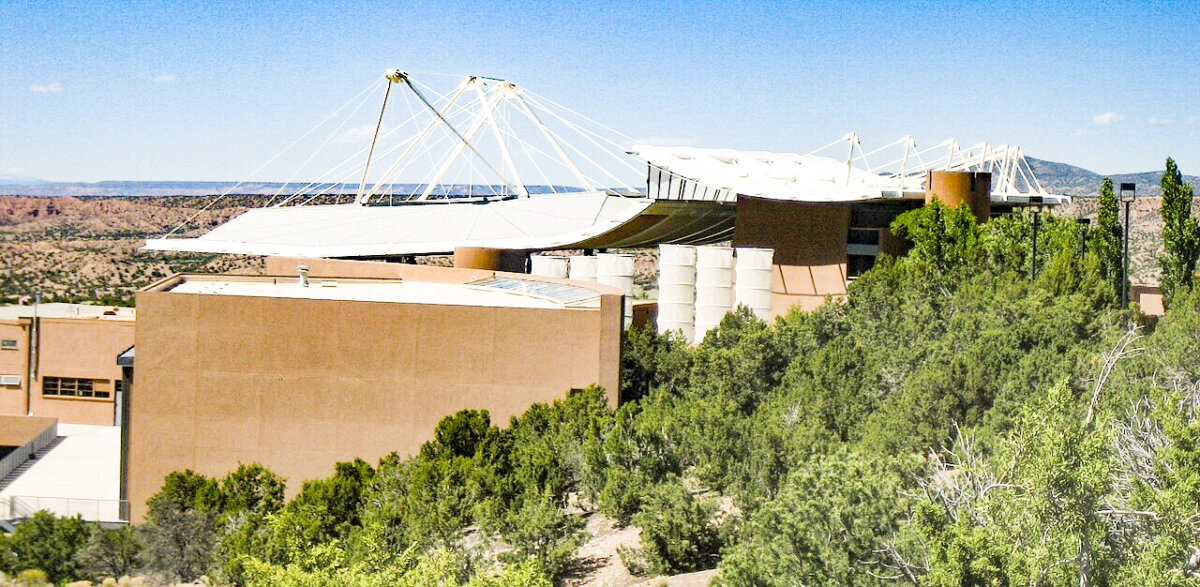
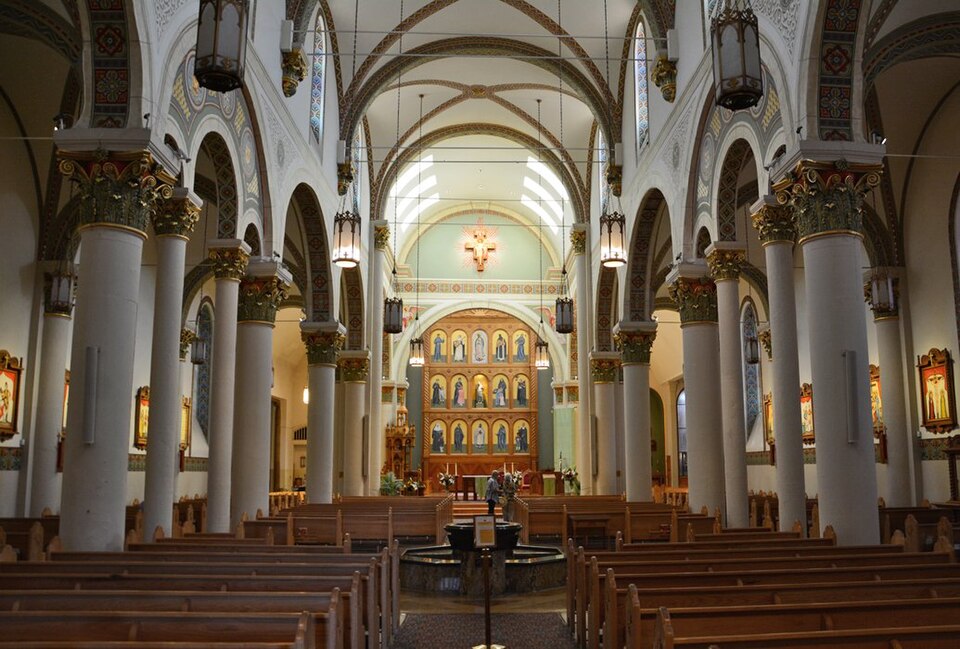
The conductor was John Crosby, whose impossible vision of producing stellar, international-level opera in the middle of the American Southwest was perfectly in keeping with the insanity of Archbishop Jean-Baptiste Lamy, who oversaw the building of a Romanesque Revival-style stone cathedral, complete with a rose window, on a site surrounded by adobe huts. Built between 1869 and 1887, what is now Santa Fe’s Cathedral Basilica of St. Francis of Assisi dominates the central plaza of Santa Fe, just as Crosby’s Santa Fe Opera, nestled in those hills he rode over, leads the pack of summer artistic events.
The small (pop. 89,837) city of Santa Fe, New Mexico, strikes many as the most unlikely spot on the planet for a cultural mecca. Yet here it is: Host to prestigious summer opera and chamber music festivals that attract music lovers from all over the world; home to spiritual traditions of many origins, bringing pilgrims to various sites; surrounded by mountains and clouds that virtually shout the name Georgia O’Keeffe, whose images hang in a museum named after her; Indian and Spanish/Hispanic Contemporary markets that spill over with arts and crafts.
And on a perhaps less elevated but more immediately gratifying level, there is the cuisine. Among other things that distinguish it from Mexican fare per se, New Mexican food exploits the contrast of zesty green Hatch chiles and earthy red chiles. The “huevos divorciados” (literally “divorced eggs”), for instance, serve eggs cradled between the two. Good restaurants are plentiful, so I have only two suggestions: The Shed (SfShed.com) features the original green chile cheeseburger and is served with pozole, a local favorite side dish made of seasoned hominy, while the Plaza Café (PlazaCafeDowntown.com) serves a griddle cake made of two local ingredients: blue corn flour and pinion nuts.
Santa Fe Opera
That land Crosby rode across was a 199-acre dude ranch he purchased with a $200,000 investment from his parents. From the start, the venue was uniquely open to the elements: the back, sides, and a portion of the overhead were uncovered. All but the latter remain so nearly 70 years after the company’s first season in 1957. Too many productions were rained on, so today the overhead is entirely covered.
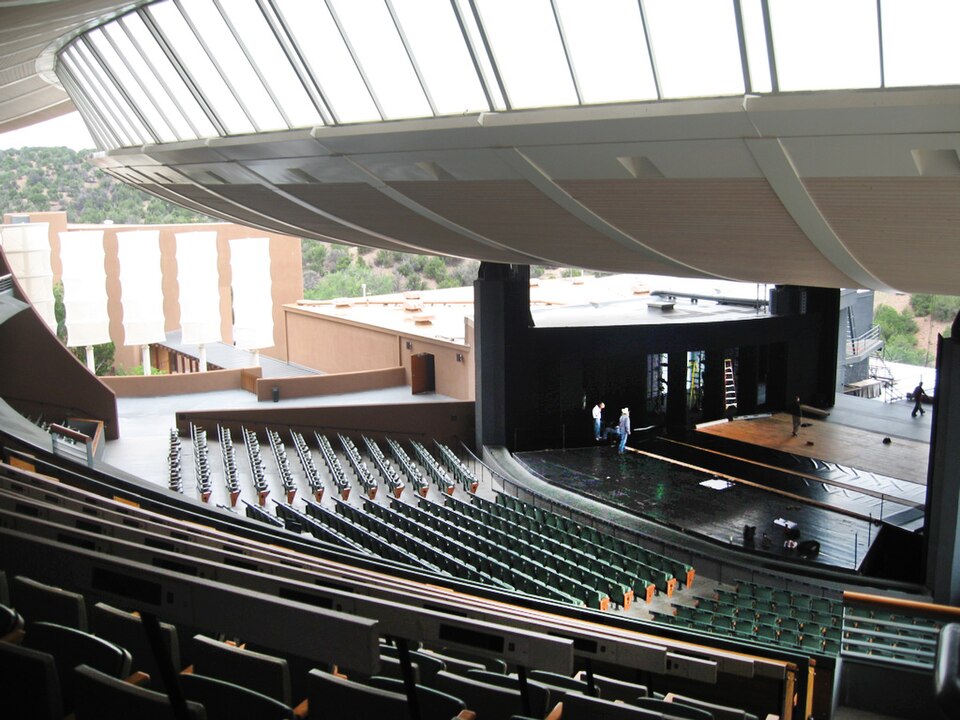
In its first 69 seasons, Santa Fe Opera has staged some 2,000 performances of nearly 200 different operas, from mainstream Italian and German works to world premieres. Crosby was its artistic director and principal conductor until 2000 and established a reputation for producing the works of Richard Strauss. Six Strauss operas were given their American premieres here. Though Strauss has largely faded from the current lineups, the other composer favored by Crosby continues to be represented nearly every season: Mozart’s “The Magic Flute” is on tap this summer, and his “Così fan tutte” is scheduled for next year.
Performances remaining for this year are: Puccini’s “Madama Butterfly” (Aug. 26 and 29), Handel’s “Rodelinda” (Aug. 21), and the American premiere of Tobias Picker’s “Lili Elbe” (Aug. 27). All remaining performances of “Magic Flute” are sold out. Go to SantaFeOpera.org for more information.
Santa Fe Chamber Music Festival
Its first season, the summer of 1973, consisted of six concerts. The great cellist Pablo Casals oversaw it and lent the festival immense prestige. Today, it’s six weeks of concerts featuring the finest available classical musicians from around the world playing a vast and varied repertoire.
On our recent visit, we heard Paul Neubauer, who has done more to lift the status of his instrument, the viola, than any other living master of that instrument. Appointed principal viola of the New York Philharmonic in 1984 at age 21, Neubauer left that position to become that rarest of classical birds, a viola soloist, and has since performed with more than 100 orchestras worldwide. In Santa Fe, he played Schubert’s “Arpeggione” Sonata and joined with four colleagues for Shostakovich’s powerful Piano Quintet.
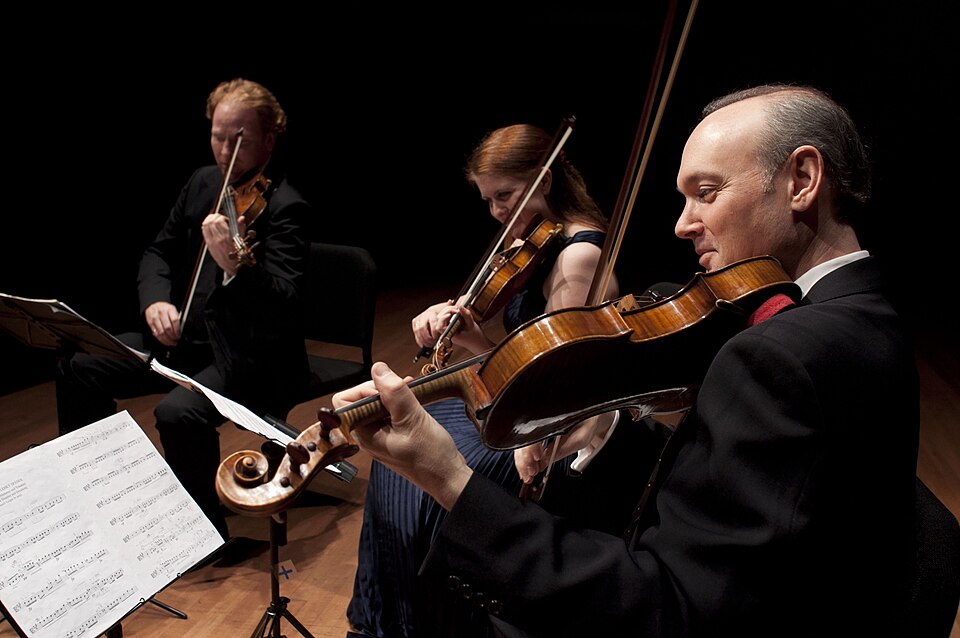
He is one of more than 70 major-league string, wind, percussion, keyboard, and vocal musicians on the roster this summer. Performances continue on various dates through Aug. 24 and feature music by Bach, Mozart, Beethoven, Schubert, Mendelssohn, Rachmaninoff, Brahms, Bartok, and a new work by Magnus Lindberg. For more information, go to SantaFeChamberMusic.org.
Spiritual Culture
The Santa Fe area was known to the Pueblo Indians as a spiritual center long before Europeans discovered it. A number of pueblos near Santa Fe are open to visitors. The pueblo Chimayo, 25 miles to the north, is known as a sacred space. Its healing shrine, credited with many successes, is called the “Lourdes of North America.” Go to HolyChimayo.us to learn more.
St. Francis Cathedral is now officially the Cathedral Basilica of St. Francis of Assisi. It was named a basilica—a cathedral of special historic or artistic importance—in 2005 by Pope Benedict XVI. When studying the façade, notice the triangle over the main archway, representing the Holy Trinity. Inside are the four Hebrew letters we transcribe as YHWH—the Hebrew term for God. What are they doing over the entrance to a Catholic church? It seems that Jewish merchants contributed to the building’s construction, and in return, Lamy had the letters carved in stone.
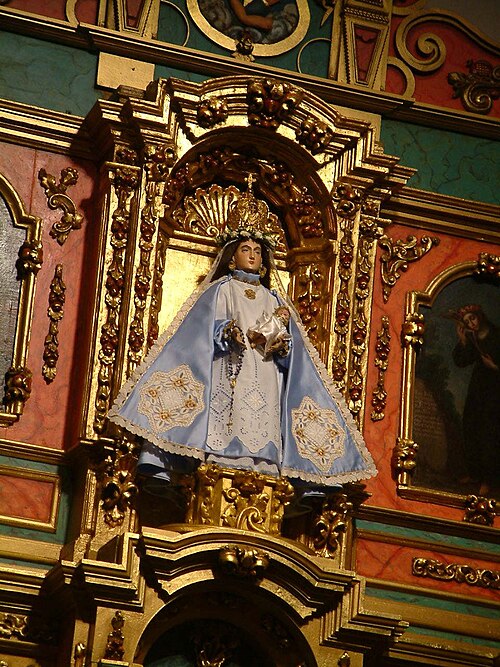
Perhaps the most interesting item at Cathedral Basilica, in addition to many statues of Lamy, St. Francis, and others, is a 30-inch-tall wooden statue of Our Lady known as “La Conquistadora.” Her origins are veiled, but it is thought she was carved in Italy or Spain in the late Renaissance and brought to Santa Fe in the early 1600s. She is the oldest extant representation of St. Mary in North America. Look for her in her own small, flower-enclosed chapel on the building’s south side. Sometimes she holds a baby Jesus, sometimes not. Over the years, she has worn more than 300 different costumes donated by everyone from actress Ali McGraw to an Alaskan Eskimo tribe.
Georgia O’Keeffe
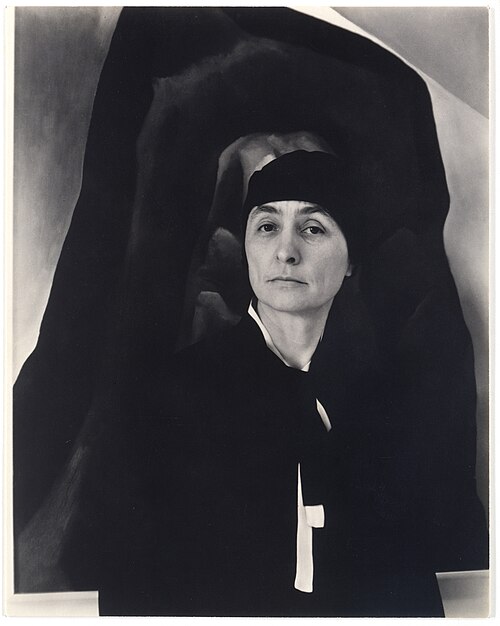
In 1929, Georgia O’Keeffe came from New York to northern New Mexico, specifically Taos, just north of Santa Fe. She saw a unique relationship of color to shape in the landscape and turned it into a famously recognizable style. Santa Fe’s Georgia O’Keeffe Museum contains the largest collection of her work in the world. Other artists from the area are represented here as well.
What is culture?
Santa Fe is also the location of the beloved novel “Death Comes for the Archbishop” by Willa Cather. A fictional retelling of Lamy’s life. In it, the Lamy character observes something about miracles.
Miracles, he says, depend “…upon our perceptions being made finer, so that for a moment our eyes can see, and our ears can hear what is there about us always.”
The same is true of culture, as a few days in Santa Fe will demonstrate.