



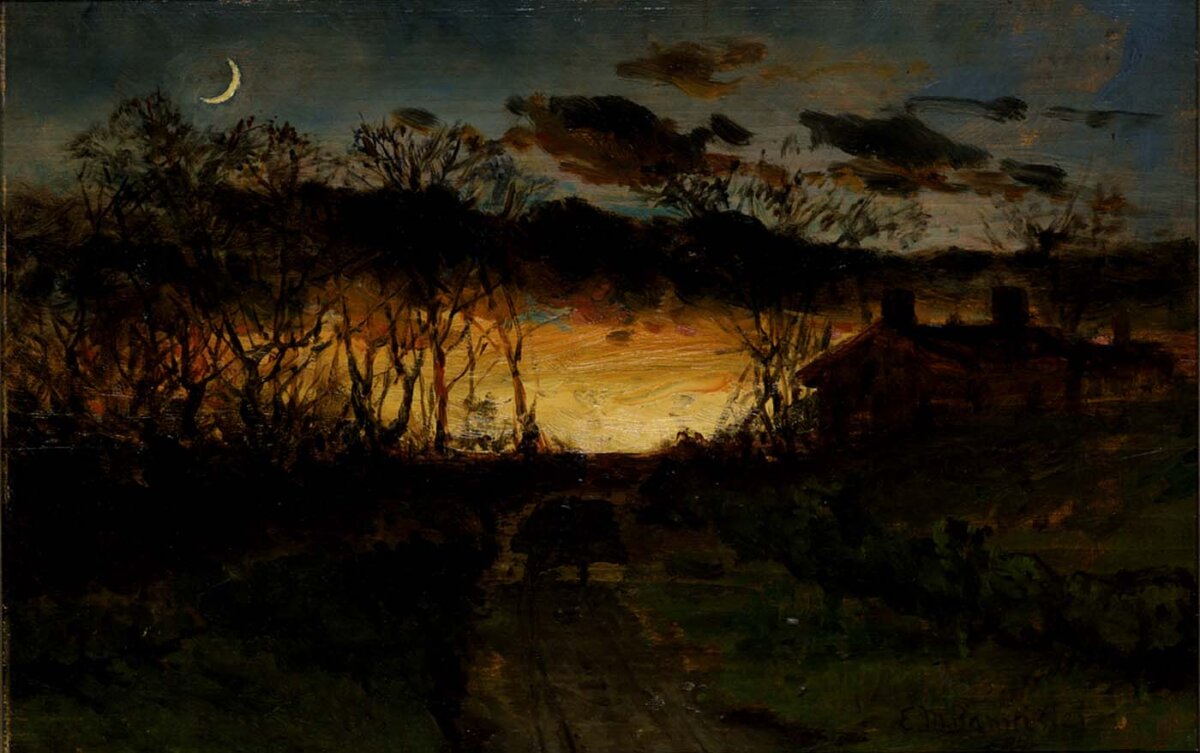
I awoke in the Midsummer not-to-call night, in the white and the walk of the morning:
The moon, dwindled and thinned to the fringe of a finger-nail held to the candle,
Or paring of paradisaïcal fruit, lovely in waning but lustreless,
Stepped from the stool, drew back from the barrow, of dark Maenefa the mountain;
A cusp still clasped him, a fluke yet fanged him, entangled him, not quit utterly.
This was the prized, the desirable sight, unsought, presented so easily,
Parted me leaf and leaf, divided me, eyelid and eyelid of slumber.
When Victorian poet Gerard Manley Hopkins (1844–1889) converted to Catholicism at age 24, he believed poetry and piety were incompatible, and he decided he to burn his poetry. He feared that writing poetry stemmed from vanity and would keep him from wholly devoting himself to God.
However, when several years later he entered the seminary to become a Jesuit priest, he realized that writing poetry did not conflict with his faith. On the contrary, poetry was a means of giving greater glory to God and of illuminating the work of grace in the world.
When at age 30, Hopkins began his priestly formation at St. Beuno’s College in Wales in 1874, he resumed writing poetry. During his time there, he wrote 11 sonnets, including some of his most famous works, such as “Pied Beauty,” “God’s Grandeur,” and “The Windhover.”
He also wrote several other poems, including a mystifying short poem called “Moonrise.” It’s unknown whether it was an abandoned fragment or a complete, short poem. “Moonrise,” a lesser-known work, is distinctive among Hopkins’s poems yet illustrates the same faith that pervades his other poetry.
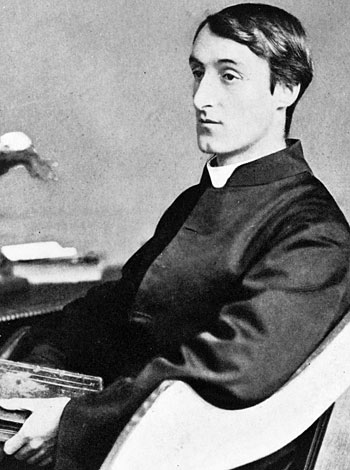 Gerard Manley Hopkins was an English poet, Roman Catholic convert, and Jesuit priest. (Public Domain)
An Unconventional Mystique
Though the poem lacks a rhyme scheme, it is filled with alliteration and assonance (repetition of vowel sounds) that link the words together. The repetition of the short “i” and “n” sounds in the second line (“dwindled,” “thinned,” “fringe,” “finger-nail”) creates a closed, thin sound that mirrors the scarcely perceptible moon. The same repetition occurs in the fourth line (“fluke,” “fanged,” “entangled”): the repeated consonant sounds make the line halting and difficult to recite, mirroring the spiritual and literal darkness that Hopkins describes. The interplay between the words’ sounds embodies their meaning, so that we not only see the scene in our mind’s eye but also feel immersed in it.
The speaker awakens in the time between night and dawn, a delicate balance echoed in the waning moon. Hopkins likens the moon to the edge of a fingernail, which is a reverse metaphor because the moon-shaped, pale base of a nail is called a “lunula,” or little moon. His second image for the moon is of a thin slice of “paradisaïcal fruit,” which is likely a reference to the fruit in the Garden of Eden.
 The moonlight is minimal, like the edge of a fingernail backlight by candlelight. (Sherlock808/CC BY-SA 4.0)
Maenefa is the hill directly above St. Beuno’s. As Hopkins mentions, the remains of two Bronze Age barrows, or burial mounds, lie on its slopes. The hill’s name means “Rock of Eve,” strengthening the poem’s link to the Garden of Eden.
Hopkins reemphasizes the poem’s fragile balance: As the speaker is caught in an hour that seems neither night nor day, the moon is caught on its walk and now seems fixed, as though it was caught upon the mountain. The moon hangs only by a cusp (the horn of a crescent moon) or by a fluke (the barb of an anchor). Hopkins uses the word “fanged,” which means “caught” or “held” in Old English.
Grace, Illuminated
Hopkins often used night in his poetry as a metaphor for spiritual darkness. The moon is an unexpected but “desirable sight” amid the darkness. It is “lovely in waning” even though it is “lustreless.” Perhaps this is an opportunity to encounter the Creator through the beauty of his creation even in a fallen, dark world. A sliver of beauty offers the chance to return to the relationship with God that man enjoyed in the Garden of Eden, a small glimpse of what man is created to fully enjoy one day in Heaven. The speaker, like the moon, has not yet “quit utterly” the darkness of the world, but God still encounters him there, waiting to pour grace into the soul.
In the final line, Hopkins uses repetition in “eye from eye” and “leaf from leaf” to depict how the moon cleaves the soul. In this context, “leaf from leaf” may refer to the pages of a book. As the speaker’s eyes are opened to the moon, his mind is also opened and renewed by its beauty. To close on this note, whether intentional or not, is quite beautiful as it reflects how the speaker has arrived at the extent of what is in man’s power to do, namely to remain open to the inpouring of God’s grace.
Nothing remains for the speaker to say or do; his part has been minimal throughout the entire poem. Aside from waking, he is entirely passive, acted upon by the moon. Though the moon is scarcely visible, it is enough to work dramatic change upon the speaker. He seems awakened from a second sleep, “parted” and “divided” from a spiritual slumber. His sight is returned to him.
 Moel Maenefa, the Welsh mountain that provided a setting for Hopkins’s poem. (Chris Heaton/CC BY-SA 2.0)
Through this channel of grace, this unexpected encounter with beauty, the speaker’s soul is startled from its slumber and elevated in wonder. The speaker sees God present in his creation and is transformed as he is opened to the outpouring of grace.
Hopkins shows that one does not require a dramatic occasion or overawing beauty to encounter God. The speaker meets him in a still, small voice, a faint crescent moon hung in the fragile balance between night and morning. The speaker has only to watch and be open to God’s work. He is presented, through no effort on his part, with what he didn’t even know he fervently desired. He is brought back from spiritual death in the barrows to a foretaste of the paradise that man lost, a paradise to which God ever draws humankind back.
What arts and culture topics would you like us to cover? Please email ideas or feedback to features@epochtimes.nyc.
