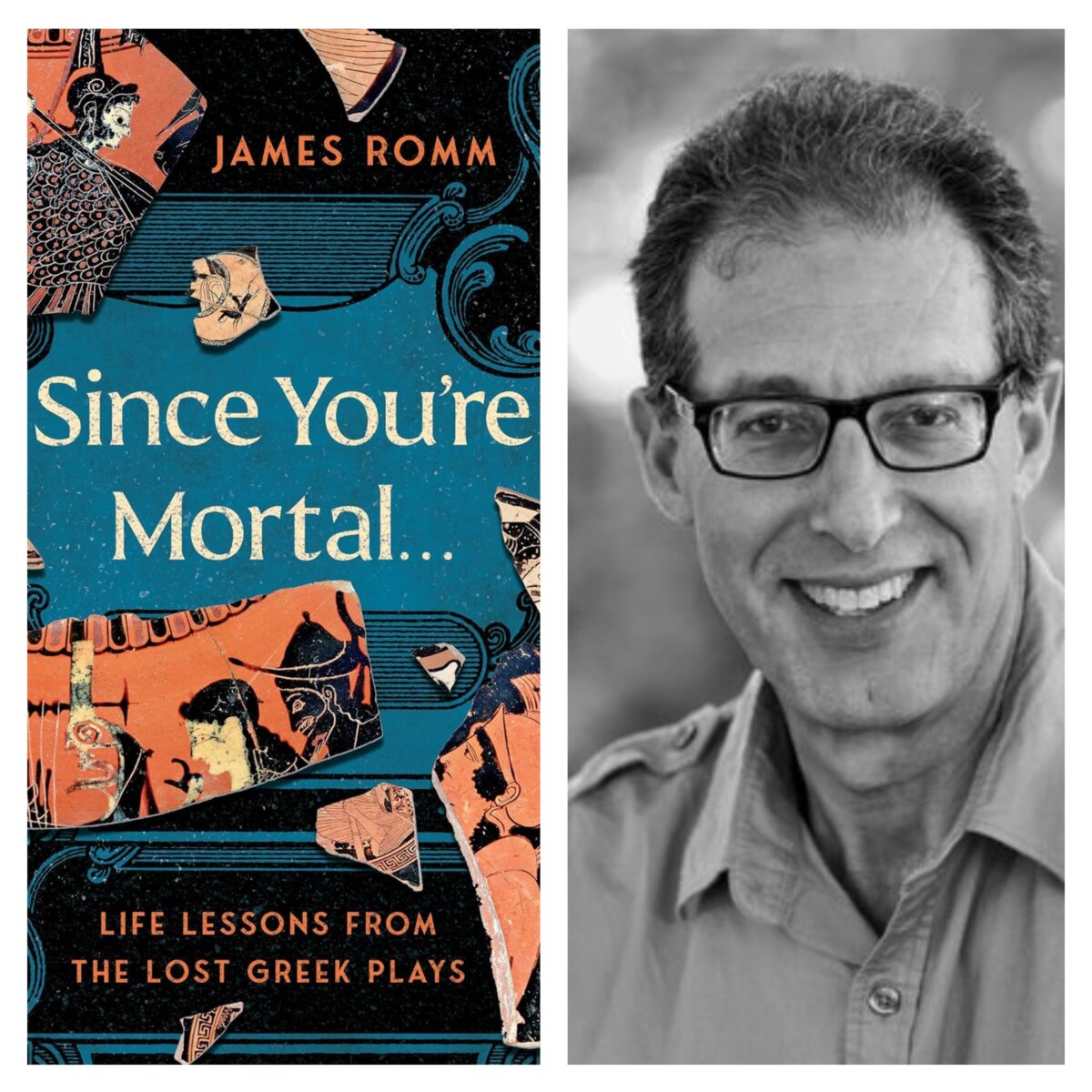
There is a line of wisdom in the Bible’s Book of Proverbs that states, “A word fitly spoken is like apples of gold in pictures of silver.” There is hardly anything more powerful or more beautiful than a great line, whether it be a proverb, a line of poetry, or a dramatist’s monologue. James Romm’s new book, “Since You’re Mortal … : Life Lessons from the Lost Greek Plays,” gifts the reader these textual forms in all their beauty and wisdom.
As mentioned in one of the recent editions of “The Reissue,” in which I discuss newly edited or translated classic works with the editors or translators, over the millennia, most ancient works—whether plays, philosophies, or works of history—have been lost to us. Papyrus was hardly a format capable of enduring the elements over thousands of years. As Romm notes in his Introduction, “copyists working in libraries and monasteries (during the 5th century) were switching over from the perishable papyrus scrolls to more durable books with leaves made of vellum. … The expensive new medium forced them to be selective in choosing what texts to write out.”
Choosing the Best
Much was lost, but thankfully, the efforts of a caring Roman father, Stobaeus, salvaged “hundreds of thousands of quoted words, including long philosophical musings” to gift his son a book of wisdom. This labor of love ultimately became a work for posterity. Romm, the James H. Ottoway Jr. professor of classics at Bard College, chose “a small percentage”—what he calls “the best of the best”—to be printed in this short work. In fact, “Since You’re Mortal …” is the first volume of these ancient Greek fragments to be translated into an English volume.
Romm has chosen more than 300 lines, proverbs, and brief monologues from the likes of Aeschylus, Menander, and Philemon. There are many attributed to Anonymous, and for those whose lines translators and philologists are uncertain about, Romm has cited them under the heading of Monostichs, which are poems consisting of a single line. These 300-plus complete lines, sourced from ancient fragments, are grouped into 14 thematic categories, which include love, friendship, luck, politics, old age, and dying.
Timeless Relevance
For those unacquainted with the works of the ancients, it may be surprising how relevant these observations about the human condition are. They indeed could pass for contemporary observations.
Many of these proverbs are pulled from Greek plays that did not survive fully intact. In fact, Romm made a point of not including anything from intact Greek plays. These proverbs range from the serious to the humorous (including dark humor) to the morbid, like “Ignorance is a misfortune we bring on ourselves” (Menander), “Never think anyone lucky until they are dead” (Monostich), or “You must fear age; it does not arrive alone” (Menander).
Some lines speak to our current social and political conditions, like “The thing that’s believed has mastery over what’s true” (Sophocles) or “The great beginning of all human woes is good things that are too good” (Alexis).
Wisdom for All
Whatever one may be looking for when it comes to wisdom or insight into the human condition, it can likely be found in this small book of quotable quotes. As Romm states in his Introduction, “Since we’re mortal, we have much to learn, as Stobaeus knew, from the playwrights of ancient Greece, whose understanding of the mortal condition has stood the test of millennia.”
“Since You’re Mortal …” is a fine book, beautifully crafted and illustrated (by Markley Boyer). It is a book for anyone in any stage of life, but would certainly be appropriate for the purpose that Stobaeus originally had in mind. Younger generations would benefit from this book, not simply because of the wisdom it possesses, but also because of the timelessness of its ideas: It implies that as times change, the human condition does not. At any rate, one can never discount the power of “a word fitly spoken”—even if spoken thousands of years before.
‘Since You’re Mortal … ‘
By James Romm
W.W. Norton & Company: May 5, 2026
Hardcover, 176 pages
What arts and culture topics would you like us to cover? Please email ideas or feedback to features@epochtimes.nyc.