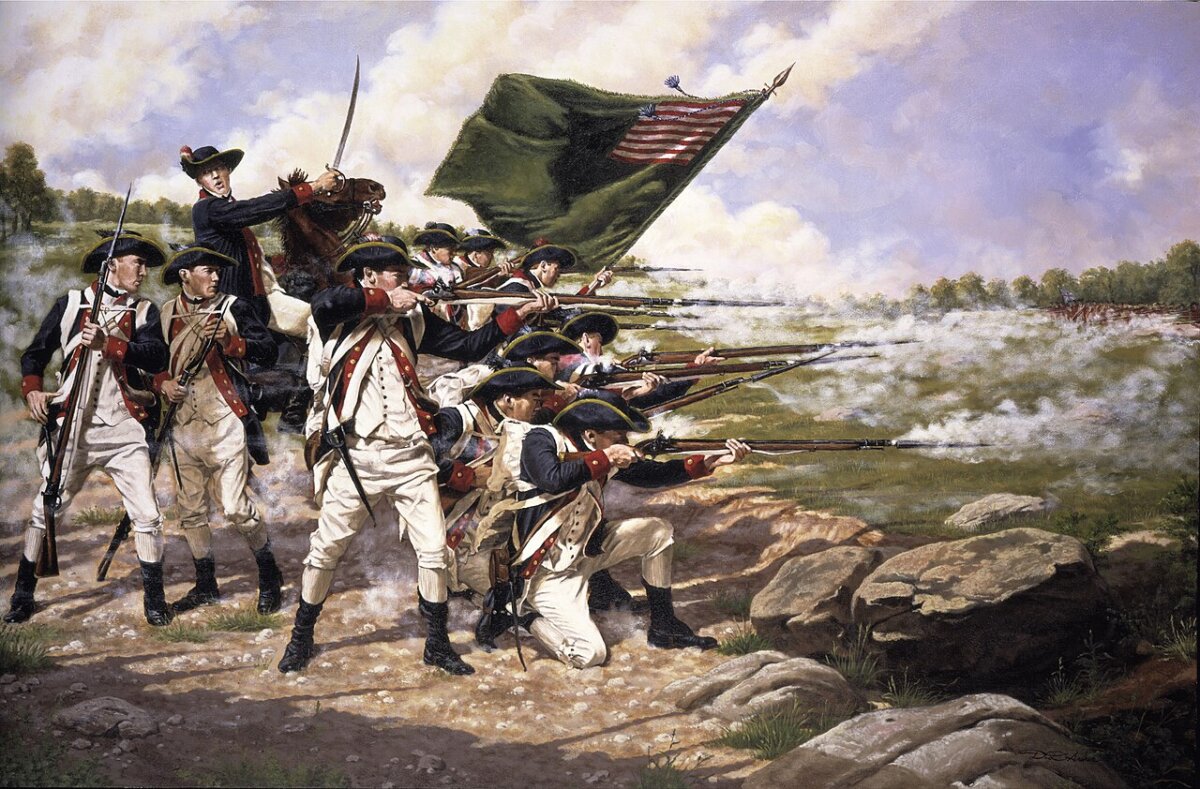
As commander in chief of the Continental Army, Gen. George Washington was responsible for defending the newly declared United States. In the summer of 1776, such a burden would have crushed an ordinary man.
Throughout July and August, Washington and his staff watched from their New York City headquarters as hundreds of enemy ships delivered over 32,000 professional soldiers and auxiliaries from Great Britain and Hesse-Kassel to Staten Island for one purpose: to extinguish American independence and restore British rule over the colonies. Most historians agree that Britain had assembled the largest overseas expeditionary force in its history—a record that stood until World War I.
Washington used the time to strengthen defenses on Manhattan and Long Island for the inevitable showdown.
When the British finally struck on the morning of Aug. 27, the Americans were routed. By nightfall, Washington, many of his best officers, and more than 9,000 soldiers were trapped on the Brooklyn Heights peninsula. With their backs to the East River and Britain’s Royal Navy controlling the surrounding waters, the core of the Continental Army faced annihilation.
A disaster of this magnitude could have forced the nation’s surrender and the end of the American Revolution.
But Washington was not an ordinary man, and he was about to receive help from an unlikely source.
War or Peace?
Following the British Army’s evacuation from Boston on March 17, 1776, Washington knew the British would return and correctly predicted that New York City, for its vital port and strategic position, would be their next target.
Gen. Charles Lee was dispatched to survey the city and recommend measures for its defense. He assessed the Royal Navy’s ability to encircle Manhattan, leaving the 13.4-mile island vulnerable to bombardment and invasion. He concluded that it was “impossible to make it defensible,” adding, “Whoever commands the sea must command the town.”
Lee recommended transforming Manhattan into a costly conquest so that Britain “shall pay a very dear price for it.”
The Continental Congress nevertheless ordered Washington to fortify and defend the city. But he faced a logistical nightmare. Of the roughly 19,000 troops available to defend the New York area, about half were inexperienced militiamen. Thousands more were unfit for duty, suffering from dysentery, smallpox, and other diseases.
Adding to Washington’s difficulties, Loyalists outnumbered Patriots in much of Manhattan and the surrounding areas.
Despite these issues, Washington arrived in the city on April 13 and began implementing Lee’s recommendations. Among them was placing Gen. Nathanael Greene in charge of fortifying Brooklyn Heights across the East River to protect his left flank.
On June 29, the first elements of the massive British fleet arrived off New York. Over the following weeks, thousands of British and Hessian soldiers disembarked on Staten Island, which became Britain’s base of operations.
Leading this invasion force were Gen. William Howe and his brother, Adm. Lord Richard Howe. Both retained affection for Americans, who had honored their brother, Lord George Augustus Howe, after his death during the French and Indian War, and hoped to resolve the conflict peacefully.
Duty, however, compelled the brothers to reassert British control over the colonies. Recognizing their desire for reconciliation, the British government also appointed them as peace commissioners.
Lord Howe attempted to initiate peace talks on July 14, but disputes over letters addressed to “George Washington, Esq.”—purposely omitting his military rank—delayed the talks for days.
Finally, on July 20, Lord Howe’s adjutant general, Lt. Col. James Paterson, met with Washington and his officers and explained the Howes’ authority to grant pardons to those who laid down their arms and submitted to British authority. Washington rejected the premise, stating, “Those who have committed no fault want no pardon.” The meeting ended with no resolution, leaving war all but inevitable.
Final Preparations
On Aug. 1, Gen. Henry Clinton and Gen. Charles Cornwallis arrived after their failed campaign in South Carolina, further strengthening Howe’s invasion force.
On Aug. 22, British and Hessian forces landed at Gravesend Bay on Long Island. Washington was uncertain whether the landing was a diversion intended to draw his forces away from Manhattan.
Days earlier, Greene had fallen seriously ill and relinquished command of the Long Island defenses. Gen. John Sullivan temporarily assumed command before Gen. Israel Putnam was placed in overall command.
Continental forces established defensive positions along a string of wooded hills located between Brooklyn Heights and Gravesend Bay. Gen. William Alexander, better known as Lord Stirling, commanded the Continental right flank near the East River. Sullivan commanded the center, covering the Flatbush and Bedford passes. Col. Samuel Miles guarded the left flank between the Bedford and Jamaica passes.
The British Flank Attack
All was ready on the night of Aug. 26.
Around 9 p.m., a British attack force of 10,000 redcoats—led by Howe, Clinton, Cornwallis, and Lord Hugh Percy, and guided by three Loyalist farmers—began marching eastward in total silence. They planned to swing around the Continental left flank, then head west undetected along Jamaica Road and position themselves directly behind the Continental lines before launching a surprise attack.
As part of the plan, British Gen. James Grant and Hessian Gen. Leopold Philip von Heister were to conduct diversionary frontal attacks against the Continental lines, drawing attention away from Howe’s massive flanking column.
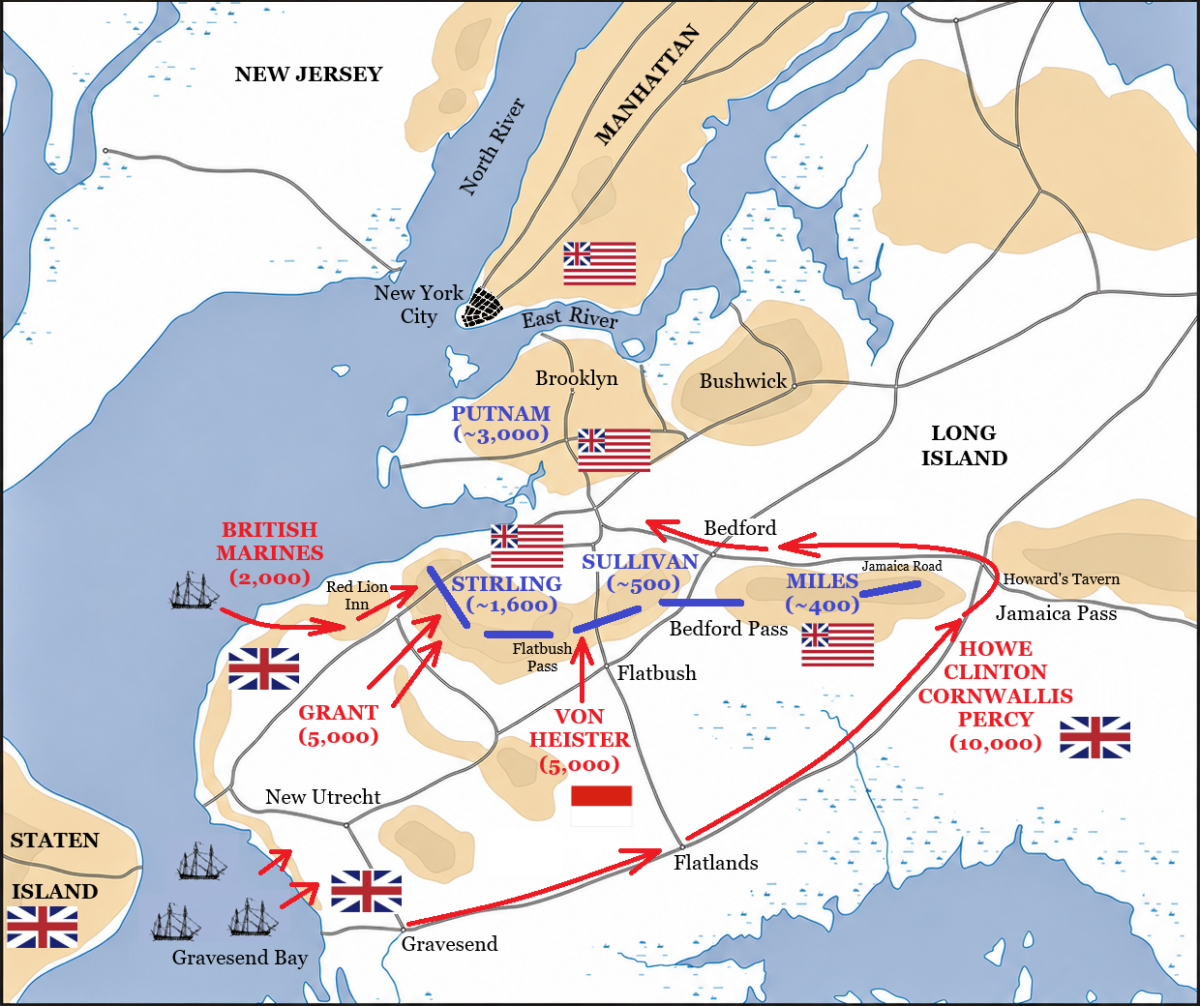
At 11 p.m., Grant began moving 5,000 redcoats toward Stirling’s position. Von Heister and his 5,000 Hessians remained stationary opposite Sullivan’s lines.
The Battle of Long Island officially began after midnight as Continental pickets exchanged gunfire with Grant’s redcoats near the Red Lion Inn. The pickets resisted briefly before being driven back.
Stirling arrived with reinforcements and checked Grant’s advance. By morning, Hessian artillery began pounding Sullivan’s lines.
From Manhattan, Washington ordered additional troops across the East River before crossing with Adjutant Gen. Joseph Reed to observe the battle himself.
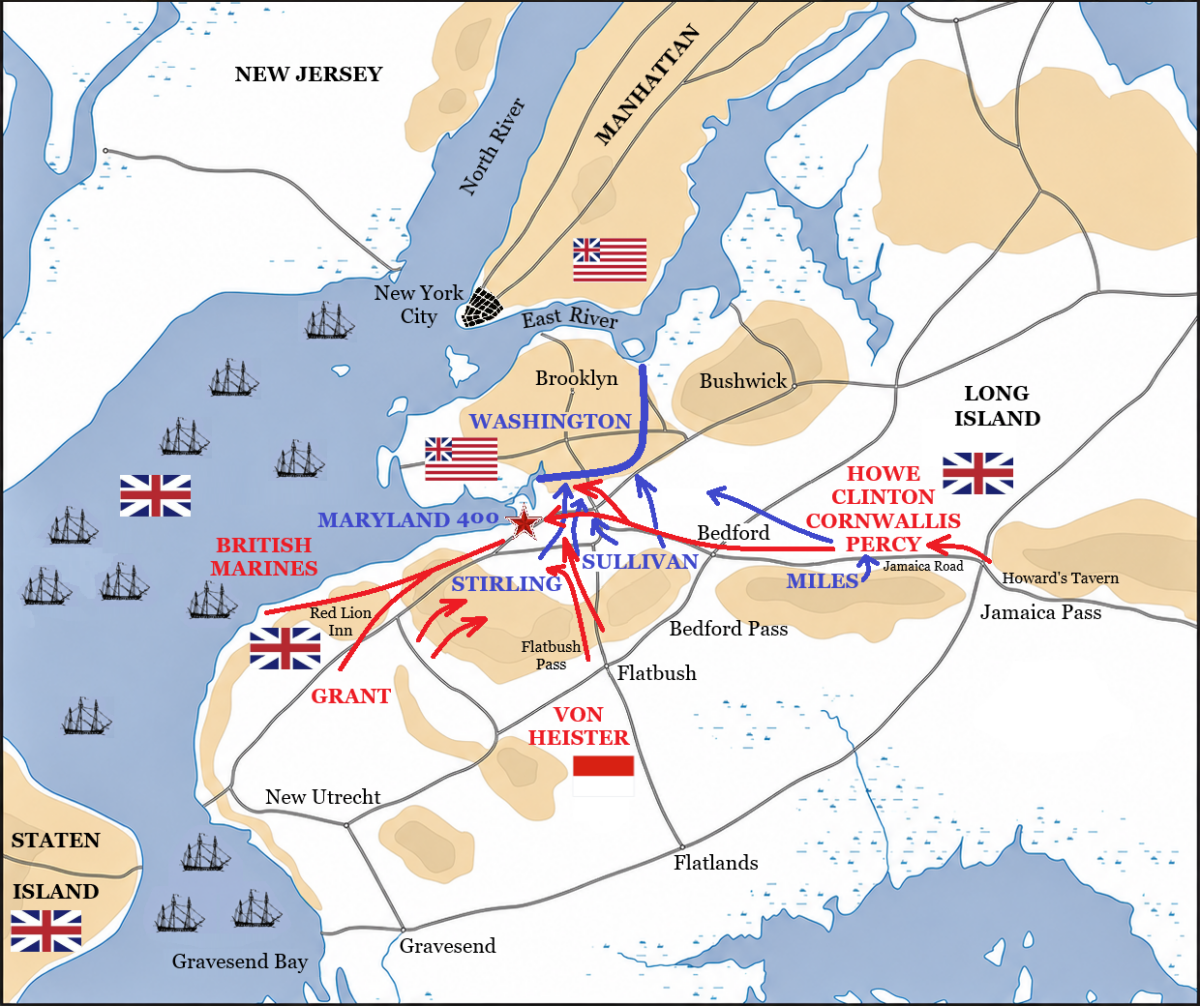
Howe’s flanking column secured its position behind the Continental lines. At 9 a.m., a cannon blast signaled the attack.
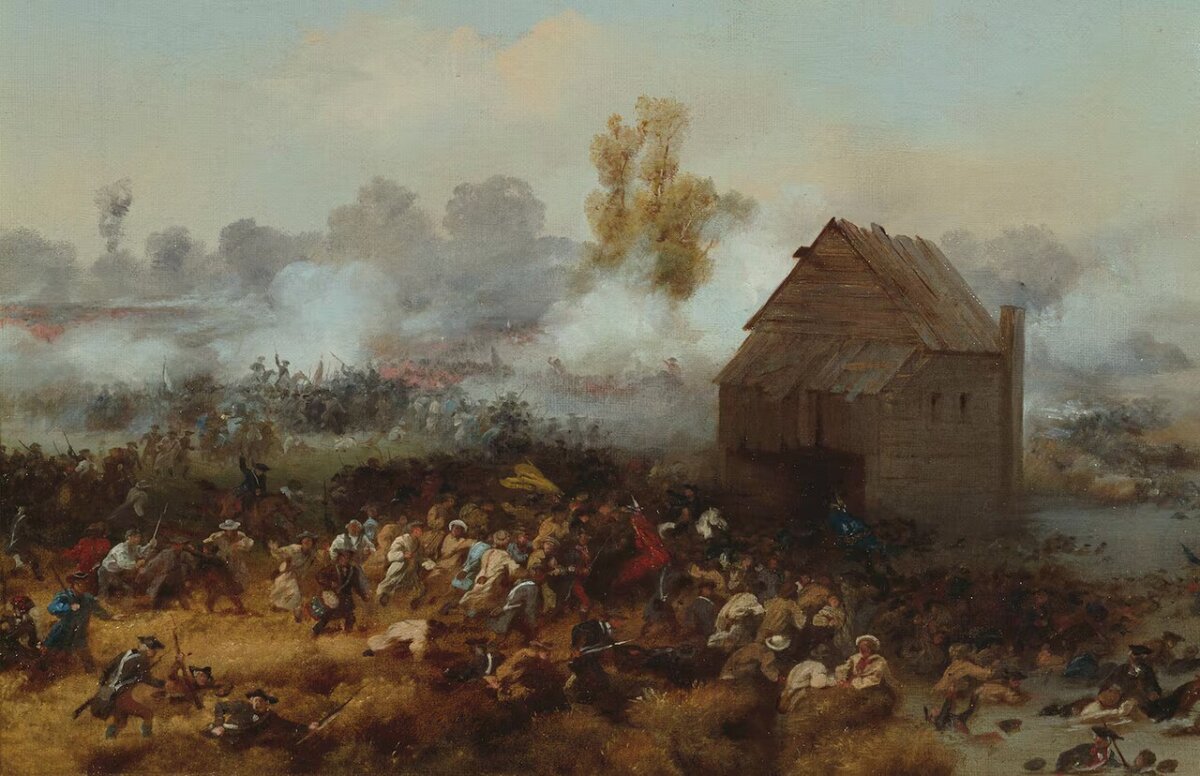
To the south, von Heister’s Hessians heard the signal and launched their frontal assault with a bayonet charge, quickly trapping Sullivan’s men. Savage hand-to-hand combat ensued. Continental lines collapsed under attacks from multiple directions, leading to chaotic retreats. Sullivan and Miles were both captured.
Stirling’s force fought valiantly, but by 11 a.m., Hessians, redcoats, and 2,000 British marines were closing in from all sides.
Recognizing the peril, Stirling ordered most of his men to retreat. He, Maj. Mordecai Gist and several companies of the 1st Maryland Regiment remained behind to cover their withdrawal. Washington observed from a nearby redoubt as the “Maryland 400” repeatedly attacked the much larger force, exclaiming, “Good God, what brave fellows I must this day lose!” The regiment suffered devastating casualties, and Stirling was taken prisoner.
Trapped
By nightfall on Aug. 27, more than 9,000 Americans were trapped in Brooklyn Heights. Washington now confronted one of the most consequential decisions of his life. If the British breached the defenses or moved warships into the East River, the core of the Continental Army faced total destruction. Such a disaster would likely end the war.
Heavy rains the next day forced a lull in the fighting.
At 4 p.m. on Aug. 29, Washington convened a council of war. The decision was unanimous: abandon Long Island. Washington entrusted Col. John Glover and his Marbleheads to lead the evacuation.
Troops quietly gathered equipment and packed up gear. Gen. Thomas Mifflin’s rear guard kept campfires burning and manned trenches to trick the enemy into believing the Americans would stay and fight.
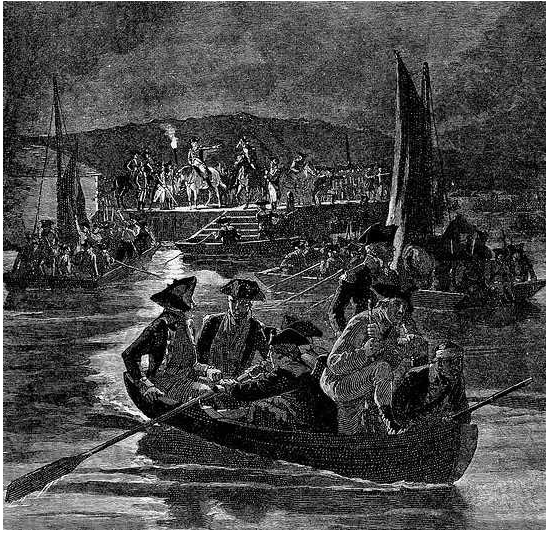
By 11 p.m., the evacuation was underway. Glover’s men ferried soldiers, horses, equipment, and artillery across the river to Manhattan. But the operation proceeded slowly. By dawn, less than half had escaped. The discovery of the evacuation could trigger an immediate British attack.
Then a dense fog rolled in, blanketing Brooklyn Heights and the East River and obscuring the Americans’ activity. Under its cover, the evacuation continued.
The deception worked. Mifflin’s rear guard quietly withdrew from the trenches and boarded the boats. By 7 a.m., the evacuation was complete. Witnesses noted Washington was among the last to depart.
Once the last boats were away, the fog lifted, and redcoats were seen rushing toward the shore. The hunters missed the hunted by mere minutes.
Aftermath
Britain won a decisive victory at the Battle of Long Island at the cost of 64 killed, 293 wounded, and 31 missing or captured. American losses were more staggering: 300 dead, 650 to 800 wounded, and up to 1,100 captured.
Washington, however, refused to quit. He denied the British the victory that mattered most—the destruction of his army.
With help from Glover’s Marbleheads and divine providence—which contemporaries credited with providing the fog—Washington’s army lived to fight another day.
Like the Allied evacuation from Dunkirk more than 160 years later, the retreat transformed what might have been a catastrophic military defeat into a desperate escape that preserved the army.
This proved critical. The fight for New York, and the war itself, was far from over.
What arts and culture topics would you like us to cover? Please email ideas or feedback to features@epochtimes.nyc.