In June of this year, a group called “Mission Marge” traveled deep into the tangled jungles of Papua New Guinea to recover a battered piece of metal. It was the wingtip of a WWII P-38 fighter plane called “Marge.”
Why so much trouble to recover part of a wreckage that’s 82 years old?
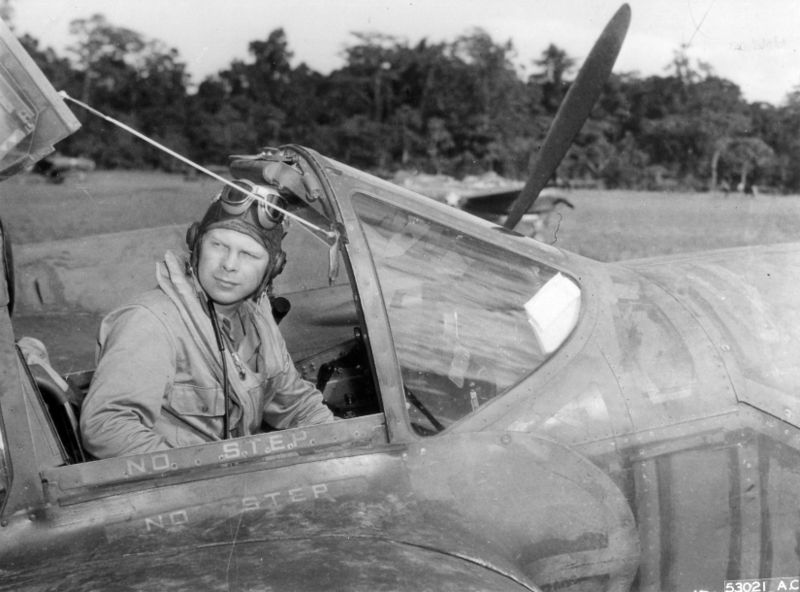
The fighter in question had belonged to Richard Bong, the “Ace of Aces,” who shot down more enemy aircraft than any other American pilot in history. He racked up 400 combat hours on 146 combat missions (instead of the standard 25 to 35 missions) and achieved 40 confirmed victories over enemy pilots.
The rusty, mangled piece of metal, embedded in the dense, hazy undergrowth of the jungle, is a kind of relic—a symbol of the incredible achievements of this unassuming 5’6″ blond-haired, blue-eyed boy from Wisconsin.
Wisconsin Boy
Richard Bong was born in Superior, Wisconsin, in 1920 to Carl and Dora Bong. His father had immigrated to the United States from Sweden over 20 years earlier. Richard was the eldest of the nine Bong children, raised on the family farm.
The flying fever took hold of Bong at a young age. When he was just 7 years old, he witnessed an Army plane carrying mail fly over the Bong farm every day during President Calvin Coolidge’s hunting and fishing vacation near Superior. Bong knew that some day he wanted to climb into the sky like that.
As a child and young man, he was well-behaved and belonged to a respectable family. Gen. George Kenney wrote in his biography of Bong: “He didn’t smoke or drink. … The only times he ever seemed to have worried his family was when he got his hands on the steering wheel of a car or a truck. He kept both in excellent shape, but when he drove either of them, he liked to push the foot throttle all the way to the floor.”
Earning His Wings
Bong graduated from Superior Central High School before attending Superior State Teachers College, where he enrolled in the Civilian Pilot Training Program. His enthusiasm for flying eventually led him to join the Army Air Corps as a flying cadet in May 1941. He graduated from flight school in January 1942, having already shown potential as a pilot.
However, his dream was deferred—because of his skill, he was kept on as a flight instructor longer than he wanted. But he made good use of the time to hone his skills even further.
Thus, when he was assigned to the 49th Fighter Squadron, 14th Fighter Group at Hamilton Field, California, he had become an exceptional pilot. His dream to join aerial combat was nearly derailed when Bong broke the rules by buzzing the house of a fellow pilot who had just been married. Some accounts, which Bong later denied, also say that he looped around the Golden Gate Bridge and flew down Market Street in San Francisco. He received a severe reprimand from Gen. Kenney for these antics, and even threats of court-martial or dismissal.
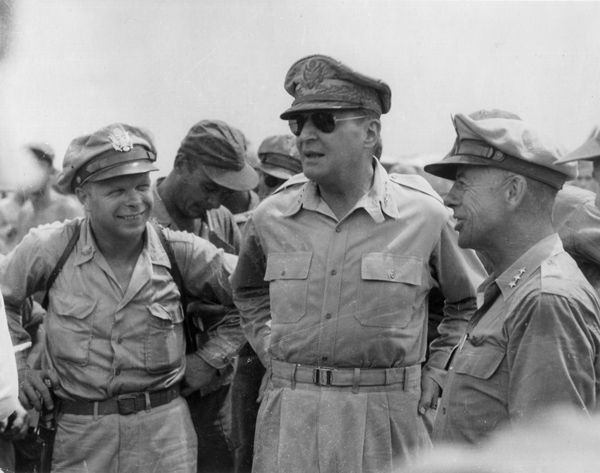
Despite the reprimand, Gen. Kenney was impressed. He recalled telling the young pilot, “If you didn’t want to loop around that bridge or fly down Market Street, I wouldn’t have you in my Air Force, but you are not going to do it any more, and I mean what I say.” He also commanded Bong to go assist a woman whose laundry Bong’s airplane had blown off the clothesline.
Gen. Kenney recognized that, despite the rule-breaking, Bong had spirit, and that’s what he wanted in his pilots, so he let him off easy.
He also recalled Bong’s unimposing appearance as “one of the nicest-looking cherubs you ever saw in your life. I suspected that he was not over twenty and maybe even younger. I doubted if he was old enough to shave. He was just a little blond-haired Swedish boy about five feet six, with a round, pink baby face and the bluest, most innocent eyes.”
Entering the Pacific War
When Gen. Kenney was assigned the task of commanding American aerial operations in the South-West Pacific Area (SWPA), he handpicked Bong to be one of his pilots.
In the early stages of the war, Allied airmen in that theater were outnumbered at least two to one. Gen. Kenney recalled, “It reminded us of the early days back in World War I when we first met superior numbers of German aviators in France.”
Bong’s first victory came on Dec. 27, 1942, over Dobodura in a dogfight during which he shot down both a fighter and a bomber. As a whole, the squadron took down 15 out of the 24 enemy planes in that engagement while sustaining no losses themselves. The newly developed P-38—with its high speed, long-range power, and strong high-altitude performance—assisted in the successes.
Bong went on from victory to victory, steadily stacking up the number of downed enemies. He flew as close as he could to enemy craft to ensure he wouldn’t miss. At one point, he shot down four enemy fighters in a single fight.
He also put himself on the line for his fellow pilots. In one episode, he rescued a comrade whose crippled P-38 was flying on only one of its two engines, with a Japanese fighter screaming after it in hot pursuit. Bong dove into action, cutting in behind his crippled comrade to draw enemy fire. He then cut power to one of his engines to make it look like he, too, was flying on only one engine. He executed some aerial acrobatics to keep the enemy fighter guessing, then, when his comrade had reached the safety of cloud cover, he rocketed out of range of the slower Japanese fighter.
Bong barely managed to make it back to base, however, due to the damage his craft sustained in the fight. He crash-landed on the airstrip, and when the wrecked plane was examined, it was considered a miracle Bong had brought it back at all. It was studded and spattered with bullet holes in the fuselage, wings, and armor plate behind the cockpit. Both main fuel tanks had been punctured.
Great Pilot, Great Man
Despite these incredible feats, Bong always maintained a modest demeanor. He even insisted on “giving away” victories to his wingmen. At one point, one of Bong’s wingmen came to Gen. Kenney complaining that Bong wasn’t claiming as many victories as he should be, instead certifying them for his wingmen. Oftentimes, Bong would take out an enemy aircraft, then tell his wingman to “finish him off,” even though the plane was already spiraling out of the sky in a pillar of smoke and flame, and then Bong would ensure that the wingman took credit for the hit. Gen. Kenney recalled, “I still am certain that Dick certified at least one victory to his wingmen for every two that he reported for himself.”
When Bong received a well-earned leave to return home in 1943, he continued to dismiss all the praise and admiration with the simple words, “Oh, I’m just lucky I guess. A lot of Japanese happen to get in my way. And I keep shooting plenty of lead and finally some of them get hit.”
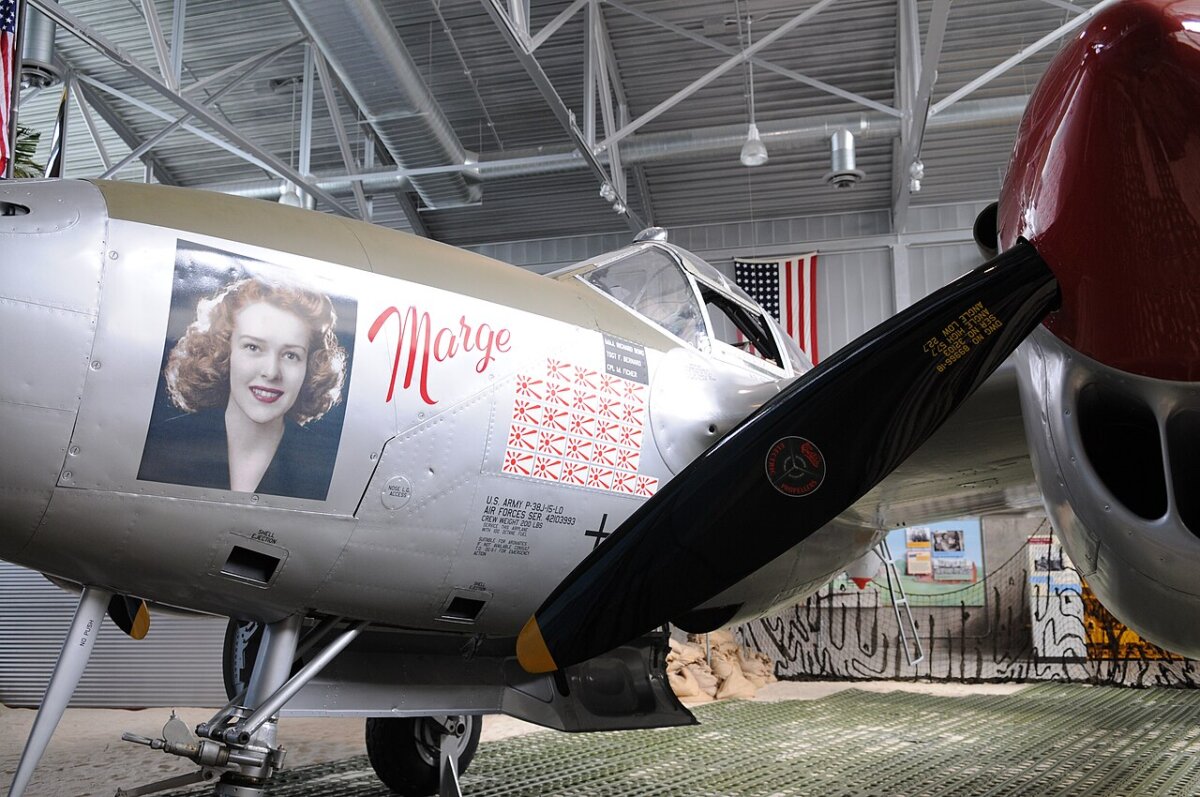
It was also during this leave that he met and fell in love with Marjorie Ann Vattendahl. When he returned to the Southwest Pacific in 1944, he had a photograph of Vattendahl enlarged and placed on the nose of his plane, which he nicknamed “Marge.” Later that year, another pilot was flying “Marge” when its propeller and electrical system failed—the pilot had to bail, and the craft descended into the jungle canopy, where it remained until it was first discovered by “Mission Marge” in 2024.
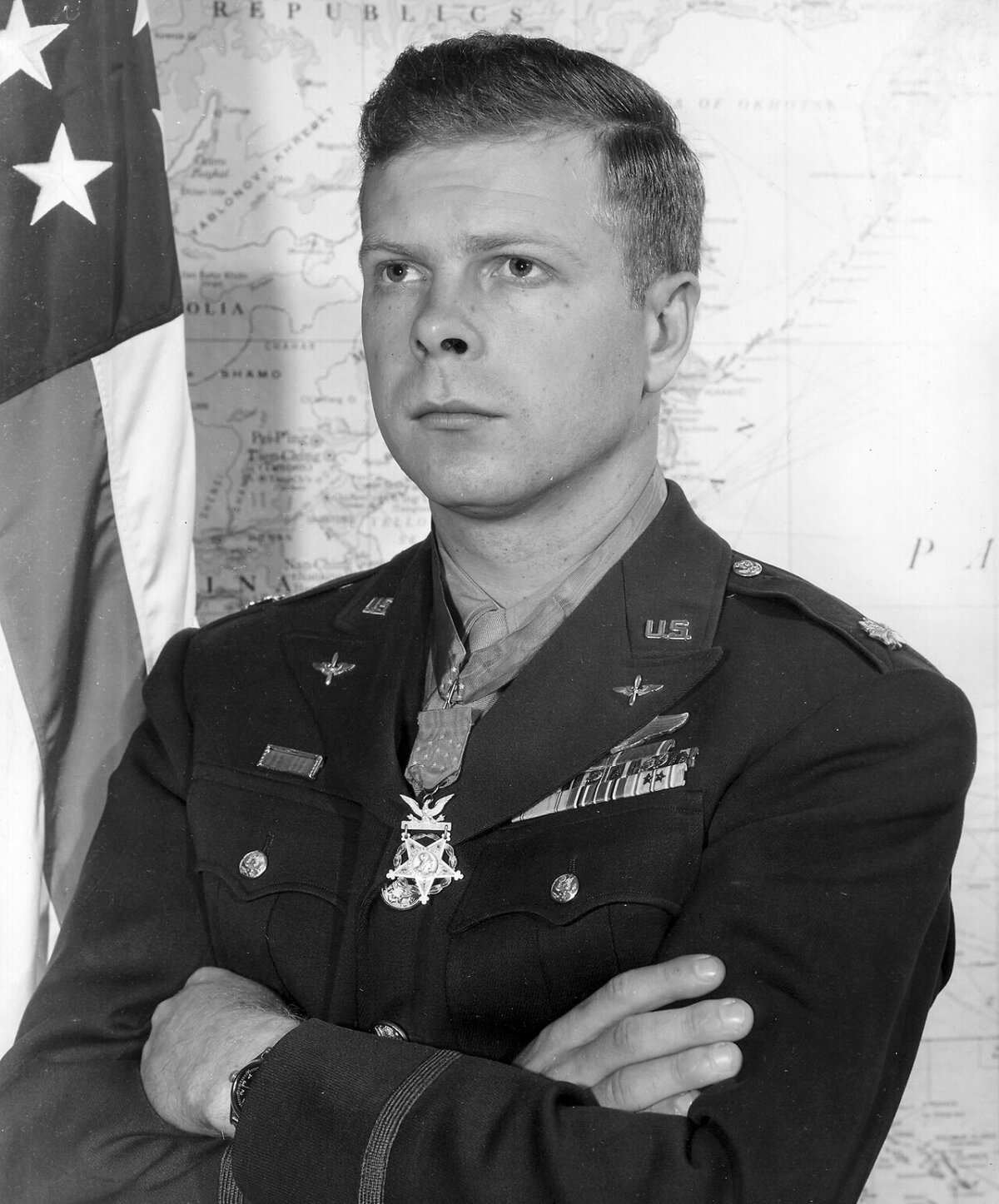
Despite his commanders’ efforts to transition Bong into non-combat roles after all he had done for the American cause, Bong continued to ask for missions. He shot down another eight enemy planes between Oct. 10 and Nov. 15, 1944. For these actions, he was awarded the Medal of Honor.
The Medal of Honor citation reads:
“For conspicuous gallantry and intrepidity in action above and beyond the call of duty in the southwest Pacific area from 10 October to 15 November 1944. Though assigned to duty as gunnery instructor and neither required nor expected to perform combat duty, Maj. Bong voluntarily and at his own urgent request engaged in repeated combat missions, including unusually hazardous sorties over Balikpapan, Borneo, and in the Leyte area of the Philippines. His aggressiveness and daring resulted in his shooting down eight enemy airplanes during this period.”
In the End
After Gen. Kenney sent him home permanently, Bong married Vattendahl on Feb. 10, 1945. But their wedded bliss was not to last.
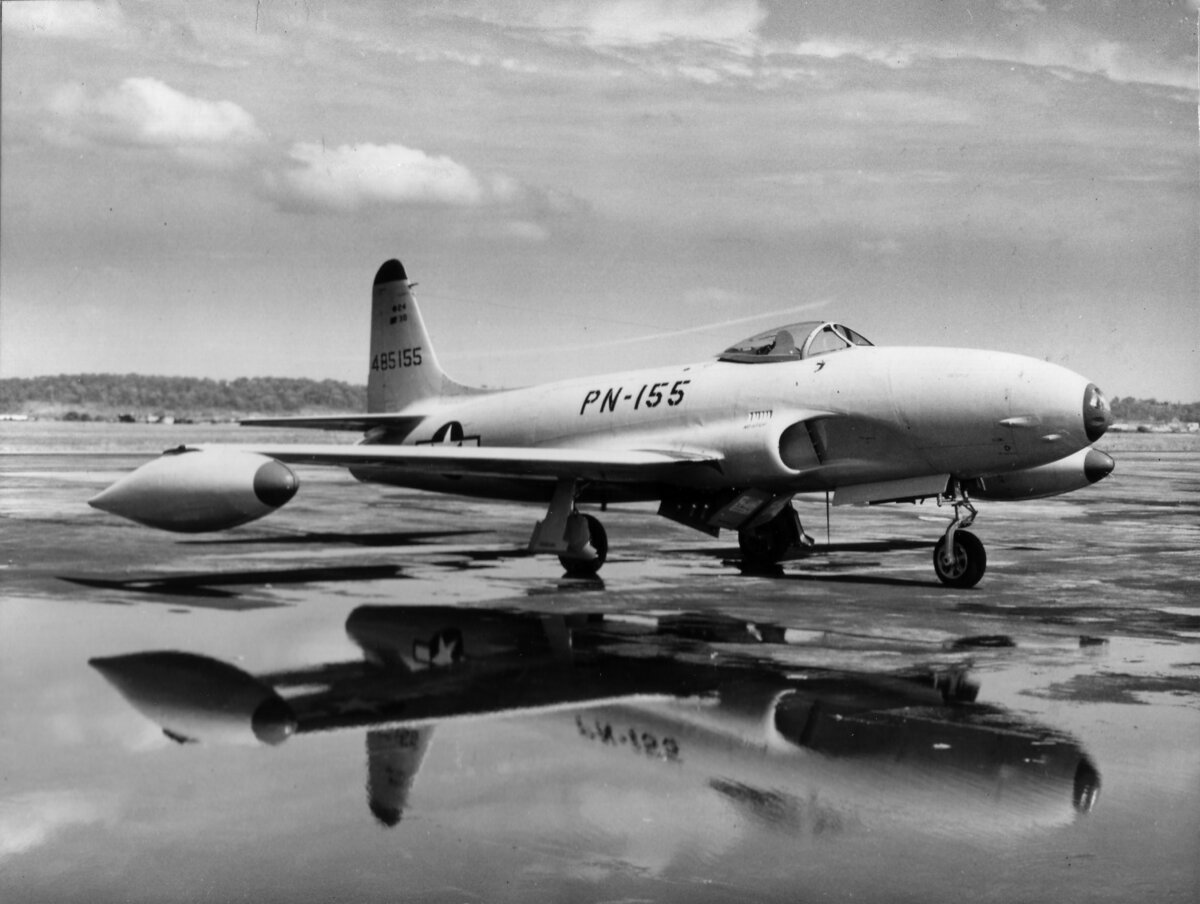
Bong had been assigned to test-fly a new type of aircraft: a jet fighter. Again putting his body on the line for his country, Bong lent his piloting skills to the development of this new and important weapon.
On Aug. 6, 1945, something went wrong.
A service mechanic from Lockheed described what he witnessed: “We knew something was wrong when we saw a puff of black smoke come out just as he leveled off in flight. The right wing seemed to tip a little. The next thing we knew the escape hatch came off. The plane started into a glide and then sort of nosed over straight down. We saw a column of smoke go up in the air about 400 feet. It was a terrible sight.”
Bong bailed out, but his altitude was too low for the parachute to work. According to crash investigators, his altitude was low at that point because Maj. Bong, knowing the plane was going down, stayed in it long enough to pilot it away from the populated areas of Burbank and North Hollywood. He expertly navigated the spiraling, flaming craft into the only vacant lot within several blocks of bungalows.
In other words, he used his piloting skills one last time and gave his life to save others.
Gen. Kenney recalled receiving the news the following day:
“It was August 7, 1945. I was on my way to the Kadena airstrip in Okinawa, to take off for Manila, when a radiogram, which had been relayed from there, was handed to me by my signal officer. I stopped thinking about the atomic bomb which the previous morning had wiped out Hiroshima, stopped speculating about the effect of the coming entry of Russia into the Pacific war, even stopped thinking of the capitulation of Japan which we all knew was due to take place in a few days. Wherever I landed, I found that the whole Fifth Air Force felt the same way. We had lost someone we were all fond of, someone that we had been glad to see out of combat and on his way home eight months before.”
Bong was only 24 years old at the time of his passing. His love of flying had ultimately led to his death, but it had also inspired him to accomplish incredible heroics and to achieve a legendary place among the ranks of America’s greatest heroes. His was ultimately a deadly passion, but it was also something powerful and soaring that took him to the heights of human achievement—like the very aircraft he piloted.
What arts and culture topics would you like us to cover? Please email ideas or feedback to features@epochtimes.nyc.