In the early 19th century, the farm was the workplace of more than half of America’s labor force and the foundation of the nation’s economy. As Americans moved toward cities and industrial life in growing numbers, artists preserved, and often idealized, the world of farms, fields, livestock, and agricultural labor. These characterizations reveal how Americans worked the land, and how they understood the land itself and the people whose lives depended on it.
A Landscape of Promise
Nineteenth-century artists often looked past the physical difficulty and economic uncertainty of agricultural work, portraying it as hopeful and thriving despite the pressures of growing cities and industrialization.
Frances Flora Bond Palmer’s “American Farm Scenes. no. 1,” published by Nathaniel Currier in 1853, is an expansive example of this approach. Palmer, who emigrated to the United States in the 1840s, became an important artist associated with Currier and Ives, the firm known for producing and widely circulating popular lithographs. The hand-colored print brings together a farmhouse, a plow, cattle, sowing, and groups of figures.
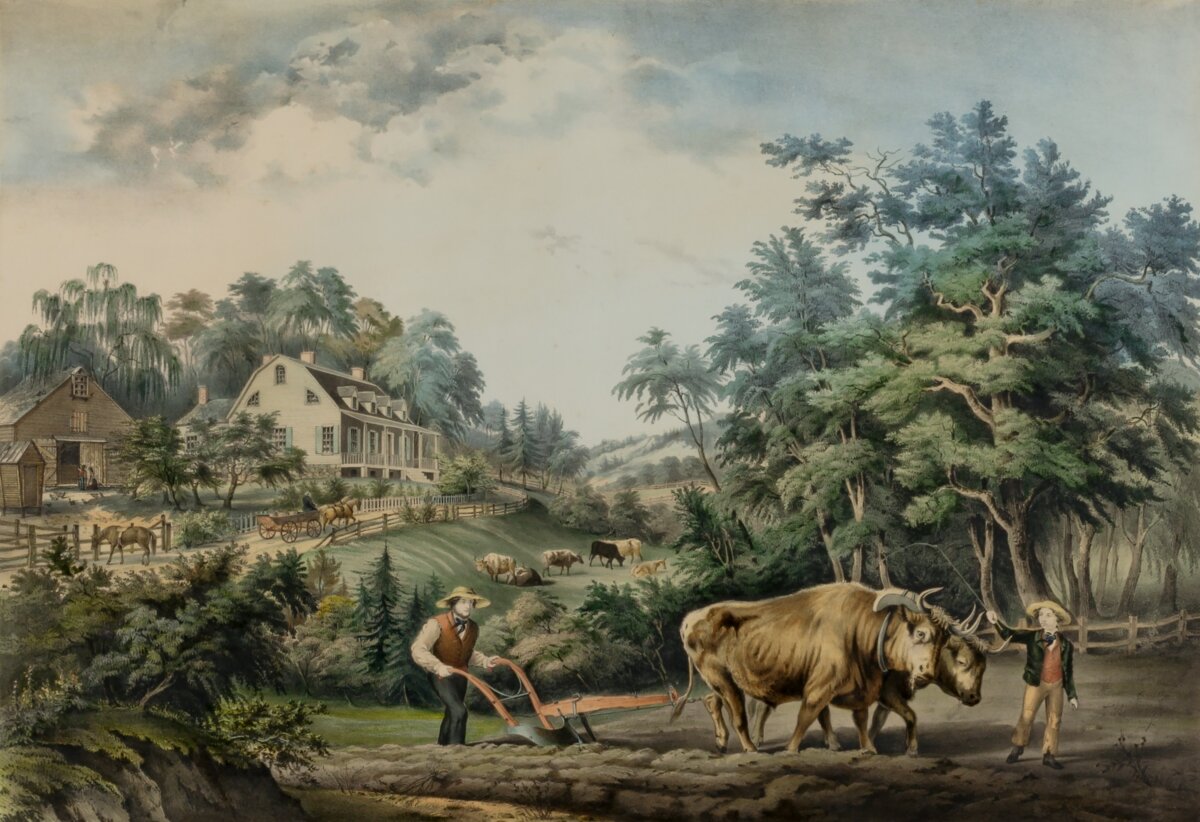
Palmer often used her husband Edmund, his friends, and their hunting dogs as models for the figures and animals. In her artwork, the plow implies progress, and the farmhouse represents permanence. Together, they sketch a vision of farm life as steady, productive, and safe from disruption.
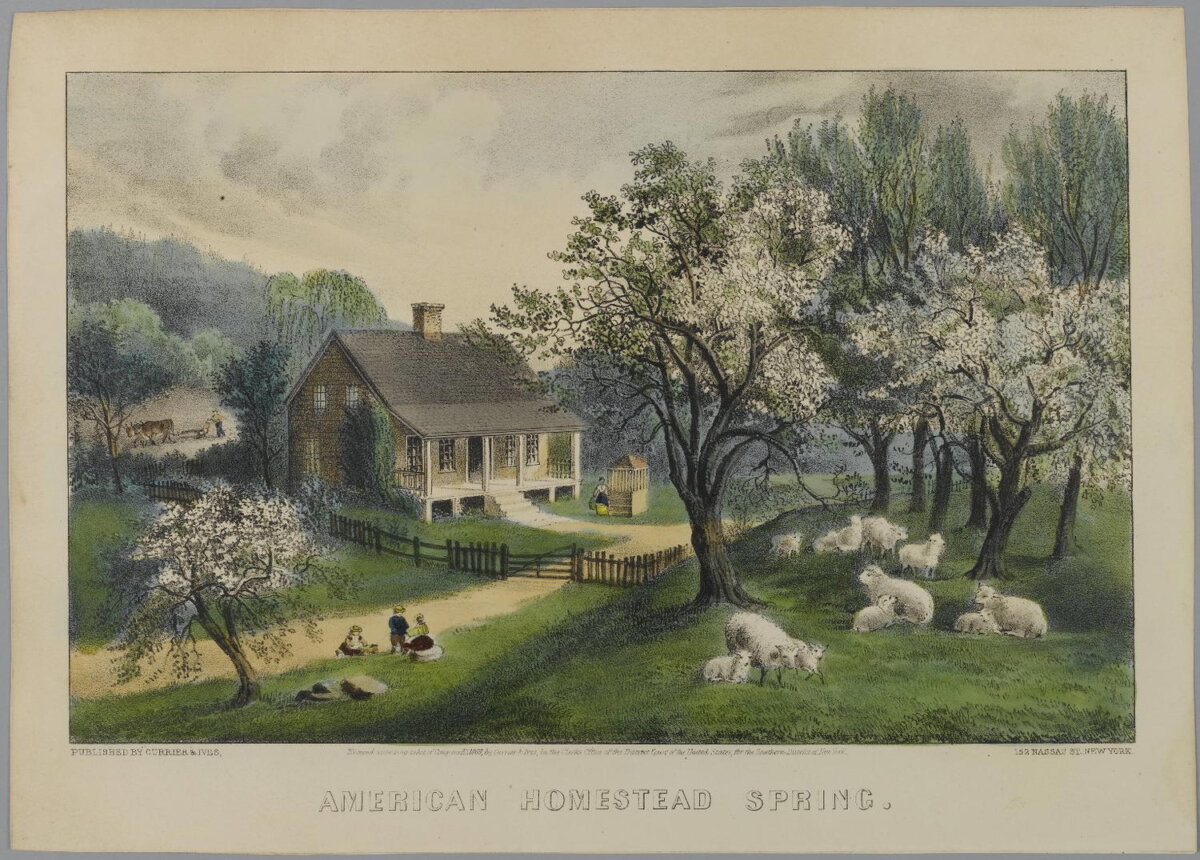
Palmer’s “American Homestead Spring” takes a related approach, framing the farm as a peaceful domestic environment, a place of renewal and plenty. Lush grass fills the fields, trees hang heavy with blossom, and new lambs scatter across the pasture.
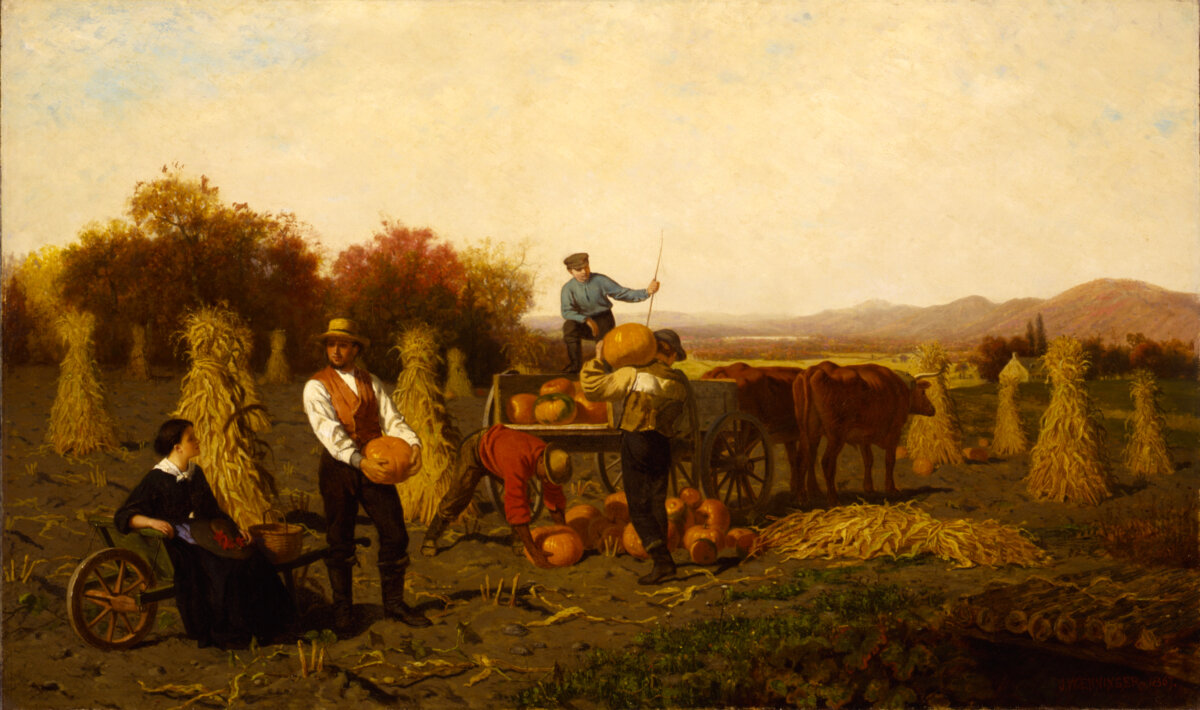
John Whetten Ehninger’s “October,” completed just two years after the Civil War, casts agriculture in much the same romantic light. The painting depicts the harvest season in brilliant autumn colors, with figures gathering plump pumpkins while cattle and a loaded cart occupy the landscape. In the foreground, Ehninger highlights the harvest’s productivity, lending the scene a sense of stabililty and continuity as the nation recovered from the devastation of war.
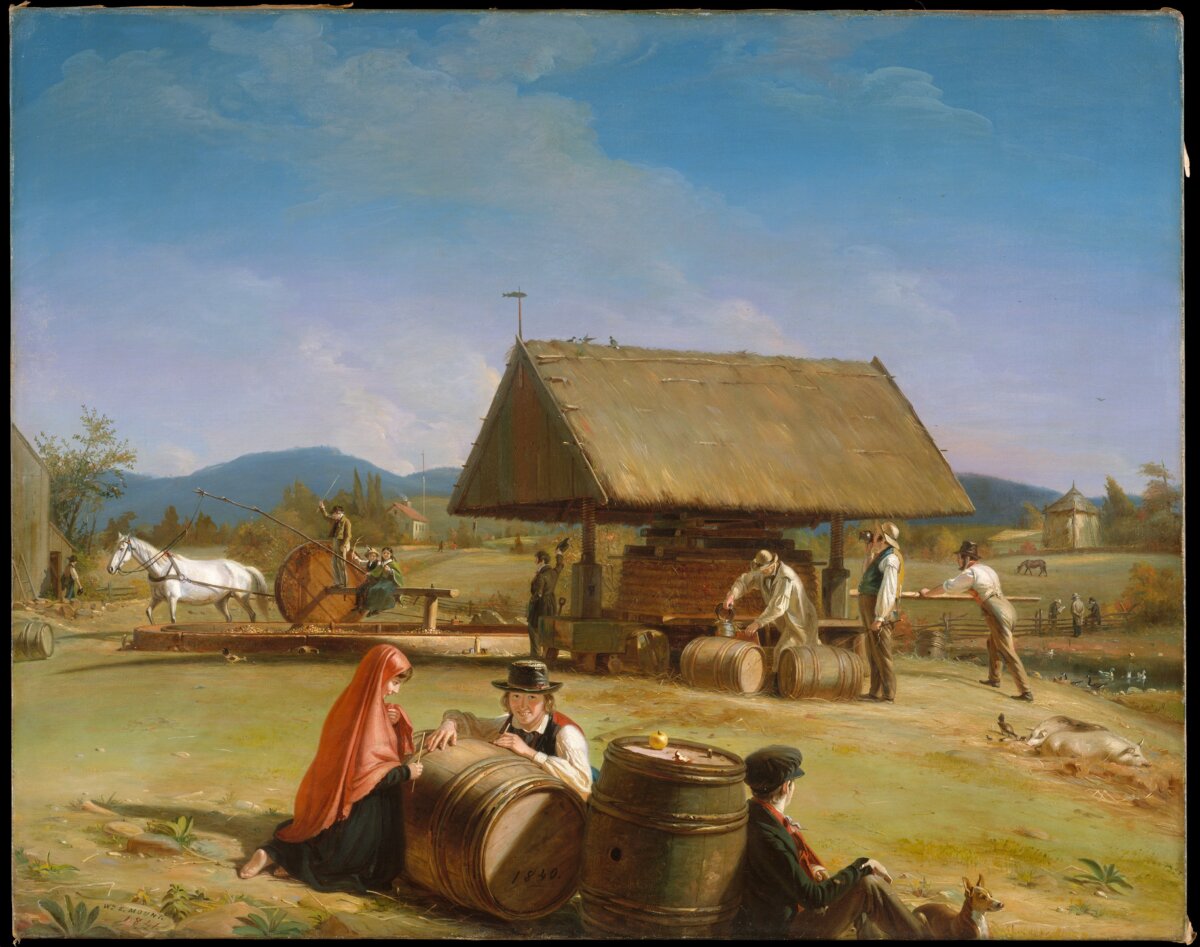
William Sidney Mount’s “Cider Making,” painted between 1840 and 1841, accentuates joy by focusing on the transformation of the harvest into something useful and enjoyable. The painting illustrates the traditional process of producing cider on Long Island: Workers crush apples and press the pulp to release the juice, which pours directly into a barrel, while nearby children have their fill of fresh, unfermented cider.
Dignifying Labor
Whether growing fresh produce, raising livestock, or producing cider, farmers are caretakers of nourishment. In the early 1800s, American agriculture was the backbone of the national economy and a major source of food security, with many families growing crops and raising animals primarily to feed themselves.
Artists who depicted the fruits of this labor also captured the work required to produce it. From preparing the soil and planting crops to feeding and tending livestock, farmwork demanded strength, skill, endurance, and cooperation. Mount’s “Cider Making,” Palmer’s “American Farm Scenes. no. 1,” and Ehninger’s “October” each reflect the importance of these qualities in agricultural life.
“Cider Making” treats labor as both an economic process and a communal activity, with multiple figures contributing to the transformation of harvested fruit into cider. “American Farm Scenes. no. 1” expands this idea across the landscape, depicting workers, animals, buildings, cultivated fields, and technology as parts of an interconnected system. “October” places workers at the center of the harvest in much the same way, showing figures gathering pumpkins and loading a wagon alongside animals, linking physical labor and cooperation to the seasonal process of bringing crops from the field to the market or to the household.
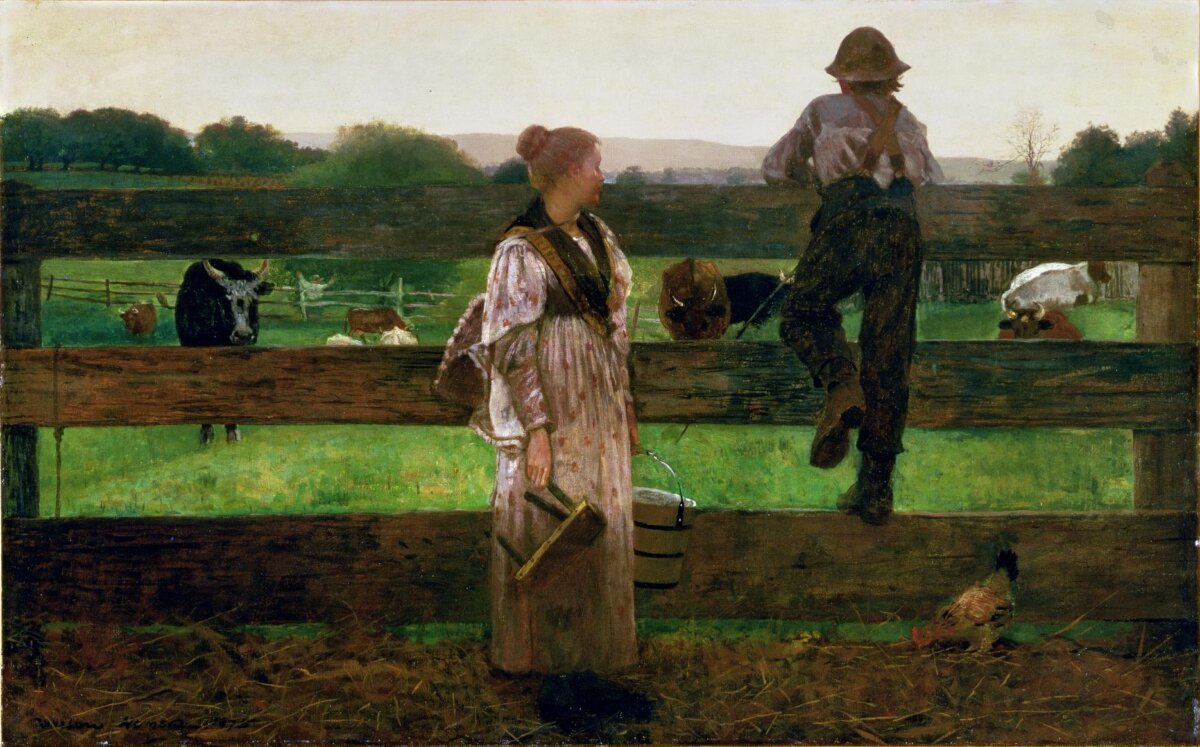
Winslow Homer’s “Milking Time” (1875) turns to a less dramatic kind of agricultural labor: The routine work of caring for livestock. Rather than depicting a dramatic moment of harvest, Homer treats milking as an essential but ordinary part of farm life. The scene reminds us that a farm’s success rested as much on repetitive, hands-on work performed year-round as on the seasonal planting and harvesting.
Farming Through Change
In addition to bringing the farm culture to life, artists captured how these scenes changed throughout the year. At the same time, their agricultural paintings preserved ways of life that were gradually disappearing as the United States industrialized.
This nostalgia runs through Ehninger’s broader body of work as well. The Smithsonian notes that many of his genre paintings depicted idealized country people and agricultural settings, later read as images of a vanishing rural life. His work sits somewhere between documentation and romanticism, capturing real elements of rural life through a wistful, nostalgic lens.
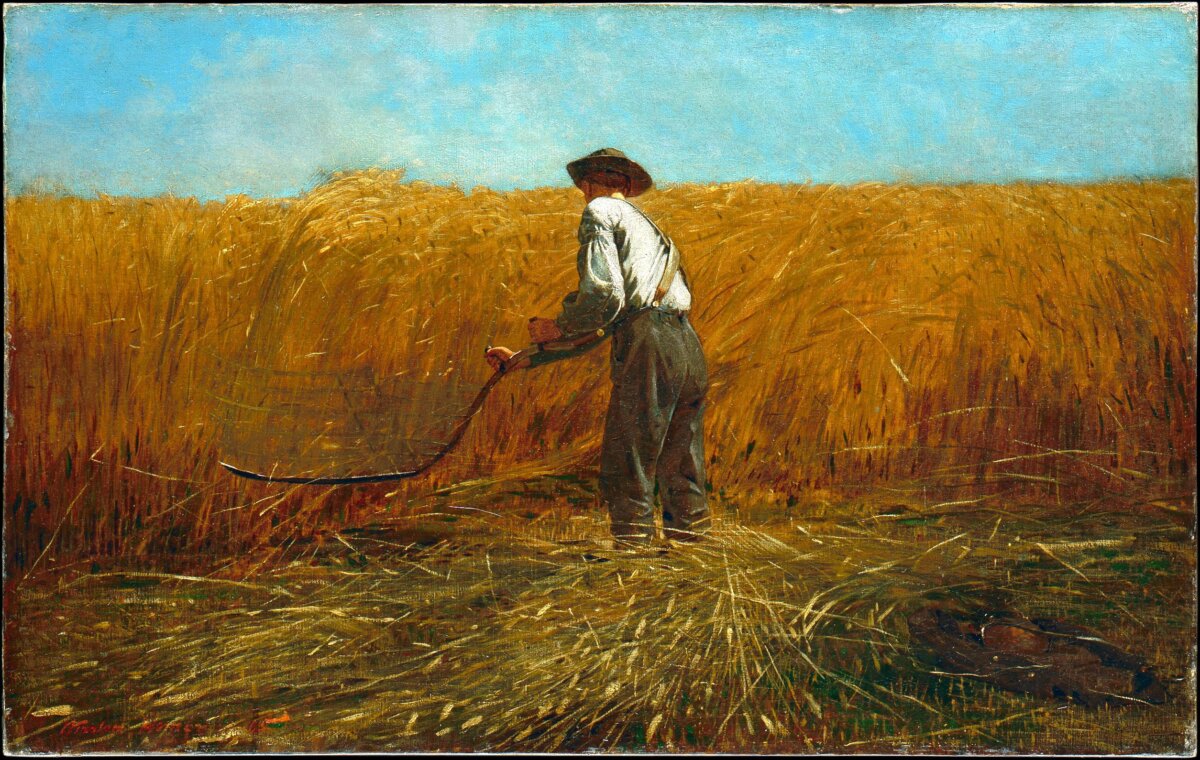
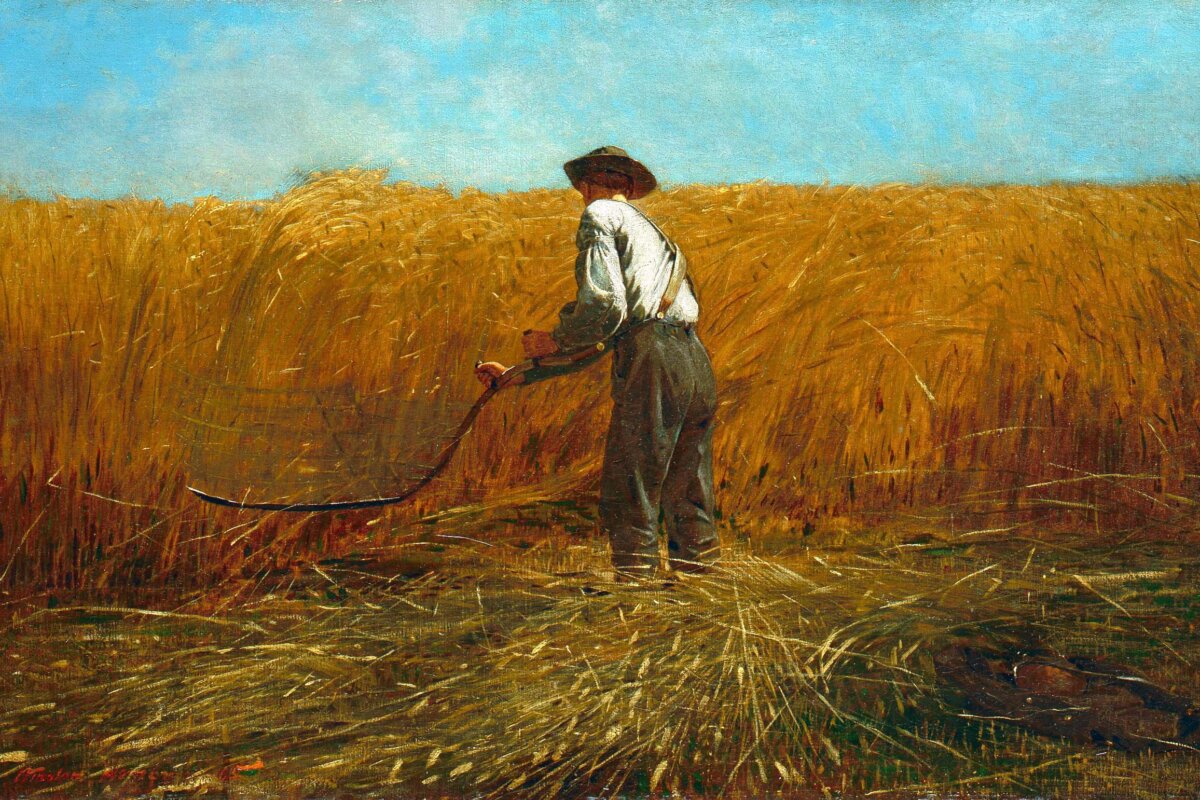
Homer’s “The Veteran in a New Field “(1865) documents that same postwar moment from a different angle. The “new field” in the title points out the battlefield the veteran has left behind. His return from military service to agricultural work turns the farm into a metaphor for resilience: Fields are cultivated and harvested, beginning the cycle anew, echoing the country’s own passage from destruction to rebuilding.
Through this visual language, artists invited viewers to grapple with tensions against the backdrop of a rural America transformed by industrialization and westward expansion. Farms multiplied accordingly, from roughly 1.4 million in 1850 to nearly 4 million by 1880 and 6.4 million by 1910. Amid this expansion, agrarian imagery could celebrate the countryside even as it mourned its passing, a tribute and an elegy in the same canvas.
What arts and culture topics would you like us to cover? Please email ideas or feedback to features@epochtimes.nyc.