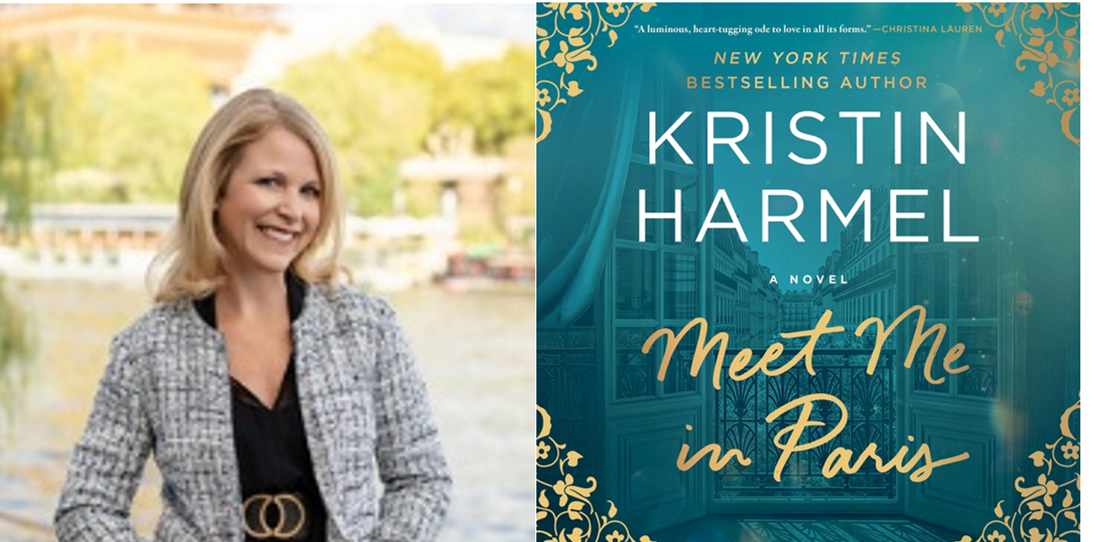
Kristin Harmel’s “Meet Me in Paris” belongs to a niche in a reliably satisfying literary tradition: the ensemble novel. This format’s shared setting serves as the connective tissue for a diverse set of tales about love and adventure.
Maeve Binchy is considered by some to be a master of sprawling ensemble fiction, with books like “Evening Class” (1996) and “Tara Road” (1998). The format follows several characters as their individual romantic struggles, secrets, and triumphs overlap, typically connecting throughout the story. The structure has been put to more solemn use as well, as in Tim O’Brien’s “The Things They Carried” (1990), a collection of interlinked stories about American soldiers in Vietnam (a brilliant and harrowing book).
Harmel’s “Paris,” however, is in unmistakably romantic territory. She uses the ensemble format to stage several love stories that unfold side by side over the course of one eventful week.

City of Lights
Julia Glover arrives in Paris with her 23-year-old daughter, Piper. The trip is doubly important for them both. It’s the first time Julia has been back since an idyllic summer 27 years before. Her pancreatic cancer is now beyond treatment, so these will be some of the last moments she shares with her daughter.
Meanwhile, Henry McGee is an American songwriter in his early 80s. He’s recently learned that a French woman he fell in love with during World War II was not, in fact, killed by the Nazis, as he believed for decades.
Her name is Celeste Didier, and she now lives in a Parisian memory care home (nursing home for residents with dementia). Even though there is little chance she will remember Henry, he takes the next flight out to Paris to stay with his granddaughter, Melanie Chaulet.
For Melanie, the timing of her grandfather’s sudden arrival isn’t great. She recently discovered a text message revealing that her husband is having an affair. She has no idea what to do about it, and isn’t sure Henry will be another burden or an ally. Besides, who is this woman he says he loved? She wasn’t Grandma.
Elsewhere, George Gallagher is visiting Paris with his closest friend, Lou Robinson. Both are Vietnam veterans visiting sites related to the Paris Peace Accords as part of a tour group. They both miss their late wives and are looking forward to exploring new horizons in Paris.
Jackson Quick is a 55-year-old rock star starting a comeback tour in Paris in four days. His breakout single, “City of Light,” was written by songwriter Henry McGee for a woman McGee loved during World War II.
The trip gives Jackson a chance to reflect. He considers his fading celebrity, his lifelong bachelorhood, his never having sung his own music, and his history of poor romantic choices.
Many of the characters cross paths at an Anglo pub called Le Maison Grog, run by Russ Rodgers, a 45-year-old Australian expat who’s getting tired of being a bar owner. His eye catches Shelby Anderson; her girlfriends convinced the newly divorced Alabama woman to have a “divorce party” in Paris.
That covers about half the characters in “Meet Me in Paris.”
Romance Above All
Harmel’s writing can be melodramatic and cliched at times, where the phrase “her breath caught in her throat” might show up. She also seems fine with ignoring the realities of time to provide a good romantic premise.
“Meet Me in Paris” takes place in the present, but she features a WWII veteran who is “barely a day over eighty” with a granddaughter who “had just turned fifty.” That is questionable math, to be sure.
If you’re looking for inventiveness in storytelling, this isn’t the book for you. The stories in “Paris” are formulaic, and the characters are basic, though easily likable. All the romantic hurdles and scenarios they encounter are ones we’ve seen before.
Yet, admittedly, it all works to Harmel’s advantage. She’s clearly not looking to break new ground with “Meet Me in Paris,” and she’s skilled enough to know which heartstrings to pluck at the right moment.
The ensemble format efficiently removes the need for contrived obstacles to keep the couples apart. As a result, you have a wide variety for romance fans to enjoy, and you can’t get a much better setting than Paris.
There are, however, a couple of sour notes. The “secret, unspoken gay relationship” trope has become so common in modern entertainment media that one might wonder if there is a literal checkbox on every producer and publisher’s desk for a project to get a green light. Indeed, this particular relationship in “Meet Me in Paris” is rather underdeveloped compared to the other stories. Perhaps that indicates it was an afterthought.
The other tiring moment comes with a short political soapbox speech about immigration issues. It also seemed shoehorned into the narrative. Modern publishers, apparently, don’t want readers to enjoy stories without having politics rammed into them.
Whether or not elements like these bother you, they account for only a small part of the story and are easy to skip.
Harmel provides a fun, if predictable, set of stories in “Meet Me in Paris” that are engaging and a pleasure to read.
‘Meet Me in Paris’
By Kristin Harmel
Gallery Books: July 28, 2026
Hardcover, 368 pages
What arts and culture topics would you like us to cover? Please email ideas or feedback to features@epochtimes.nyc.