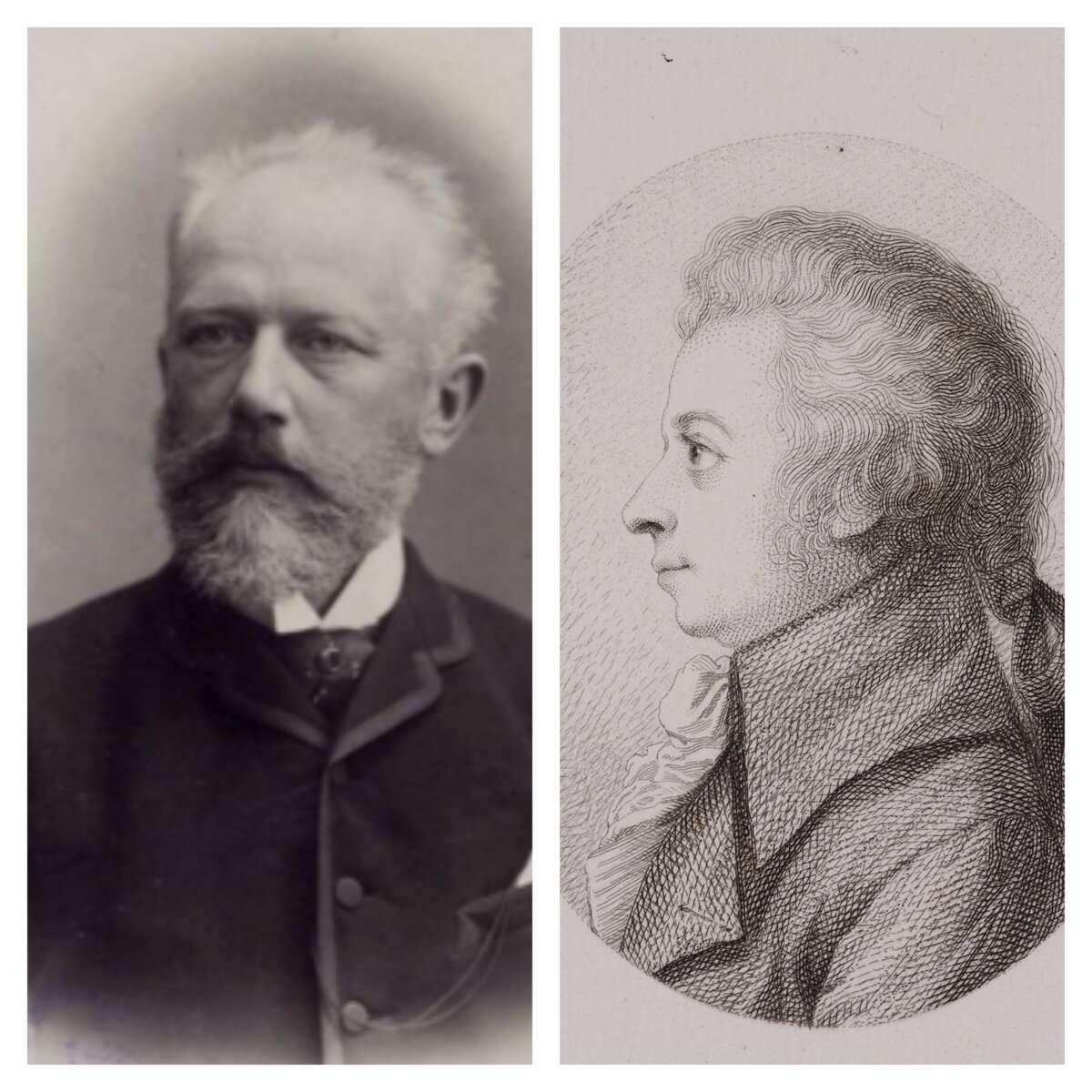
The most persistent misattribution of a piece to a composer is not “Bach’s Minuet in G major.” That error was corrected decades ago, though it remains challenging to say “Petzold’s Minuet in G major” instead. No, the most frustrating misattribution in classical music is that Tchaikovsky composed the work we call Tchaikovsky’s “Suite No. 4 for Orchestra.”
Who actually composed this bright, beautiful, blooming bouquet? (Sorry.) The suite’s nickname gives a clue: “Mozartiana.” Tchaikovsky was simply the orchestrator of three Mozart piano works and a Mozart choral work adapted for the piano by Franz Liszt.
To be fair, Tchaikovsky, conducting the work’s premiere in 1887, did not label the score as his “Suite No. 4.” The program listed it as “Mozartiana,” indicating a more immediate relationship to the earlier composer. How the moniker “Suite No. 4” came about is unclear, but it suggests the work as belonging with Tchaikovsky’s first three suites, all of which were, unlike the present work, wholly original.
Tchaikovsky’s Devotion to Mozart
Why did Tchaikovsky, a major figure in Russian music of his day, put time and effort into creating a more than 25-minute tribute to another composer? You might as well ask a parishioner why he kneels. To say that Tchaikovsky adored Mozart would register slightly below the whole truth: He virtually worshipped Mozart.
“Mozart is the highest, the culminating point that beauty has attained in the sphere of music,” he wrote, adding, as “Christ inspires in me the true and exclusive feeling of love, … then I love Mozart as the musical Christ.”
For his tribute to his musical deity, Tchaikovsky chose three short pieces and a much longer one and clothed them in lush, late-19th-century orchestration. The first three might be summarized respectively as sparkling, embracing, and prayerful. The fourth, longer one is a set of 10 variations that mercurially trip from one mood to the next. Here is a performance of the suite. (Listen)
These are the movements:
- Gigue: Allegro, after Mozart’s “Little Gigue for Piano,” K. 574
The Mozart original is a story unto itself. While visiting Leipzig, where J.S. Bach lived most of his professional life, Mozart wrote this 90-second wonder directly into the notebook of the Leipzig court organist. The subject bears a strong resemblance to that of the B minor fugue from Bach’s Well-Tempered Clavier, but sped up from Largo to Allegro.
- Minuet: Moderato, after Mozart’s Minuet, K. 355. Warm and filled with musical sighs, this is a minuet for lovers.
- Preghiera (Prayer): Andante ma non tanto. Based on Franz Liszt’s piano transcription of Mozart’s choral Ave Verum Corpus, K. 618, it is generally considered the weakest movement, as Liszt’s arrangement sentimentalizes the original.
- Theme and Variations: Allegro giusto. The theme comes from an opera aria by Mozart’s contemporary, Gluck. Tchaikovsky’s orchestration is the most colorful of the lot. Listen as invention unfolds from one variation to the next.
All the pre-orchestration originals are available on YouTube.
The last ballet created by fabled Russian-American choreographer George Balanchine used this music. Watch “Mozartiana” ballet on YouTube.
What arts and culture topics would you like us to cover? Please email ideas or feedback to features@epochtimes.nyc.