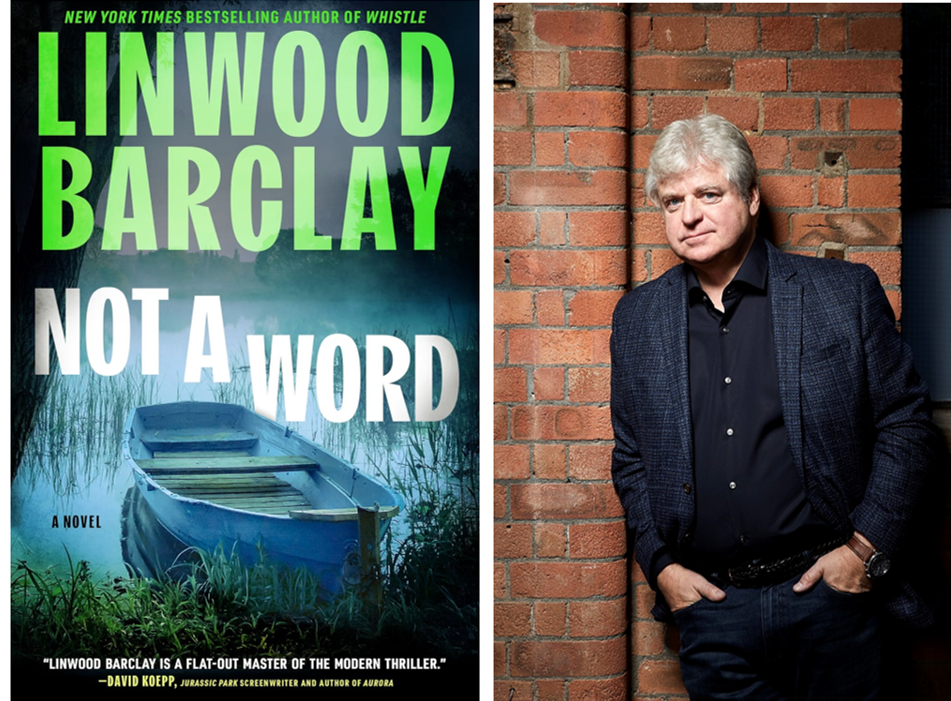
Linwood Barclay’s “Not a Word” is a smart, intimate family mystery that gets under your skin almost immediately. It begins with a brief, unsettling prologue: a conversation between an unidentified master manipulator and a subordinate who seems thoroughly under that person’s influence. No context is given, but the exchange is decidedly creepy.
The story shifts to Reece Chartwell, whose life takes a tragic and gruesome turn when he discovers the bodies of his parents in the bedroom of their affluent Toronto-area home, both victims of a violent death.
Reece recounts the discovery to Detective Janice McCabe, who is assigned to investigate. At first, the evidence points toward a straightforward murder-suicide. Brent Chartwell appears to have shot Catherine beside him before turning the gun on himself. Reece gradually begins to accept that explanation when he suddenly gets a phone call from his mother who is very much alive.
Who is the dead woman? What was her relationship with Brent? Was he having an affair? Did someone else make the scene look like a murder-suicide? There are also questions about Brent’s past employment at a pharmaceutical company that could be connected.

A Family Affair
What makes “Not a Word” particularly effective is that the story isn’t just about solving a crime. Reece has to figure out what happened to his father while simultaneously keeping his already complicated family from falling apart. Right away, he has to break the news to his mother that her husband is dead, and that he might’ve been cheating on her.
Next on his list of concerns is his teenage son, Gage, who practically idolized his grandfather. The death will devastate him. When it comes to Reece’s brother, Holden, it’s even worse. Holden has struggled with substance addiction for years, making the trauma of Brent’s death a potential trigger for another relapse.
Reece himself has to contend with the horrifying memory of finding his father dead in the bedroom of his childhood home. But little does he know that this is only the beginning.
As the investigation progresses, long-hidden family secrets begin coming to light, and Reece discovers that the people closest to him have been concealing things far darker than he could have imagined.
Go Real or Go Home
“Not a Word” isn’t a traditional whodunit in the classic Agatha Christie sense. The investigation is central to the story, but much of the problem-solving is done by regular suburbanites watching their lives slowly fall apart.
Barclay rejects the idea of creating a collection of eccentric suspects and opts instead to show how recognizable people respond when something extraordinary and terrible happens to them.
The dialogue is a major reason that this novel works so well. Conversations between Reece and Catherine, for example, feel like conversations between actual family members rather than exchanges designed solely to deliver information to the reader.
When Reece tries to break the news to his mother gently, he dances around the subject intending to speak to her in person. It’s riveting because Barclay is allowing them to breathe, to adjust, to panic when necessary.
Elsewhere, even small exchanges reflect this commitment. When McCabe orders a feckless suspect to lie down with their arms above their head, the suspect’s first response is to complain about getting dirty. It’s a tiny moment, but one that makes it more human.

Believability Tops Fantasy
With one exception, the people in “Not a Word” are refreshingly ordinary. They have recognizable jobs, marriages, children, addictions, family disagreements, and everyday frustrations. They aren’t superheroes or larger-than-life tropes.
Barclay doesn’t feel the need to turn McCabe into a conventionally glamorous or melodramatic television detective. He describes her as “five eight, black hair with a few gray streaks running through it,” adding that she is “not striking in any way.” Her methodical, unemotional, no-nonsense approach feels exactly right for someone doing this job professionally.
Her life outside the investigation is equally believable. She has a rebellious teenager who doesn’t always respect curfews, an absent father, and the familiar challenge of balancing work and family responsibilities. None of it feels artificially heightened to make her more interesting. It makes her more relatable.
In that respect, “Not a Word” has something in common with the best Hitchcock thrillers. The famous director understood that suspense can be more effective when the average Joe is placed in extraordinary circumstances. Barclay understands this. When the Chartwells’ secrets begin surfacing, there is a real sense of what they stand to lose.
The result is a story that feels like a cross between a Hitchcockian thriller and a tightly constructed limited streaming series. It has the escalating revelations and momentum of a thriller, but its real strength lies in the intimate attention it pays to the people caught in the middle of the mystery.
“Not a Word” is about figuring out who the killer is, but it’s more. It’s about watching a family discover just how little it knew about itself—and how much those hidden truths can cost.
‘Not a Word’
By Linwood Barclay
William Morrow: Aug. 25, 2026
Hardcover, 320 pages
What arts and culture topics would you like us to cover? Please email ideas or feedback to features@epochtimes.nyc.