
On Aug. 31, 92-year-old Wendell Berry (1934–2026) died in Port Royal, Kentucky, not far from his birthplace. In 1964, Berry returned to his native state along with his wife and two children, bought a 12-acre farm, Lane’s Landing, which grew to 117 acres, and settled into a life of teaching, writing, and farming. There, he worked the land with draft horses rather than with mechanized equipment. There, too, he wrote his many books of fiction, poetry, and essays with pencil and paper rather than with a computer.
In that multitude of books, Berry’s wife Tanya once quipped that her husband was “to repeat himself for 70 years.” There is truth in this observation, for again and again, in novels like “Hannah Coulter,” poems like “The Peace of Wild Things,” and essays in “What Are People For?,” Berry returned to his life’s passions: caring for the environment, loving and treasuring place and community, small farms and natural crops, hard work, and the preservation of the individual in an age of corporations, high-tech, and big government. These repetitions never dulled his writing. His zeal and his craftsmanship, a talent he treasured in others, illuminate his words.
We might select almost any of his published works and find these themes woven into the words. Because by our nature we must all take an interest in food, let’s look at Berry’s essay “The Pleasures of Eating.”
Food for Thought
As Berry stated in his essay, he wrote “The Pleasures of Eating” as his answer to those in his audience who often asked him, “What can city people do?” He would typically reply, “Eat responsibly.” His essay is his attempt at a more thorough explanation.
“I begin with the proposition that eating is an agricultural act,” he wrote, his reminder to readers who don’t grow their own food that the chicken, potatoes, and tomatoes in the grocery store don’t just magically appear in the grocery store. “The industrial eater,” as Berry calls such people, “is, in fact, one who does not know that eating is an agricultural act, who no longer knows or imagines the connections between eating and the land, and who is therefore necessarily passive and uncritical—in short, a victim.”
Then come the recurrent threads of freedom, place, beauty, and more that run throughout his essays. We can’t be completely free, for instance, if our food and the fields of its origin are under someone else’s control. Hurrying through our days, we have lost the aesthetic of dining and taking pleasure in our food: “Our kitchens and other eating places more and more resemble filling stations.” Most people ignore the impact on the soil—and on themselves—of foods grown from chemicals.
Berry then delivers a seven-item list of suggestions for enhancing our food awareness, like taking individual responsibility for our choices, buying local whenever possible, and learning more about agriculture and the foods we eat.
Near the end, he offers this glimpse of the foundation of his lived philosophy:
“Eating with the fullest pleasure—pleasure, that is, that does not depend on ignorance—is perhaps the profoundest enactment of our connection with the world. In this pleasure we experience and celebrate our dependence and our gratitude, for we are living from mystery, from creatures we did not make and powers we cannot comprehend.”
Work, Love, and the Ties That Bind
For most Americans, Berry would contend, that connection with the world, with the real, no longer exists, severed by a disengagement from nature, by technology and constant entertainment, by our lack of affection and honor for place, and more. Reading him, we must bear in mind that not only did his writing point to a way of restoration, but he also lived out his ideas on the land and among the people of Henry County, Kentucky.
And it was this intentional living that attracted so many to his work. Realistically, he knew that few people, even if they wanted, could afford to buy a small farm, work the land, and plow the fields with draft horses or mules. What he did offer them was a critique of the matrix that kept them from being fully human and some ways of escaping that prison.
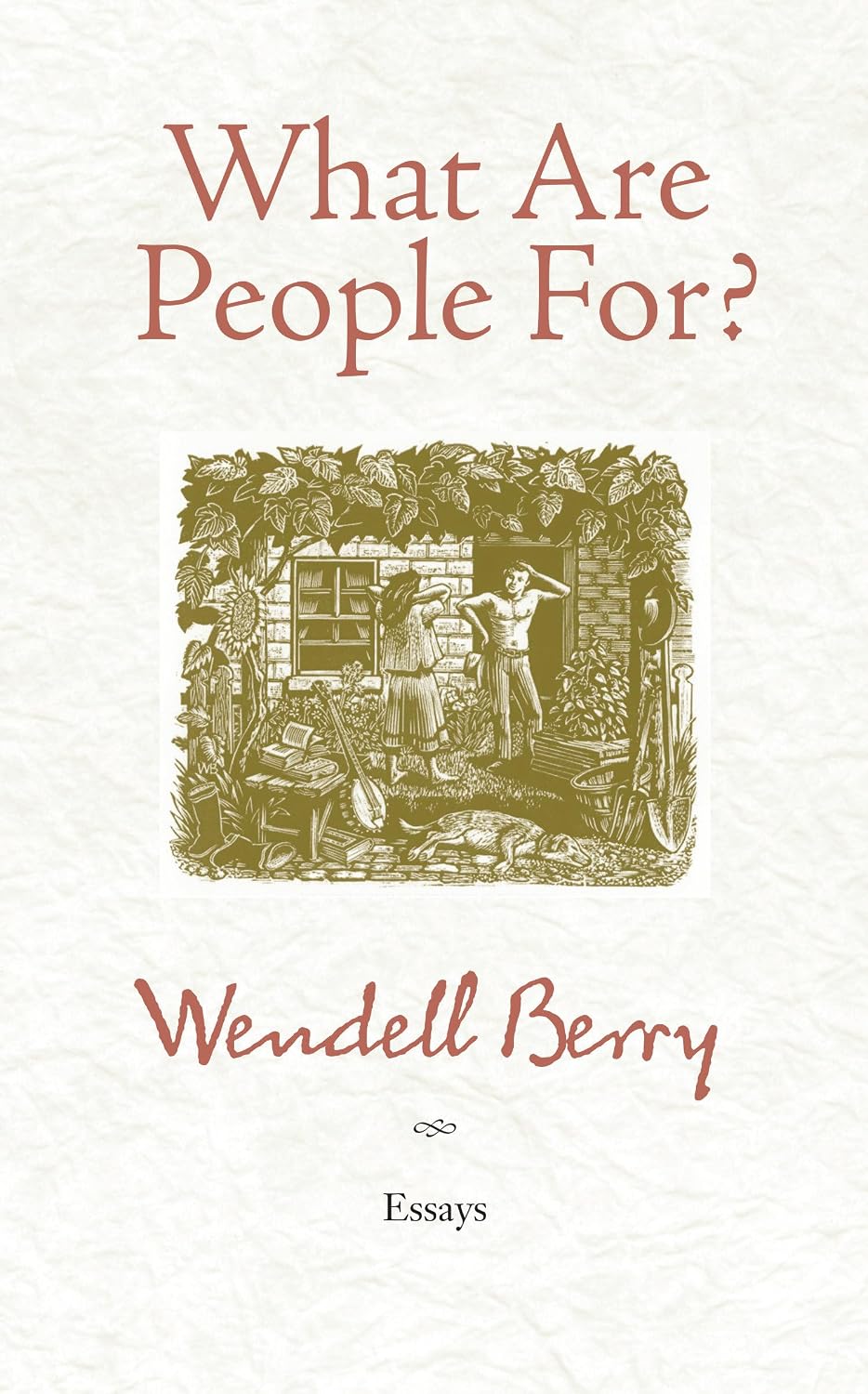
Published in 1990 in his essay collection “What Are People For?,” Berry’s essay “Feminism, the Body, and the Machine” follows this template as he describes the criticism sometimes leveled at his ideas and the difficulties even he encountered in drawing the line against technology. The essay is his reaction to the critics of his previous essay, “Why I Am Not Going to Buy a Computer.” Some of his critics took him to task for his stand against computers, but others, the feminists, “accus[ed] [him] of exploiting [his] wife.” Berry wrote his manuscripts by hand, at which point, Tanya then edited and typed them.
To this latter group and their “resort to insult and injustice,” Berry points out some inconvenient truths. These same supporters of feminism would have been happy if his wife was working with pay “under the authority of a boss.” He reminds them, too, of the consumer mentality that is present in so many marriages in which “rights and interests must be constantly asserted and defended.” These are the tenacles of a destructive culture reaching into the bedroom.
Most importantly, he writes: “It is equally regrettable that all of the feminist attacks on my essay implicitly deny the validity of two decent and probably necessary possibilities: marriage as a state of mutual help and the household as an economy.” He and Tanya are a team, helpmates who produced dozens of excellent books.
In this clearly affectionate relationship between husband and wife, we again see intentionality at work. Implicitly, Berry urges his readers to follow the same path in their own marriages and so connect with what is real.
The Legacy
In rereading some of Berry’s essays, a prayer learned by my son-in-law and repeated by his family after the traditional mealtime blessing came to mind. “God bless the poor and the hungry and all those whose work has brought us this food.” This time, however, the words took on a new meaning.
So many men and women of the 21st century are starving from a poverty of the spirit and a hunger for truth, beauty, and goodness, whether they know it or not. And Berry was one of those rare writers who brought them food which, if they partake of it, might alleviate that poverty and that hunger.
The man is gone now, but the words remain, and a fervent band of readers continue to share his writing with others. Writer and thinker Paul Kingsnorth of Great Britain, for instance, edited “The World-Ending Fire: The Essential Wendell Berry,” which was first published in the UK in 2017. More recently, in February 2026, Kingsnorth founded “Writers Against AI” and, with the help of a friend, “Readers Against AI.” Barry would have undoubtedly approved such a movement against the AI-generated articles and books.
Like several other admirers, Kingsnorth eulogized Berry in an essay. His concluding paragraph is typical of the tributes paid to the man from Kentucky:
“Wendell Berry’s beautiful poems, questing novels, and steadily passionate essays offer us all a legacy we can engage with. Those of us who are more flawed as human beings than he undoubtedly was, or less able to practice what we preach, can find a way in through the many doorways he built with words, backed up by decades of energetic practice. May he rest in peace.”
What arts and culture topics would you like us to cover? Please email ideas or feedback to features@epochtimes.nyc.