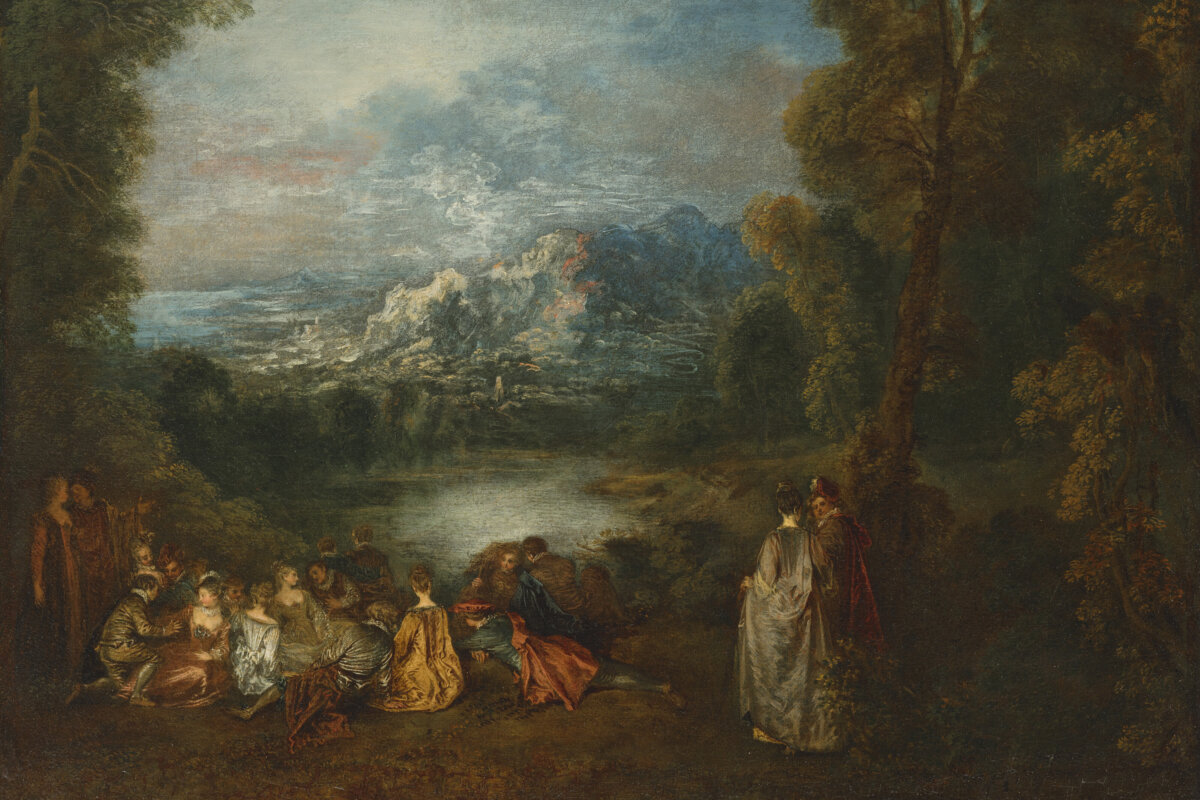
On Sept. 23, 2026, Christie’s Paris will auction 60 lots from the storied collection of the discerning Graziella Patiño de Ortiz Linares (1900–1980). Graziella was the daughter of the Bolivian industrialist Simón Iturri Patiño. He was one of the world’s wealthiest men, known as “The Tin King” and “The Andean Rockefeller.” Gifted a glorious Parisian residence by her father in 1926, Graziella and her husband Jorge Ortiz Linares filled its interior, as well as that of their country home, with one of the most outstanding assemblages of Old Master paintings and decorative arts. Works formerly in the chic couple’s collection are now in prestigious institutions such as the Louvre, Palace of Versailles, and the Getty Museum.
The Christie’s sale, on public exhibition from Sept. 17 to 23, is organized in three main categories—paintings and drawings, furniture and works of art, and silver. Many items have royal provenance. Amassed over 40 years, the core of Graziella’s collection focused on 18th-century French chefs-d’oeuvres.
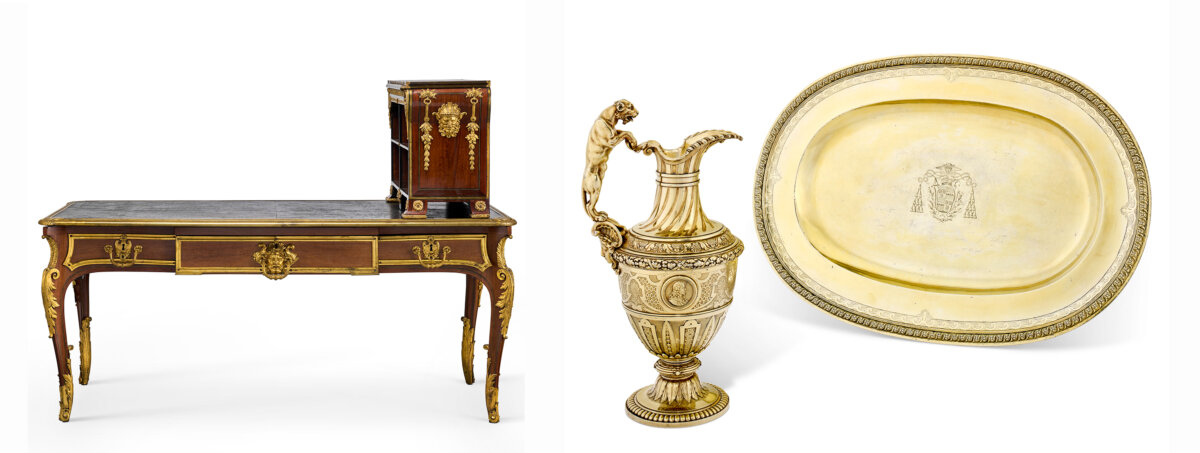
Sale highlights include a rare Jean-Antoine Watteau painting, a romantic Jean-Honoré Fragonard oil on canvas, an imperial commission from Napoleon III to Jean-Auguste-Dominique Ingres, French-made candelabras for the King of Portugal, a Royal Savonnerie Manufactory carpet, lacquerware furniture, and a desk and its cartonnier attributed to André-Charles Boulle. Masterworks from outside of France include Italian Renaissance drawings by Fra Bartolommeo and four gold table services ordered by Frederick Augustus II, Elector of Saxony, King of Poland.
Watteau’s ‘Fête Galante’
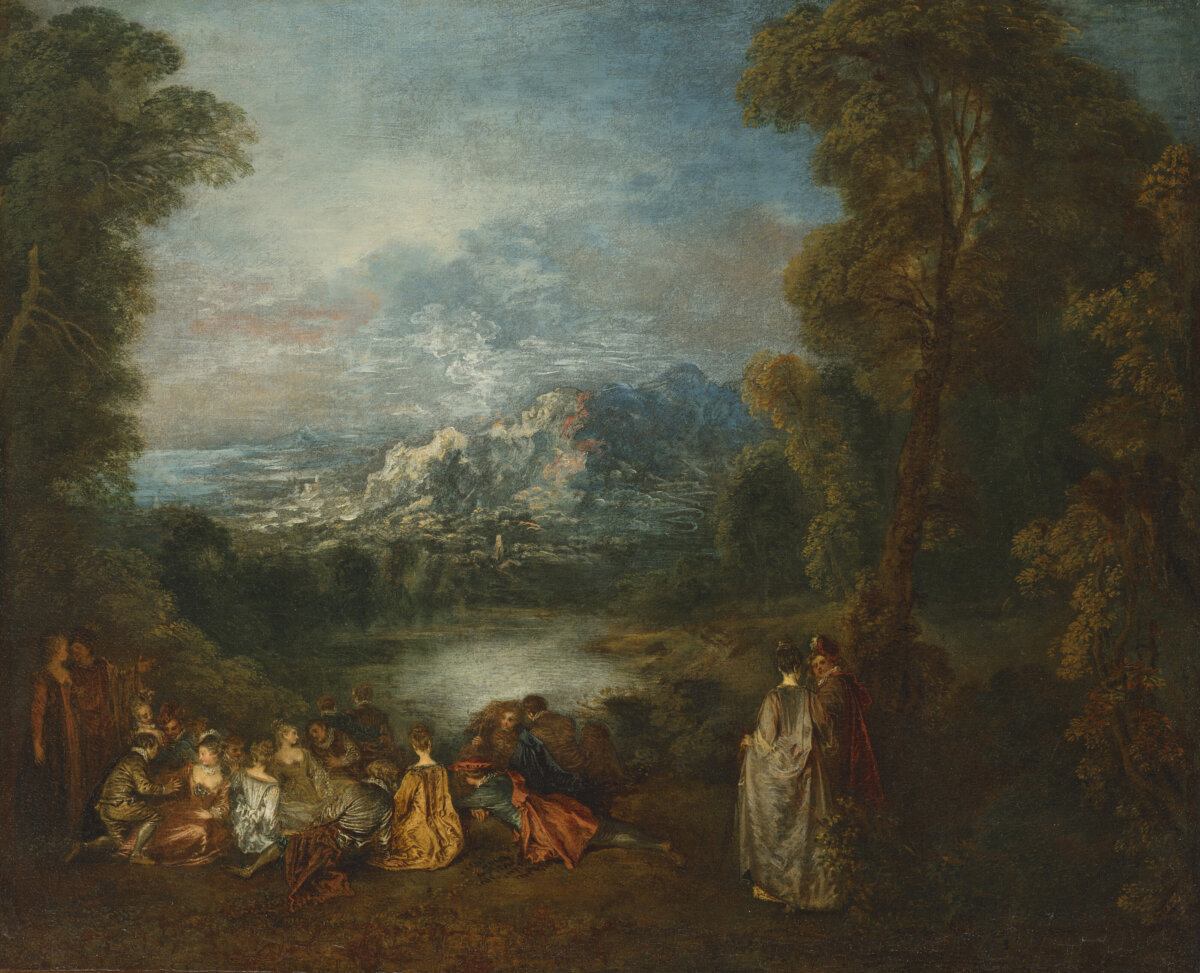
Watteau’s (1684–1721) ethereal circa 1717 “The Enchanted Isle (L’Île enchantée)” is the paramount work by the artist still in a private collection. It is an example of a “fête galante,” which is a category of paintings that feature small-scale compositions of elegant men and women in dreamy outdoor settings, a genre created by Watteau. The canvas was originally purchased or commissioned from the artist by the architect Jean-Sylvain Cartaud, who worked for one of Watteau’s premier patrons. Subsequent owners of the painting included the British portraitist Sir Joshua Reynolds and French parfumier François Coty.
The most sublime element of the painting is its landscape, created from Watteau’s subtle layering of glazes. Indeed, this work was influential on the development of British landscape painting. It was copied by J.M.W. Turner and studied by the likes of Thomas Gainsborough and Joseph Wright of Derby.
In this refined work, one can see how Watteau was inspired by Renaissance artists, both from the Venetian school (Titian and Veronese) and the Milanese school (Leonardo da Vinci). In Christie’s catalogue essay, Alan Wintermute noted that Leonardo’s “Mona Lisa” and the “Virgin and Child with Saint Anne” at the Louvre both “have fantastical, blue-tinted, snow-capped and craggy mountainous backgrounds that seem to have offered direct inspiration for L’Île enchantée.” Indeed, one of the few comparable artworks for “The Enchanted Isle” is the Louvre’s Watteau painting “The Embarkation for Cythera.” This is the artist’s most famous painting, and it is part of the art historical canon.
Significant Silver Service
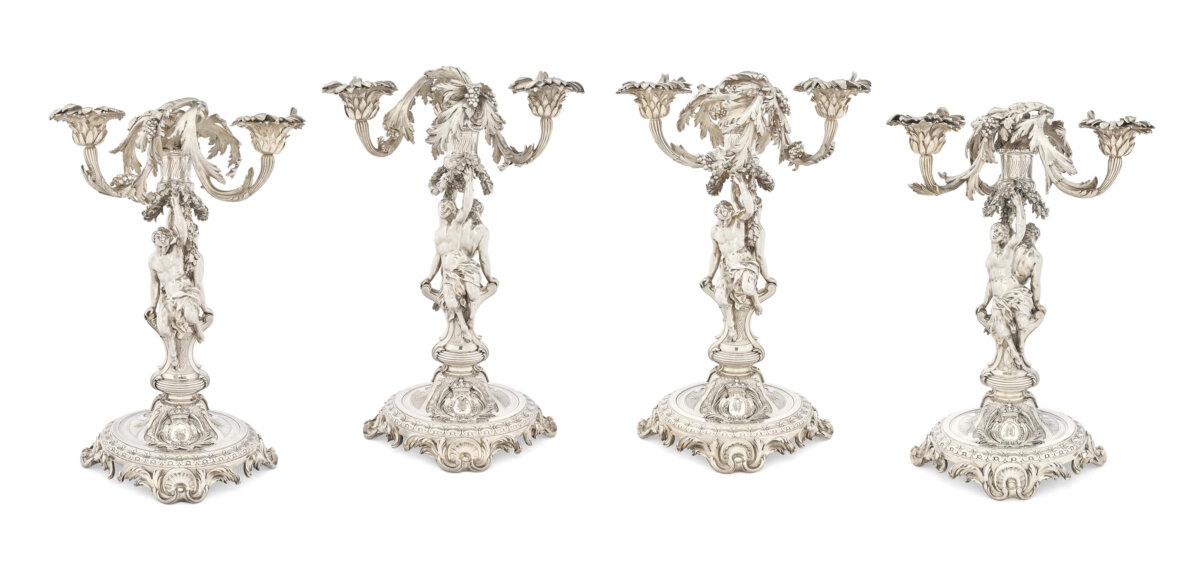
The sale’s most sublime pieces of silver are four three-light candelabras from the Portuguese Royal Service, the most significant 18th-century silver service ever made in France. This foreign court’s commission was fulfilled by the Germain workshop, led first by Thomas Germain (1673–1748) and then his son, François-Thomas (1726–1791). The Germains were silversmiths to the kings of France. The first Portuguese service made by the workshop was destroyed in the 1755 Lisbon earthquake; they began swiftly crafting a second service after this disaster.
Over 100 craftsmen labored on this assignment. Deliveries from France to Portugal of different components, totaling approximately 1,200 pieces, took place over a period of nearly eight years. While the Portuguese Crown paid preemptively for the full service, it was never completed because François-Thomas went bankrupt, leading to diplomatic tensions between the two nations.
Scholars believe that these candelabras date to around 1735 and that they were conceived by Thomas for his own collection. Perhaps overwhelmed by the magnitude of the royal commission, François-Thomas added his hallmark and sold them to the Portuguese king. These dynamic and sculptural silver pieces feature Rococo scrolls, satyrs, and fauns.
The candelabras have had a remarkable history, surviving centuries of upheaval. When the royal family fled Portugal for Brazil due to Napoleon, they took the Germain service with them. After the Liberal Revolution of Porto in 1820, King João VI returned to Lisbon with most of the Germain service. However, this set of candelabras, along with some other pieces, stayed in Brazil with his son, Emperor Pedro I.
Following the 1889 deposition of the next generation’s ruler, Pedro II, they were dispersed along with the rest of the service that had remained in Brazil. Miraculously, they were never melted down for ready funds. Today, items from the service can be found in museums such as the Louvre, The Met, and the Calouste Gulbenkian Museum. These four candelabras are some of the last pieces of this service still in a private collection.
Savonnerie Carpet
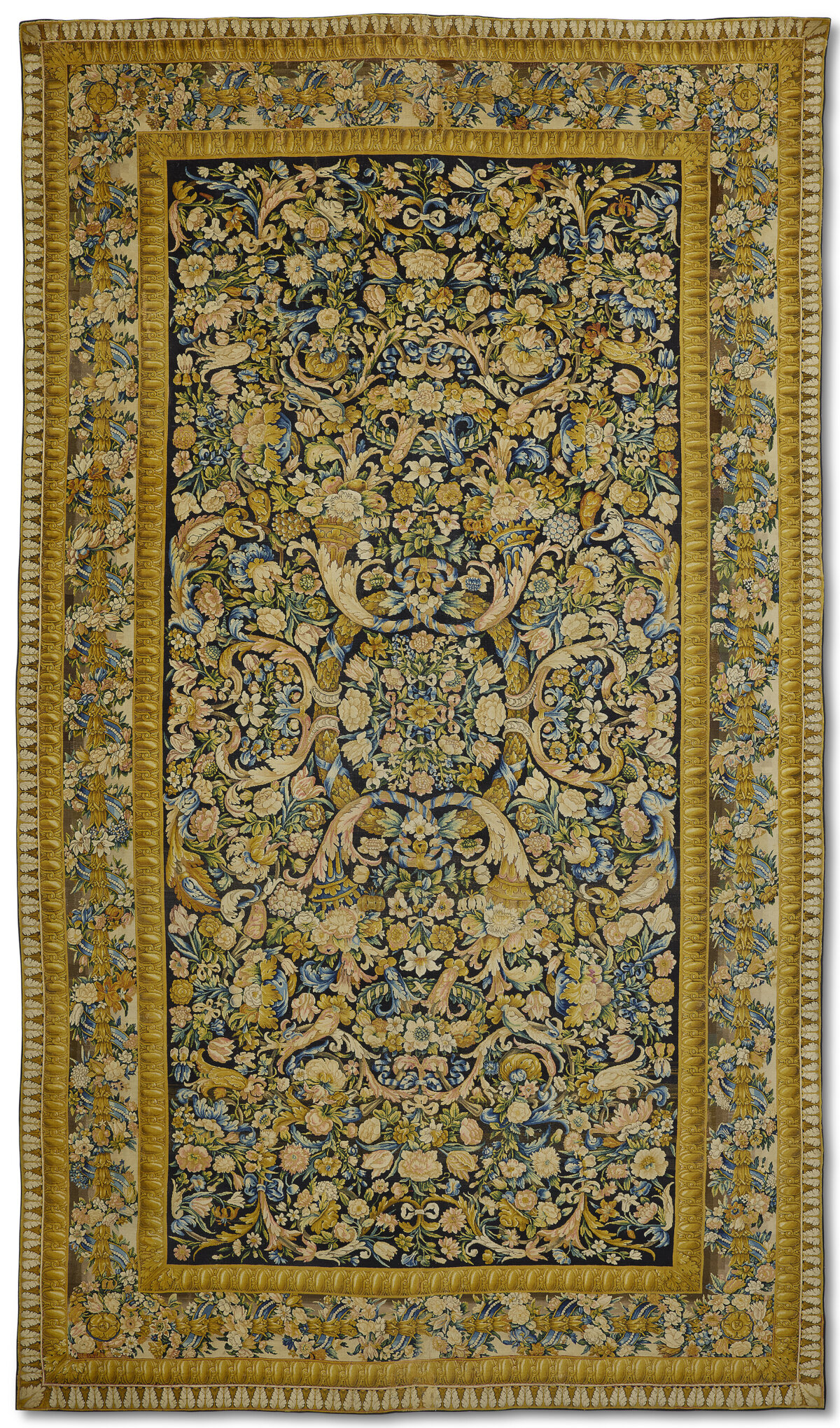
One of the most visually stunning lots in the sale is a rare carpet from the Royal Savonnerie Manufactory, probably made in the Chaillot workshop in France circa 1660 to 1664. The Manufactory was founded to encourage the domestic production of luxury goods and limit the need for imported ones. The monumental Ortiz Savonnerie carpet, at more than 19 feet, is a triumph of French design, craftsmanship, and taste.
Lavishly decorated with a “millefleurs,” or thousand flowers pattern, this grand textile is both beautiful and historically important. Specialists believe that it may have been one of the last, if not the final, “millefleurs” carpet ever woven at the Manufactory. It is one of the few examples still in private hands, and this is the first time it has ever been offered at auction.
This carpet blends elements of Safavid, Mughal, and Ottoman court carpets with the European style of depicting flowers with naturalism, as seen in contemporaneous floral still life paintings by the likes of Jan Brueghel the Elder. Another inspiration for carpets like this were Italian “pietra dura” tabletops. Identifiable flowers on the ground of the Ortiz Savonnerie carpet include carnations, daffodils, irises, narcissi, peonies, ranunculi, and tulips; these examples of flora were all viewed as à la mode and exotic during the period. Advanced technical effects used on the border create an ombré effect.
The Christie’s catalogue explains: “This use of shading adds texture and perspective, suggesting that the border is moulded, creating a three dimensional frame enclosing the field.”
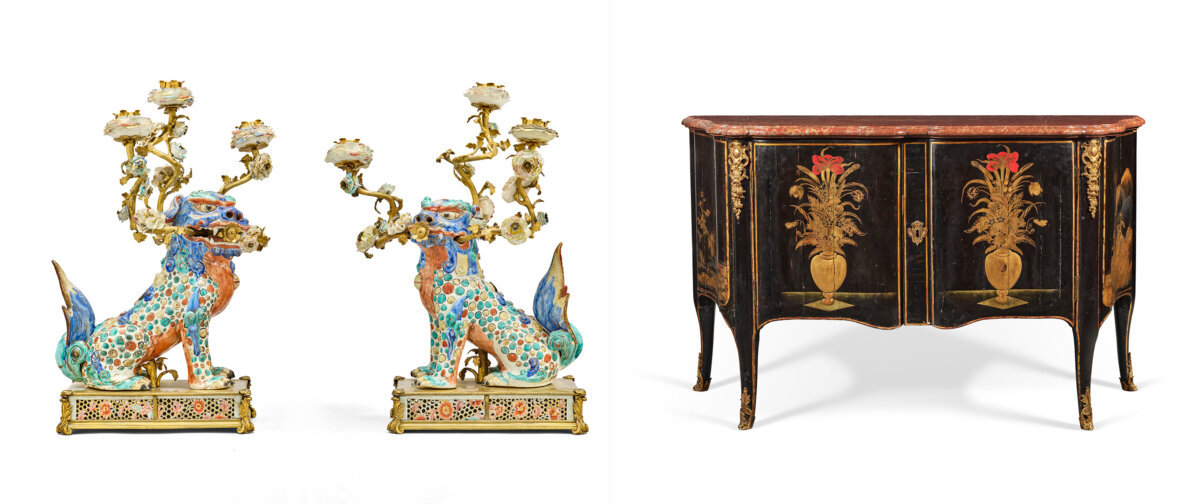
Many of the lots in Graziella Patiño de Ortiz Linares collection have not been seen by the public in decades, if at all. This sale offers the opportunity to not only view these treasures in person but affords prospective buyers the chance to secure such splendors for their own collections. The provenance of Graziella confers further excellence on these exalted works.
What arts and culture topics would you like us to cover? Please email ideas or feedback to features@epochtimes.nyc.