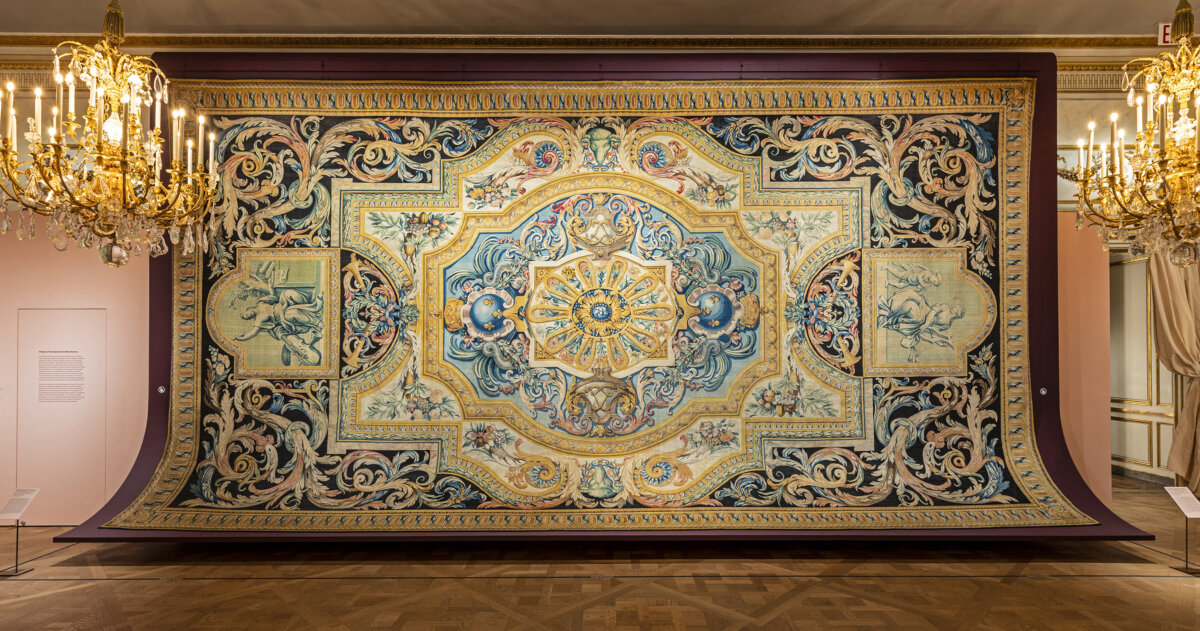
NEW YORK CITY—The first exhibition in the United States on the subject of the French carpet manufacturer Savonnerie has just opened in the Metropolitan Museum of Art’s Wrightsman Period Rooms, an enchanting recreation of historic French interiors that provide the perfect setting. “A King’s Carpet: Louis XIV and the Savonnerie,” on view through March 5, 2028, presents examples from a paragon of a project: King Louis XIV’s (1638–1715) ambitious commission, masterminded by his first minister Jean-Baptiste Colbert and begun in 1668, of the “tapis du roi,” the largest carpet ever woven.
Court painter Charles Le Brun oversaw the design of this monumental carpet. It was to be composed of 92 individual textiles. They would cover the entire floor span of the 480-yard hall, known as the Grande Galerie, that led to the king’s throne room in the Parisian palace, the Louvre. The vision was that when the Sun King entertained important visitors, they would be dazzled by the woven artistic splendor that denoted taste, wealth, and technical ingenuity. Elizabeth Cleland, Curator of The Met’s European Sculpture and Decorative Arts, explains:
“In 17th-century Europe up to this point, fine carpets had been almost exclusively silk low-pile imported from western Asia and north Africa, mostly intimate-scale precious ornamentation for furniture or placed underfoot in only the richest of domestic spaces. Louis XIV’s Grande Galerie scheme sought to astound courtiers, ambassadors, and visiting dignitaries by inviting them to walk upon lusciously thick, deep-pile carpets as far as the eye could see.”
Despite spending a huge amount of money and time (more than 25 years) on the scheme, scholars believe the carpets were never rolled out altogether. Louis XIV lost interest in the Louvre by the time they were delivered, having turned his attention to the redevelopment of Versailles. In addition, the integrity of the full project was lost since certain individual carpets were gifted to foreign diplomats.
The Grande Galerie carpets that remained in France were either kept in storage, pulled out for special occasions, or used in various other residences. As they were made according to the hall’s dimensions, sometimes—sacré bleu—they were modified to fit different homes by being cut or sewn together. After the French Revolution, some carpets were sold. Later, during the reigns of Napoleon I and King Charles X, many were reacquired by the state; these are now part of the collection of the Mobilier national in Paris.
Rolling out the Carpets
In February 2026, a landmark exhibit was held in Paris: The Mobilier national rolled out 32 carpets, the greatest gathering of the project’s individual pieces in their 350-year history. A photograph of this display is included in The Met’s exhibit, enhancing visitors’ understanding of how the carpets were intended to be placed side-by-side.
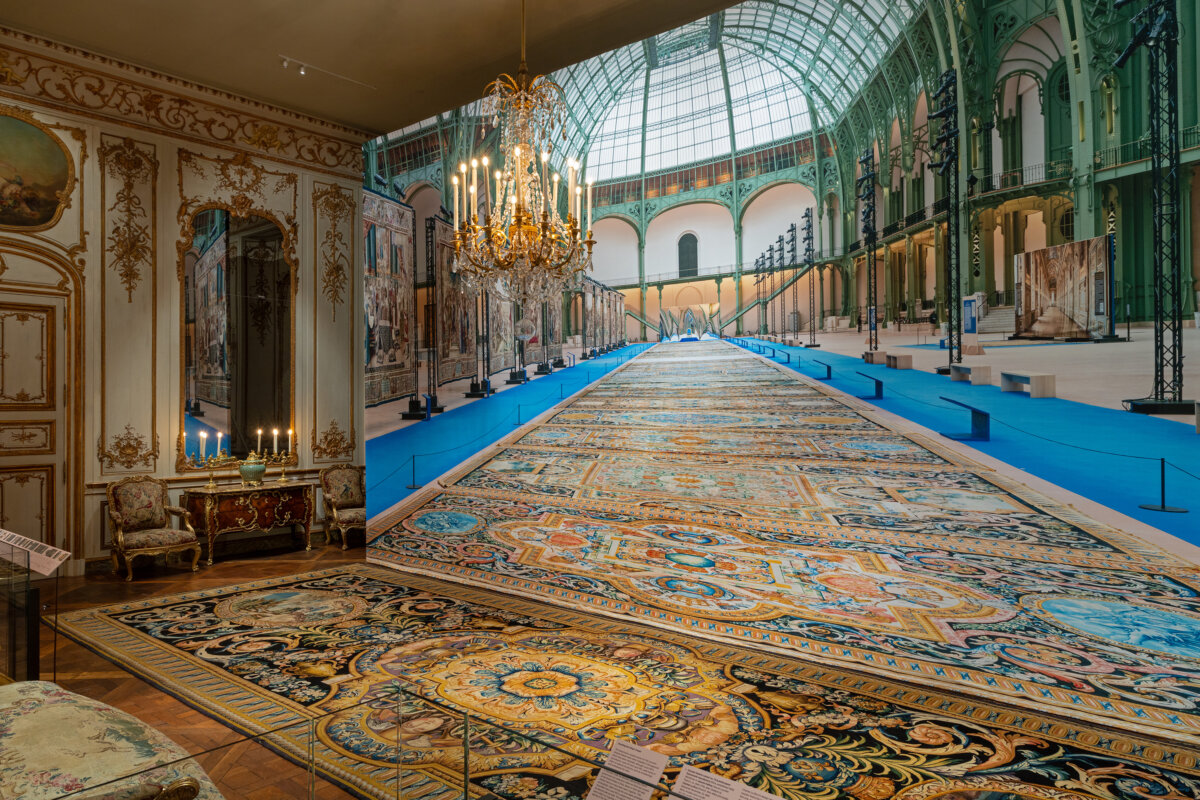
In subsequent centuries, carpets that were not repatriated, irreparably damaged, or lost, found themselves residing with society’s new “aristocrats,” including the Rothschilds, the Vanderbilts, and the Fricks. Today, surviving Grande Galerie carpets can be found in both public institutions and private collections in Europe and the United States. The Met owns three, and they comprise the centerpieces of this exhibit.
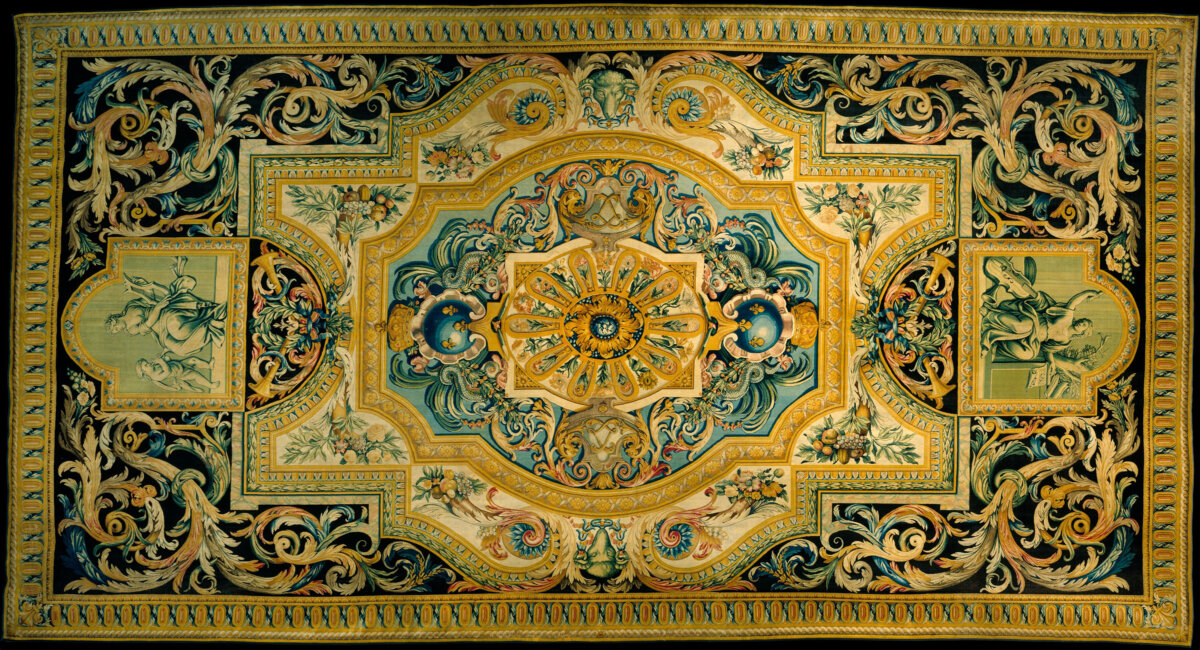
Before weaving the Grande Galerie carpets, the Savonnerie Manufactory created 13 carpets for the Louvre’s adjacent Apollo Gallery, whose decoration celebrates Louis XIV as the sun king. A spectacular example from this series, in both aesthetics and provenance, is on loan to the exhibit from a private collection.
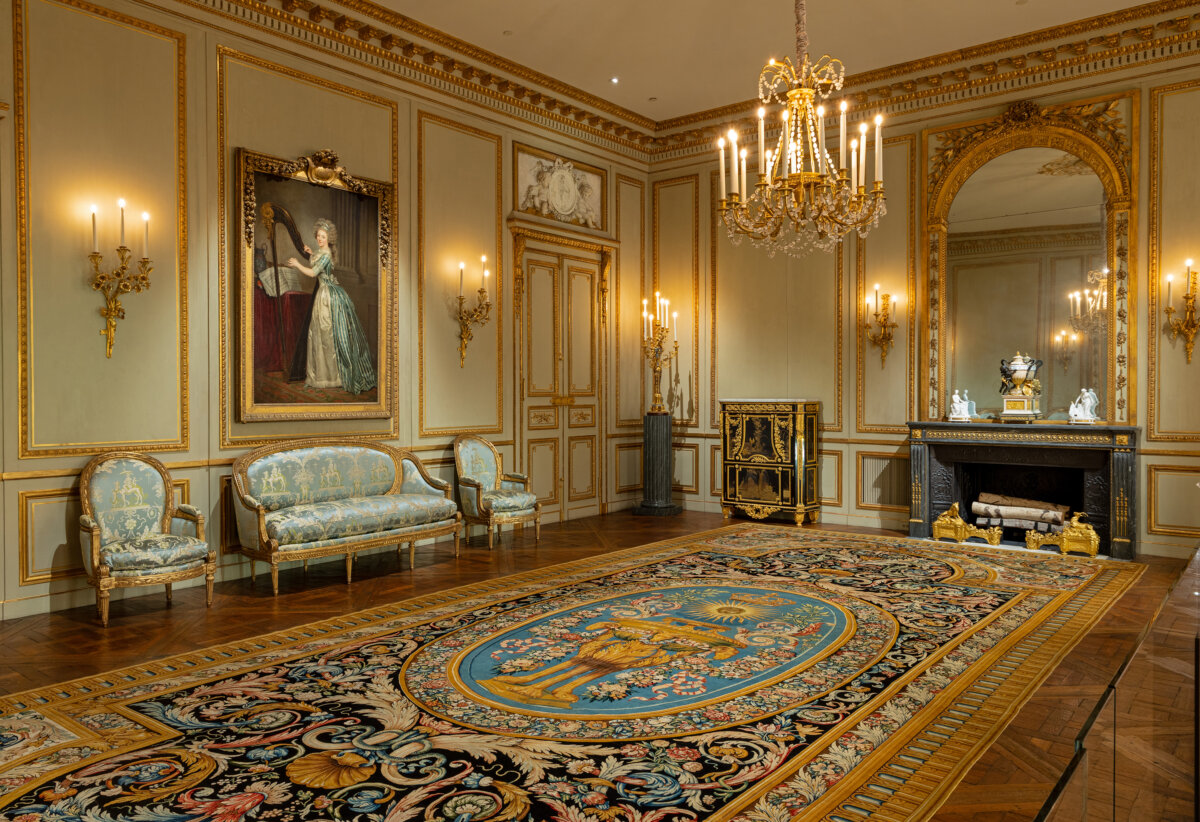
In 1785, it was used by Queen Marie Antoinette for temporary game rooms that she had built. At The Met, it is happily situated in a Wrightsman Room that contains pieces of furniture that were also owned by the queen. Subsequently, this carpet was in the collection of the Rothschild family. Arbiters of taste, the Rothschilds’ appreciation of Savonnerie carpets created a renewed interest for other elites to incorporate them in their interior decoration.
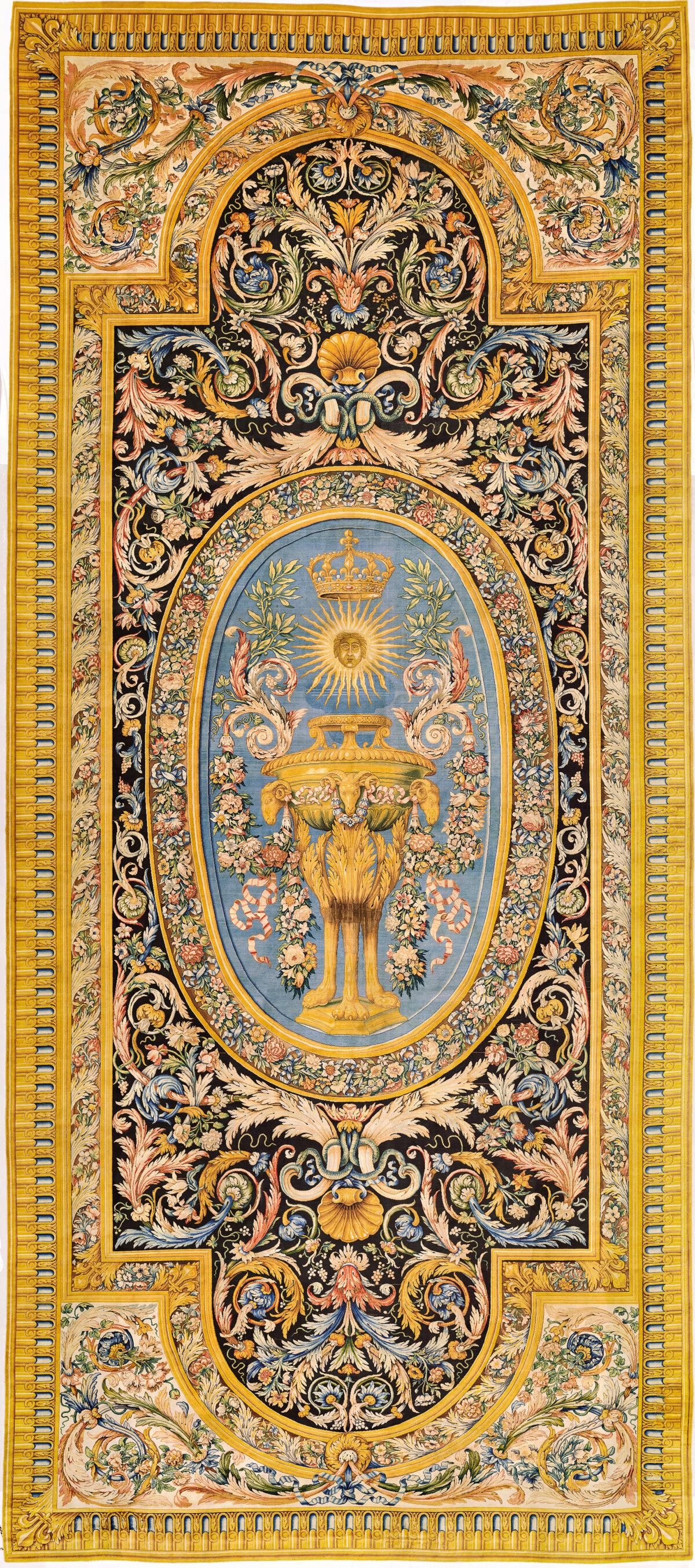
The Met’s “Grande Galerie carpet no. 38 (Fame and Fortitude)” was the first of these carpets to be imported to the United States. Before that, its French history included being in the hands of Louis XVI’s chief minister and the king’s aunt. It was acquired in the 1880s by Alva Vanderbilt for the ballroom of Marble House, her famous Newport, Rhode Island mansion. In the early 1920s, she had it shipped back to France for use by her daughter Conseulo, who was newly divorced from the Duke of Marlborough. American businessman and collector Samuel H. Kress bought the carpet in 1949. Once again, it was sent across the Atlantic to America. After his death, it was gifted to the museum.
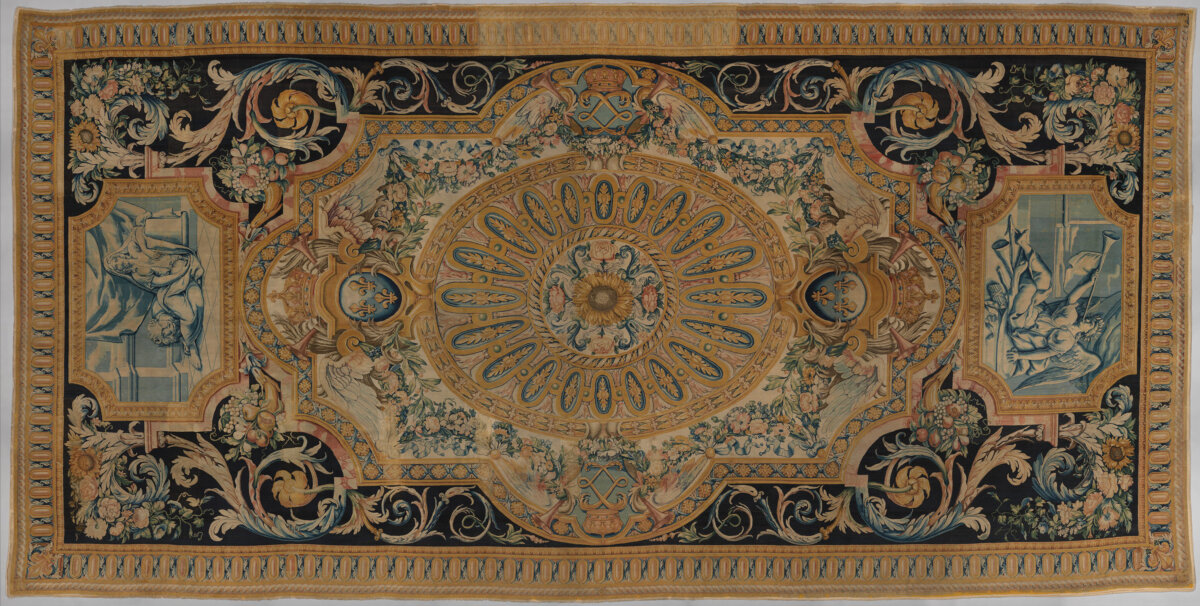
After enduring wear and tear, this carpet is being conserved by The Met as part of this exhibition. For the first time at the museum, this endeavor will be observable by visitors; a temporary in-gallery conservation studio was set up for this purpose.
A New Wall Hanging
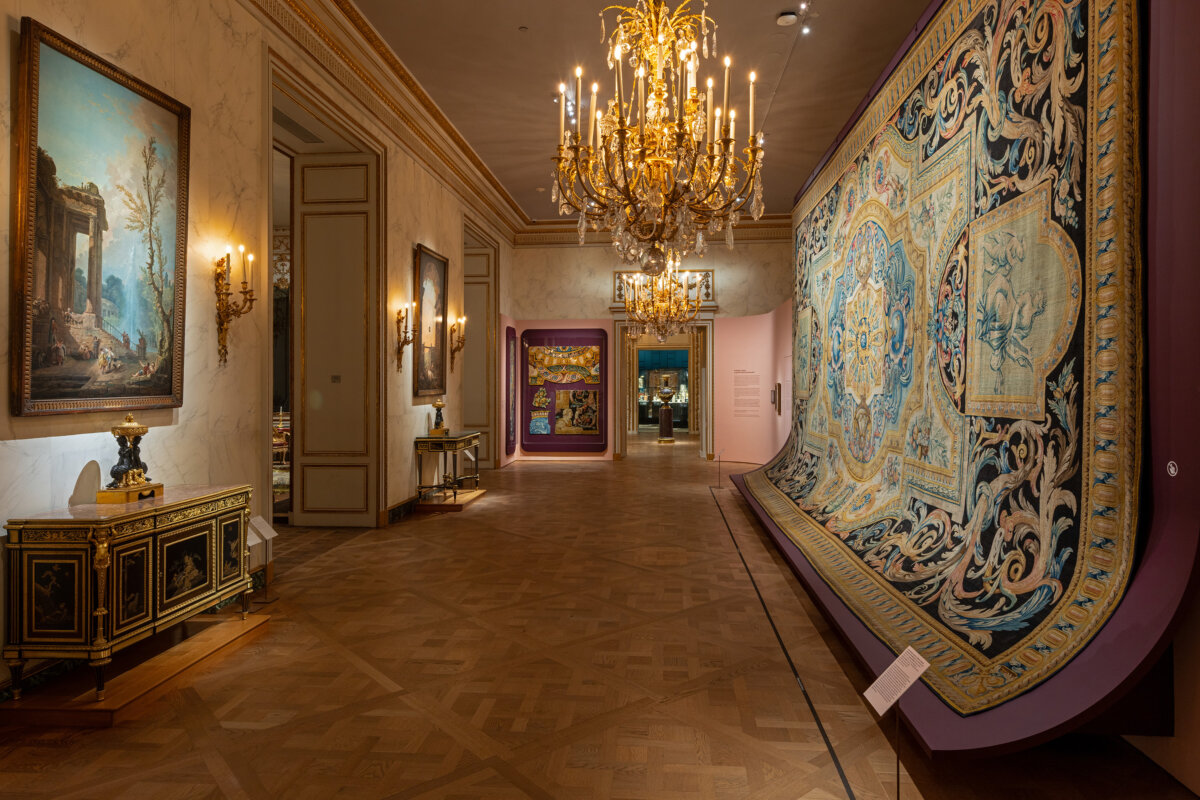
Another first for The Met is the mounting of a monumental carpet on a wall. “Grande Galerie carpet no. 11 (Music)” is hung like a tapestry, giving visitors a different viewpoint from which to appreciate its beauty. Featuring symbolism associated with music, the carpet displays Euterpe, the muse of music, and Erato, the muse of erotic lyrical poetry. This specific example was manufactured at the end of the project. It was woven based on the same cartoon, or design, as the original 11th carpet, which had been gifted by Louis XIV in 1685 to the ambassadors of Siam, known today as Thailand.
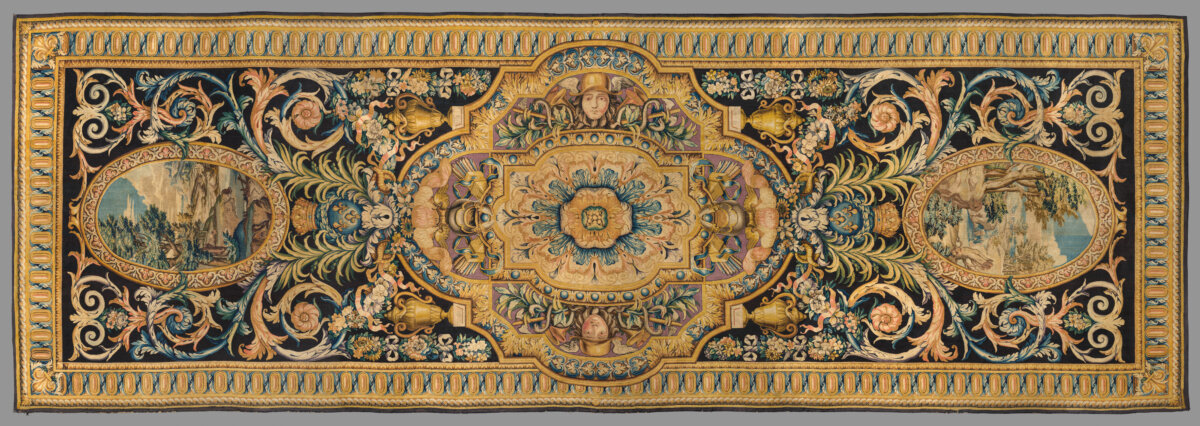
The best-preserved Grande Galerie carpet in an American public collection is fittingly at The Met and was a gift from Mr. and Mrs. Charles Wrightsman. “Grande Galerie carpet no. 73 (Landscapes)” is an example of the narrower carpets that Le Brun designed. This type has landscapes at each end. When installed, they were to be alternated with wider carpets that were decorated with allegorical bas-reliefs. In its fascinating history, it was used by the French ambassador to the Spanish court at Madrid; survived the French Revolution; spent time at the monastery in Santiago de Compostela; and withstood the Spanish Civil War.
This small but sumptuous exhibit explains the complex origins of the Savonnerie Manufactory, the Grande Galerie series, and the technical process behind creating this unprecedented commission. While celebrating the carpets’ beauty and dramatic histories, the exhibit also highlights a more human detail. The artisans of the magnificent carpets were orphans, young children, and adolescents conscripted for their sharp eyesight and small, agile fingers.
Much has been learned about the Grande Galerie series in preparation for the exhibits that debuted this year, but more archival research is needed to further unravel its mysteries.
“A King’s Carpet: Louis XIV and the Savonnerie” is on view at the Metropolitan Museum of Art in New York city through March 5, 2028. To learn more, visit MetMuseum.org.
What arts and culture topics would you like us to cover? Please email ideas or feedback to features@epochtimes.nyc.