He died believing he had failed. The opera he had labored on for years, a radical new score full of color and rhythm, was rejected by the Parisian public and the musical press on its premiere at the Opera-Comique. Critics called the plot, which involved common people of loose morals, “vulgar” and “obscene.” Audiences were confused by the Spanish folk-music elements foreign to opera, forms with strange names like “seguidilla” and “habanera.”
In short, “Carmen” was a flop.
Its composer, Georges Bizet (1838–1875) died three months after its premiere in March 1875, doubtlessly convinced that his only legacy was failure.
In history, many other artists were initially ignored or rejected, only for public opinion to reverse course. For example, Emily Dickinson wrote some 1,800 poems but fewer than a dozen appeared in print during her life.
Bizet’s case is especially tragic, as “Carmen” has consistently been at the top of the opera roster soon after the composer’s early death, apparently of a heart attack. In fact, it was following a performance of “Carmen” on the evening of Bizet’s funeral that the public began to speak well of the opera.
By the late 1880s “Carmen” was staged all over the world. It quickly became the “C” in the “ABC of Opera.” “A” was Verdi’s “Aida” and “B,” Puccini’s “La Boheme.” “Aida” and “Boheme” have slipped slightly in popularity, but “Carmen” maintains its stature as the third most performed opera on the planet, after Verdi’s “La Traviata” and Mozart’s “The Magic Flute.” Worldwide, “Carmen” enjoys more than 600 productions per year.
Rediscovered in the 20th Century
For a long time, “Carmen” was the only Bizet score anybody knew about. Over the decades, other Bizet works entered the repertoire, notably his opera “The Pearl Fishers” and the two “L’Arlesienne” suites. The final Bizet composition to be discovered and premiered was also the earliest written: the Symphony in C, composed in 1855 when Bizet was only 17.
A student assignment from his teacher Charles Gounod at the Paris Conservatoire and never performed, the Symphony in C was put on a shelf and forgotten about until 1933 when it was discovered by the musicologist Jean Chantavoine. Bizet’s first biographer, D.C. Parker, showed the manuscript to conductor Felix Weingartner, who premiered the work in 1935.
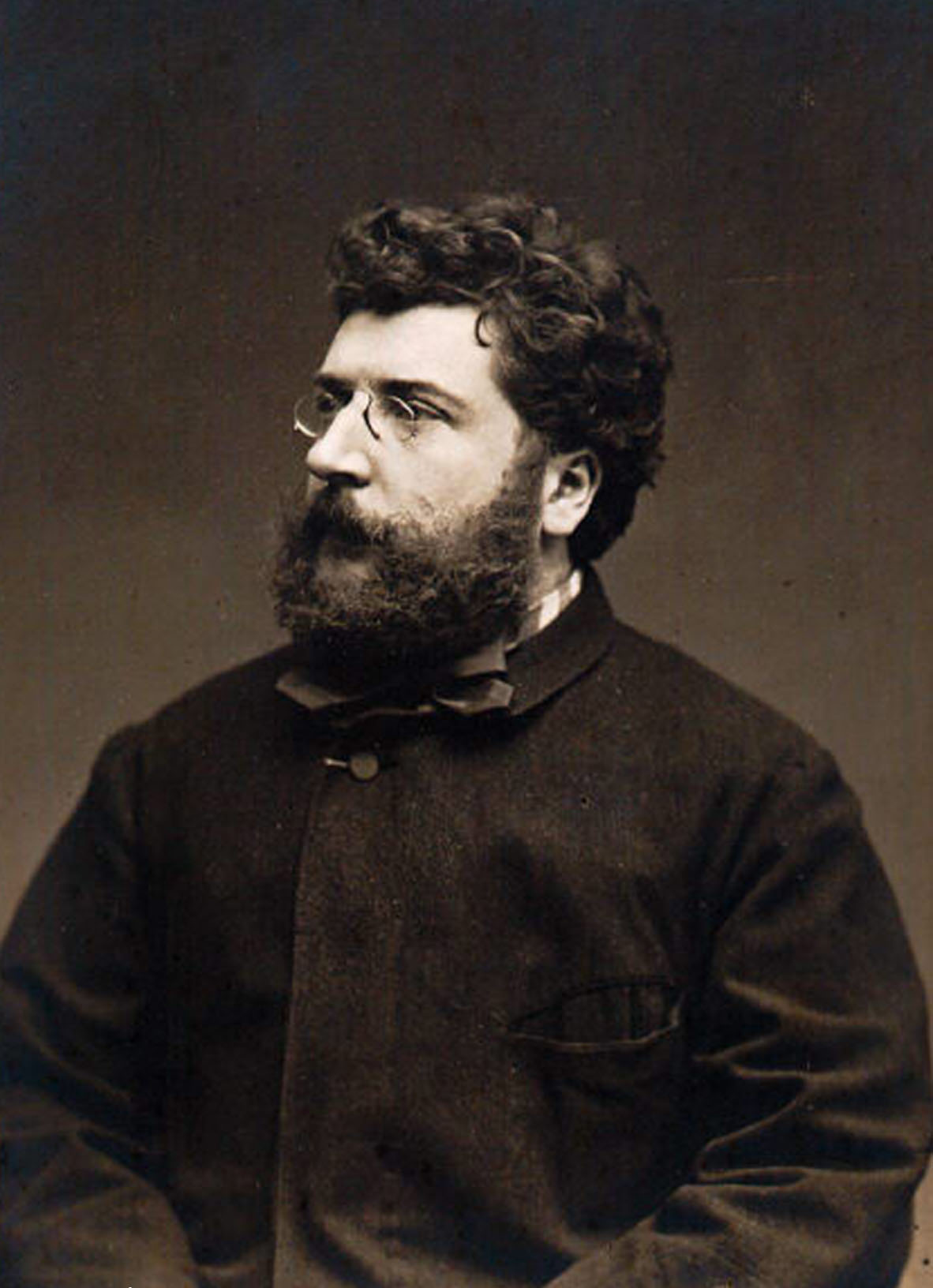 Georges Bizet photographed by Etienne Carjat in 1875. (Public Domain)
Choreographer George Balanchine made a ballet from the score, and it may be that Bizet’s symphony is heard more often in that contest than in the concert hall. While it appears in concert performances, the Symphony in C has never been as popularity as one of Schubert’s or Mendelssohn’s or Schumann’s numbered symphonies. Lightly orchestrated and without passages of grave sobriety, it is in the lighter vein of early Mozart or Haydn symphonies.
The designation Symphony No. 1 not an error; there is a Bizet Symphony No. 2, the Roma Symphony from 1871, though it is rarely played. Bizet’s Symphony in C is performed here as his Symphony No. 1 by the Netherlands Chamber Orchestra led by Gordan Nikolic. (Listen)
Symphony in C’s Movements
The symphony is in the standard four movements. First is Allegro vivo, in sonata form. The main subject exploits what is known as the feminine gesture. Listen for the three-note motif. If the first note were to go directly to the last note, that would be a masculine gesture. But it repeats the first note before going up or down. At around 2:01, the oboe enters with plangently lovely second theme.
In Andante/Adagio movement (8:06), the oboe again takes pride of place in a long-lined lyrical solo.
The third movement, Allegro vivace (19:29), is a swirling scherzo in vivacious three-four meter.
The last, Allegro vivace (25:28), has the same tempo indication as movement III but in two-beat and with a lot more notes-per-count. An exciting race to the finish line of an optimistic teen composer’s first major work.
What arts and culture topics would you like us to cover? Please email ideas or feedback to features@epochtimes.nyc.