As the Northern Hemisphere shifts seasons from summer to fall, the long days of summer shrink and the once-verdant land turns golden. Now, most of us seek warmth and comfort as winter looms. Unless it’s our livelihood, we don’t think about the farming seasons.
In Medieval times, people’s lives and livelihoods often depended on the land. They attuned themselves to the ebbs and flows of the seasons, often rising with the sun, working the land, and retiring at sundown.
Praising God’s Land
Medieval artists rendered the “labors of the months” to celebrate how people farmed the land that God provided for them to thrive. Striking images of labors of the months appeared in illuminated manuscripts such as “The Very Rich Hours of the Duke of Berry,” illustrated by the Limbourg Brothers roughly between 1412 and 1416. Later labors of the months appeared in secular settings.
Merchant and art collector Nicholaes Jongelinck (1517–1570) commissioned one of the most famous labors of the months for the dining room of his home, t’goed ter Beke, on the outskirts of Antwerp. Flemish artist Pieter Bruegel the Elder (circa 1525–1569) completed the series in 1565, on six large panel paintings hung high on the wall.
Bruegel’s “Labors of the Months” reflects the six seasons—early spring, spring, early summer, summer, fall, and winter—observed in the Low Countries, a coastal region of northwestern Europe (that includes modern-day Belgium, the Netherlands, and Luxembourg).
Bruegel’s Months
Bruegel reflected seasonal colors throughout this timeless series. In each painting, he rendered a church, with some more prominent than others.

Early spring (February/March): Storm clouds and strong winds whip the sea into a frenzy, and villagers work hard before the rain comes in “The Gloomy Day.” One villager mends a thatched roof, while other villagers prune trees, gather firewood, and bundle willow branches for fences. In the foreground, a boy wears a paper crown traditionally worn on Epiphany, but here it alludes to the season of Epiphany or Epiphanytide.

Spring (April/May): Experts believe the composition of Bruegel’s pen-and-ink drawing of the season could be similar to the missing spring painting that he completed the same year.
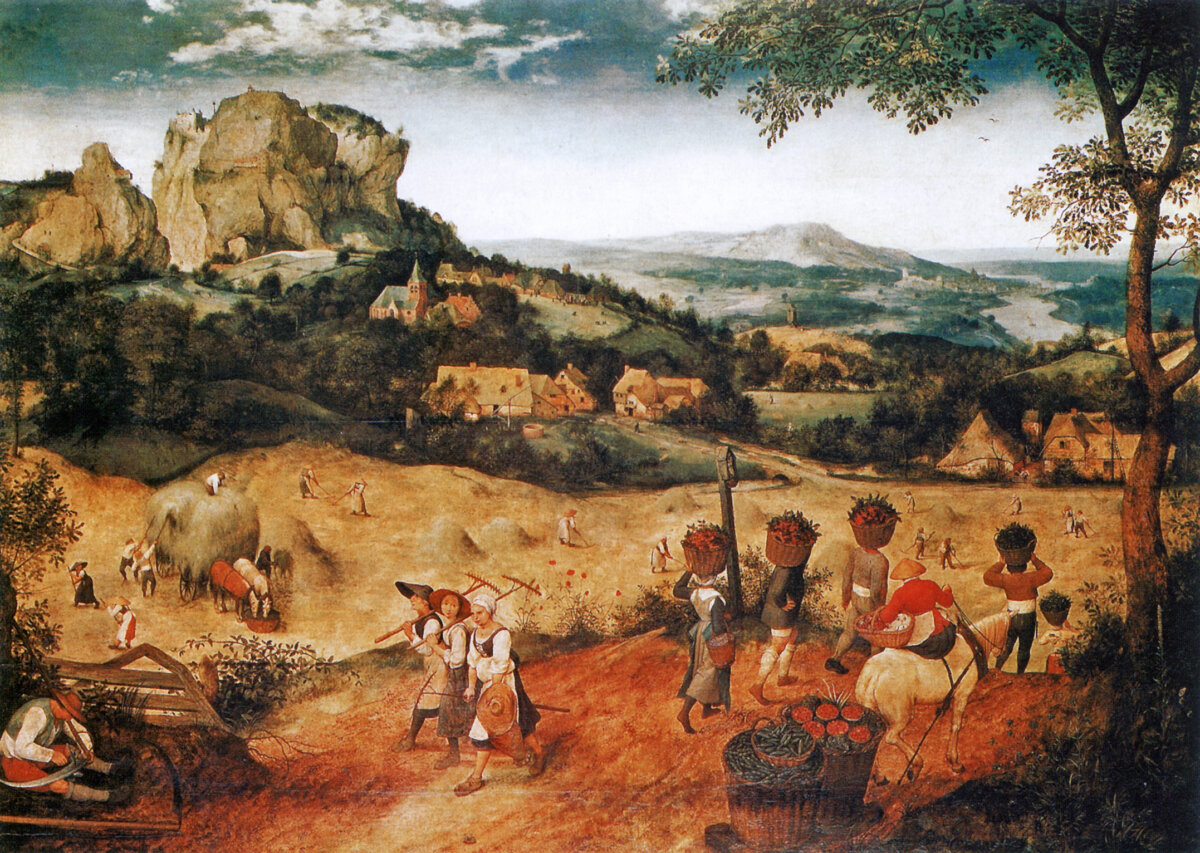
Early summer (June/July): High clouds pass across the land; it’s a tapestry of dark green woodland, honeyed hayfields, and well-trodden, red dirt tracks in “The Hay Harvest.” Women in the fields rake freshly cut grass into piles for the men to stack on the hay cart. While in the foreground, a man mends his scythe, women walk with their rakes, and another group carry baskets full of fruits and vegetables.
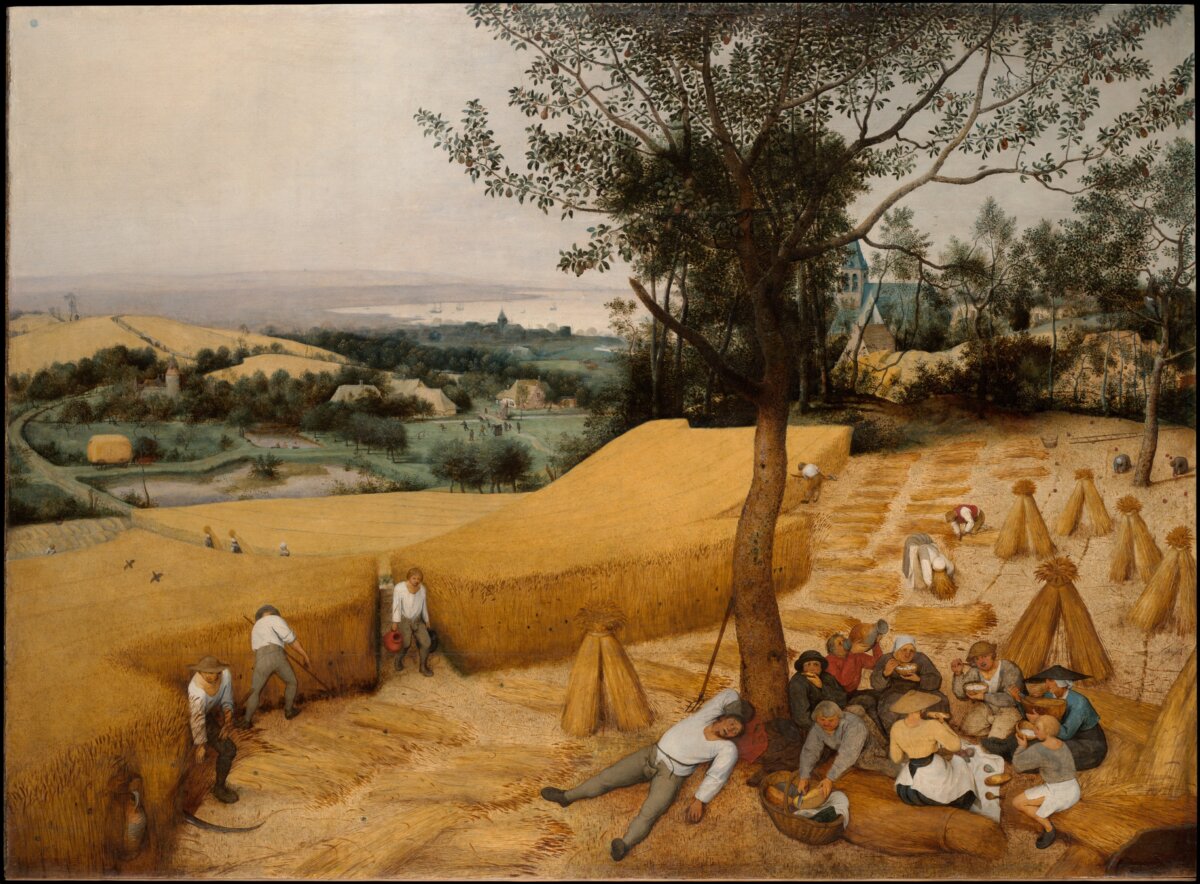
Summer (August/September): Bruegel rendered a typical summertime harvest in August in “The Harvesters.” Laborers scythe the wheat and tie it into sheaves on a clement day, before taking a well-earned break under a tree. Some laborers sit on wheat sheaves eating, while one naps.
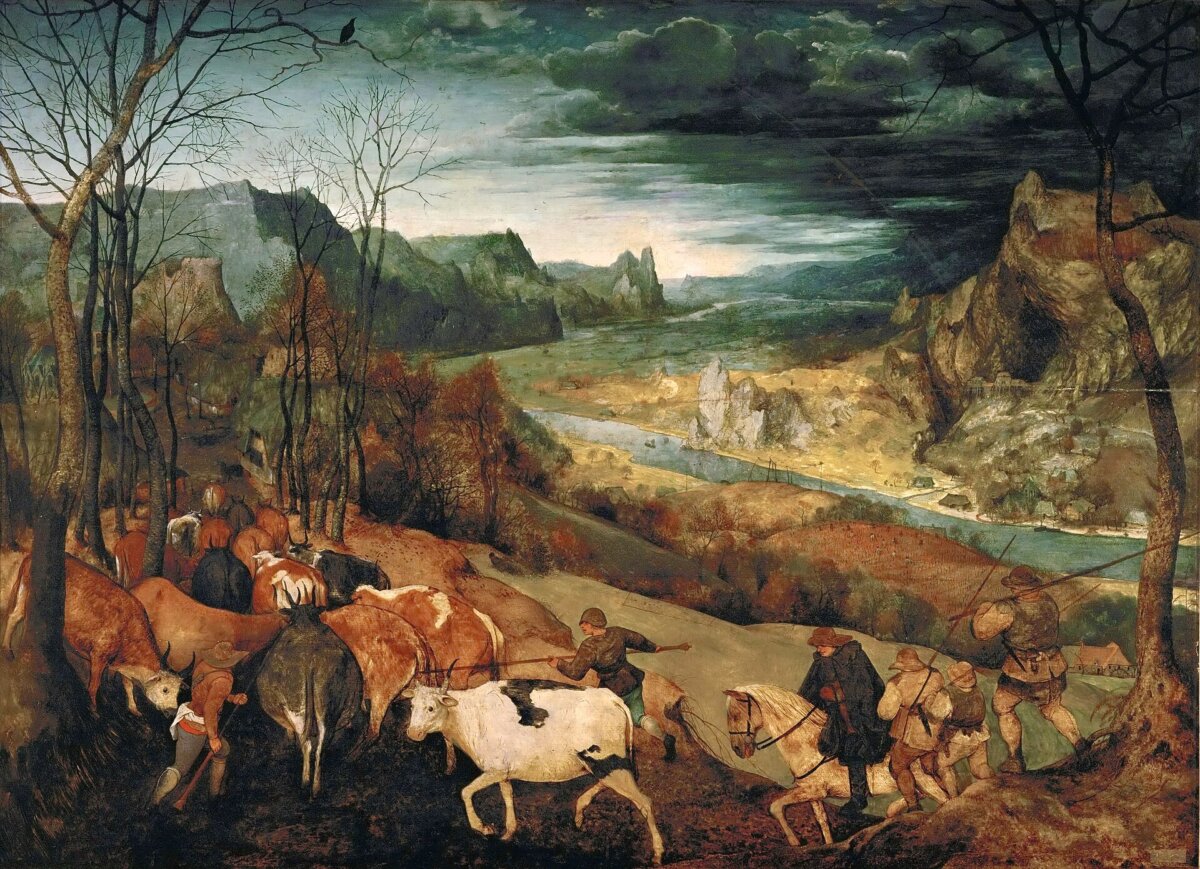
Fall (October/November): Dark clouds drift ominously across the sky, casting cool shadows across the land as farmers hasten their work before nightfall in “The Return of the Herd.” Bruegel depicted the farmers in November herding cattle uphill from the valley pastures, towards their winter quarters in the village.

Winter (December/January): Bruegel’s cool blue and green color palette emphasizes the biting cold of a harsh winter’s day in “The Hunters in the Snow.” Three hunters return from their hunt with just one rabbit. Undeterred, their hunting dogs eagerly follow a scent into the snow- and ice-covered village.
Pieter Bruegel the Elder
Bruegel first began work as a print designer for the publisher Hieronymus Cock, for whom he produced many print series distributed across Europe. The prints show scenes of virtues and vices, depicted among joyous peasant festivals and seemingly never-ending landscapes. Later in his career, he focused more on painting, such as the “Labors of the Months,” for wealthy customers in Antwerp and Brussels.
Bruegel bravely used the canvas to confront the issues of his day rather than an idealized form of reality. Some of his paintings show the horror of religious warfare.
His paintings were not mere commentary. A closer look at the everyday scenes reveals subliminal messages: Bruegel’s own pictorial language that expressed his opinions. This pictorial code allowed him to avoid repercussions while highlighting the immorality he saw.
What can be seen is that Bruegel often painted what looks like complete worlds, intricately painted, down to the most minuscule of details.
What arts and culture topics would you like us to cover? Please email ideas or feedback to features@epochtimes.nyc.