



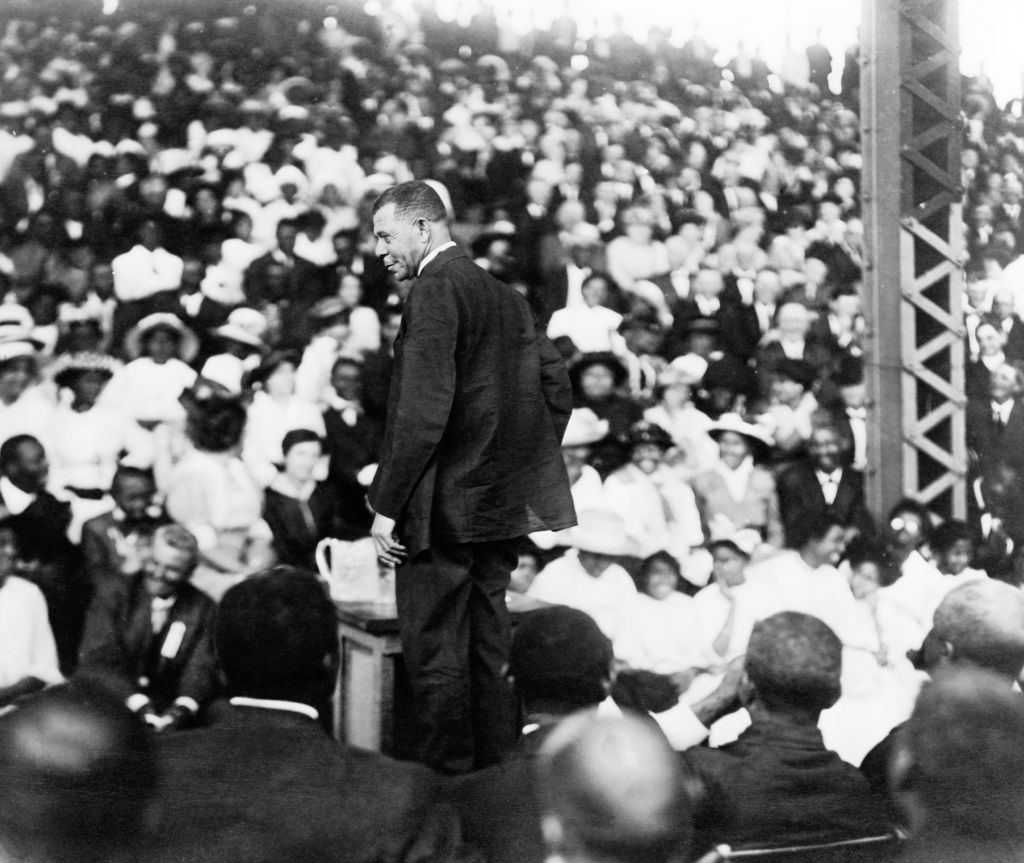
Born into slavery in Virginia in 1856, Booker T. Washington went on to become one of the most prominent advocates for former slaves and their descendants.
Freed from the bonds of slavery toward the end of the Civil War, he worked his way through a teaching and agricultural school in Virginia, later attending a Seminary college in Washington, D.C. At age 25, he was appointed the first leader of the Tuskegee Institute in Alabama, a position he held for almost 35 years, until his death in 1915.
Washington gained national attention in 1895 delivering his Atlanta Exposition Address, which was covered by newspapers across the country, leading to his becoming a popular advocate for the advancement of black people in the United States, especially in the South.
Yet as he continued to accumulate influence and power as a black leader, he was often criticized by other black leaders for his willingness to compromise with white people. Some of these leaders began to refer to Washington’s famous speech as the “Atlanta Compromise.”
While Washington often publicly expressed the idea that black people would be better served by earning money, building businesses, and working in cooperation with the predominantly white society by becoming an integral part of the economy than by protesting for equal rights, he was also privately working to secure those rights. It was not widely known until more than three decades after his death that Washington had secretly funneled a considerable amount of money to support numerous legal challenges to racist laws across the southern states.
In 1901, he published his best-selling autobiography, “Up from Slavery,” which is still studied in schools across the country. In his lifetime, he published more than a dozen books, gave hundreds of speeches, and raised millions of dollars to build and fund thousands of schools for black students.
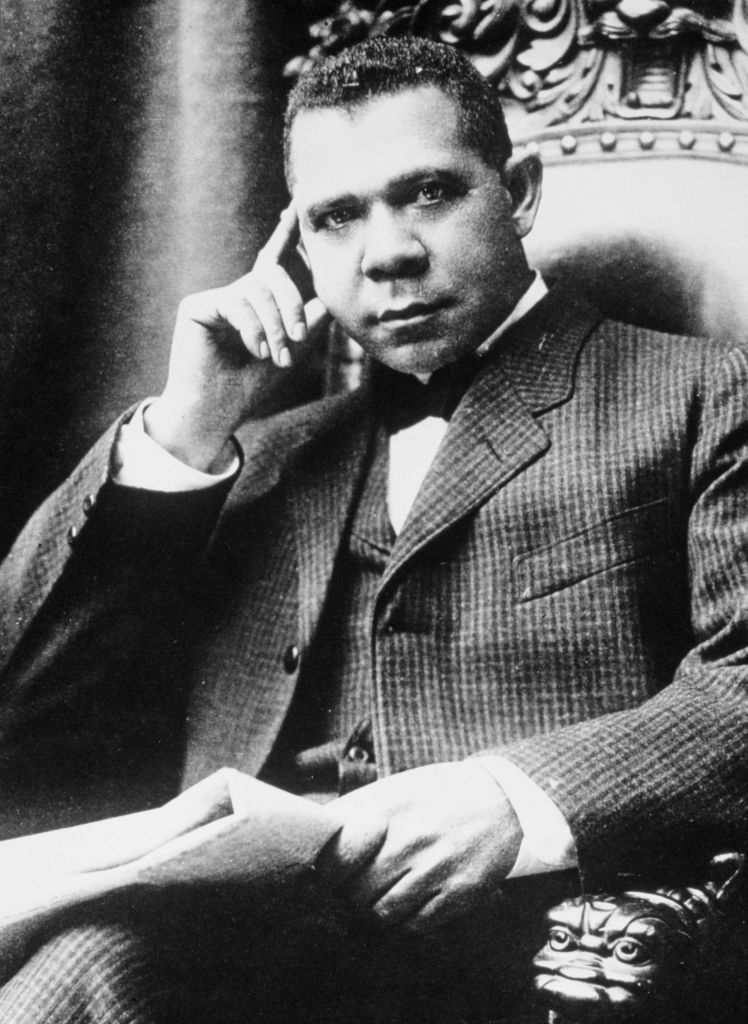 Booker T. Washington (1856–1915), circa 1885. (Archive Photos/Getty Images)
1. A Strong Work Ethic
Washington believed in the value of hard work. Not only did he express this belief in his speeches and writings, he exemplified it in his actions. “Nothing ever comes to me, that is worth having except as the result of hard work,” he wrote.
After being freed from slavery in Virginia, 9-year-old Washington moved with his family to West Virginia, where he worked initially in the salt furnaces and later in the coal mines. At 16, he returned to Virginia to attend the Hampton Agricultural and Industrial Institute, paying his tuition by working as a janitor at the school.
The president of the Hampton Institute was so impressed with Washington’s work ethic that he recommended him to run the new Tuskegee Normal and Industrial Institute in Tuskegee, Alabama. Initially, classes were held in a room donated by a local church, but within a year Washington had raised enough money to purchase a nearby plot of land, on which he and the students built the school.
They made their own bricks, cut their own lumber, and constructed classrooms and barns from the ground up. They also planted crops and raised livestock. Washington believed in the value of manual labor, so in addition to their academic training, students at the institute were also required to learn various trades and farming techniques.
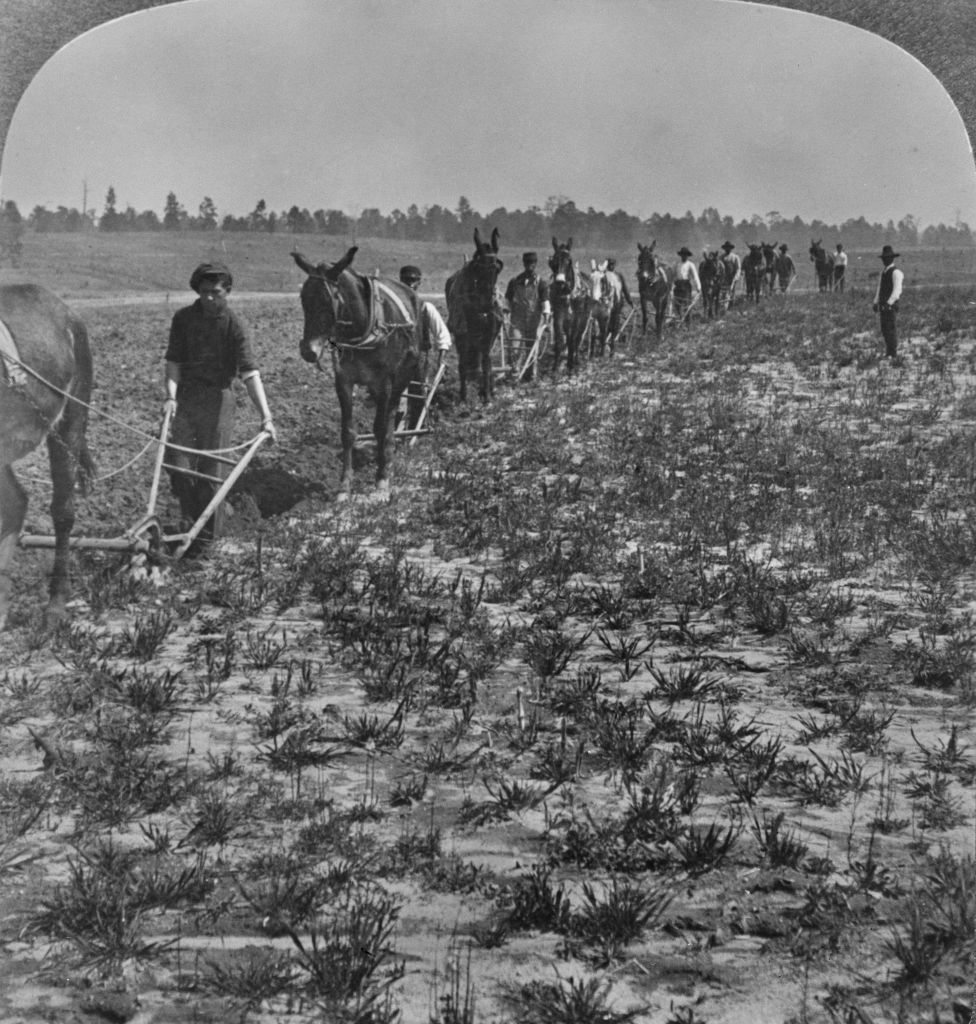 Students use horse-drawn ploughs to work a field at the Tuskegee Institute in Tuskegee, Ala., circa 1910. (Underwood & Underwood/Archive Photos/Getty Images)
2. Self-Reliance
Washington never knew his father, and although throughout his life he often gave credit to his mother for teaching him the work ethic and values that allowed him to become successful, he was in many ways a self-made man.
He left home at the age of 16 with little more than the clothes on his back, and yet he went on to become one of the most prominent black leaders and educators in the country. He pulled himself “up from slavery,” and then spent the remainder of his life working to help other former slaves and their descendants improve their condition and increase their standing in a white-dominated society.
When he started the Tuskegee Institute, many black people throughout the south remained not only impoverished, but illiterate. While Washington recognized the importance of teaching these people to read and write, he also realized that it was equally, if not more, important to teach them to support themselves by providing their own food, clothing, and shelter.
From the beginning, he designed the Tuskegee Institute to be a self-sufficient organization. The faculty and students constructed the buildings, tended the crops, and raised the livestock. Although it was primarily a teachers’ college, where aspiring educators were trained to teach traditional academic subjects, it was also a trade school, where the future teachers were simultaneously trained in the crafts and skills that might prove most useful to the people they would be teaching. So alongside reading, writing, and mathematics, the students learned additional skills including carpentry, bricklaying, farming, and ranching.
 Students working in the laboratory at the Tuskegee Institute in Alabama in 1884. Founded for black students in 1881, it was run by Booker T. Washington until his death in 1915. (MPI/Getty Images)
3. Overcoming Adversity
Like every black person in the post-reconstruction era south, Washington faced his share of adversity, yet he refused to be discouraged.
“I have begun everything with the idea that I could succeed,” he wrote.
Washington treated the adversity he faced as a challenge to be surmounted.
“I have learned,” he said, “that success is to be measured not so much by the position that one has reached in life as by the obstacles which he has overcome while trying to succeed.”
Concerning the difficult circumstances into which he and other black people were born, he believed that “out of the hard and unusual struggle through which he is compelled to pass, he gets a strength, a confidence, that one misses whose pathway is comparatively smooth by reason of birth and race.”
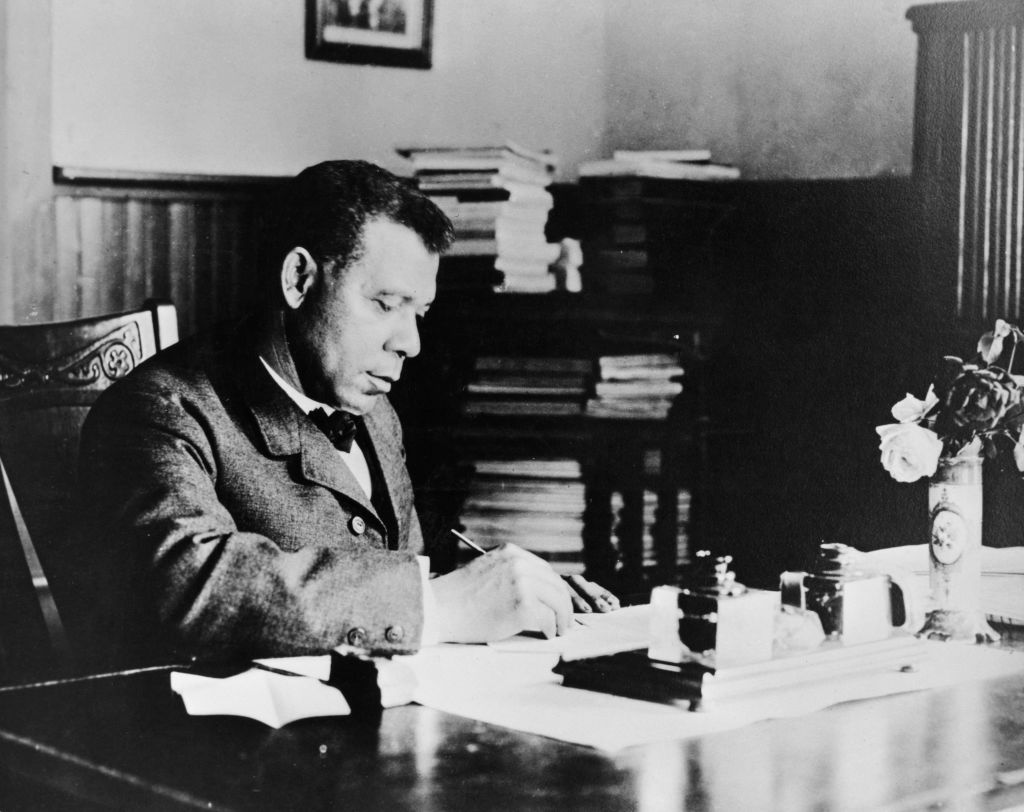 American educator, economist, and industrialist Booker T Washington (1856–1915), founder of the Tuskegee Institute in Alabama, at his desk, circa 1901. (Authenticated News/Archive Photos/Getty Images)
“Every person who has grown to any degree of usefulness,” he said, “every person who has grown to distinction, almost without exception has been a person who has risen by overcoming obstacles, by removing difficulties, by resolving that when he met discouragement he would not give up.
“The man who has learned to do something better than anyone else, has learned to do a common thing in an uncommon manner, is the man who has a power and influence that no adverse circumstances can take from him.”
4. Cultivating Relationships
Throughout his life, Washington was adept at developing strong partnerships with talented and influential people, and these relationships helped him immensely in his efforts to lift up the people of his race.
“The older I grow,” he wrote, “the more I am convinced that there is no education which one can get from books and costly apparatus that is equal to that which can be gotten from contact with great men and women.”
Washington surrounded himself with many intelligent men and women, both black and white, and he made an effort to develop these relationships and engage them in the service of his cause. At Tuskegee, he employed and worked with many talented black people, such as George Washington Carver, whom he hired to head the Agricultural Department shortly after reading Carver’s study on an infection plaguing soybean crops.
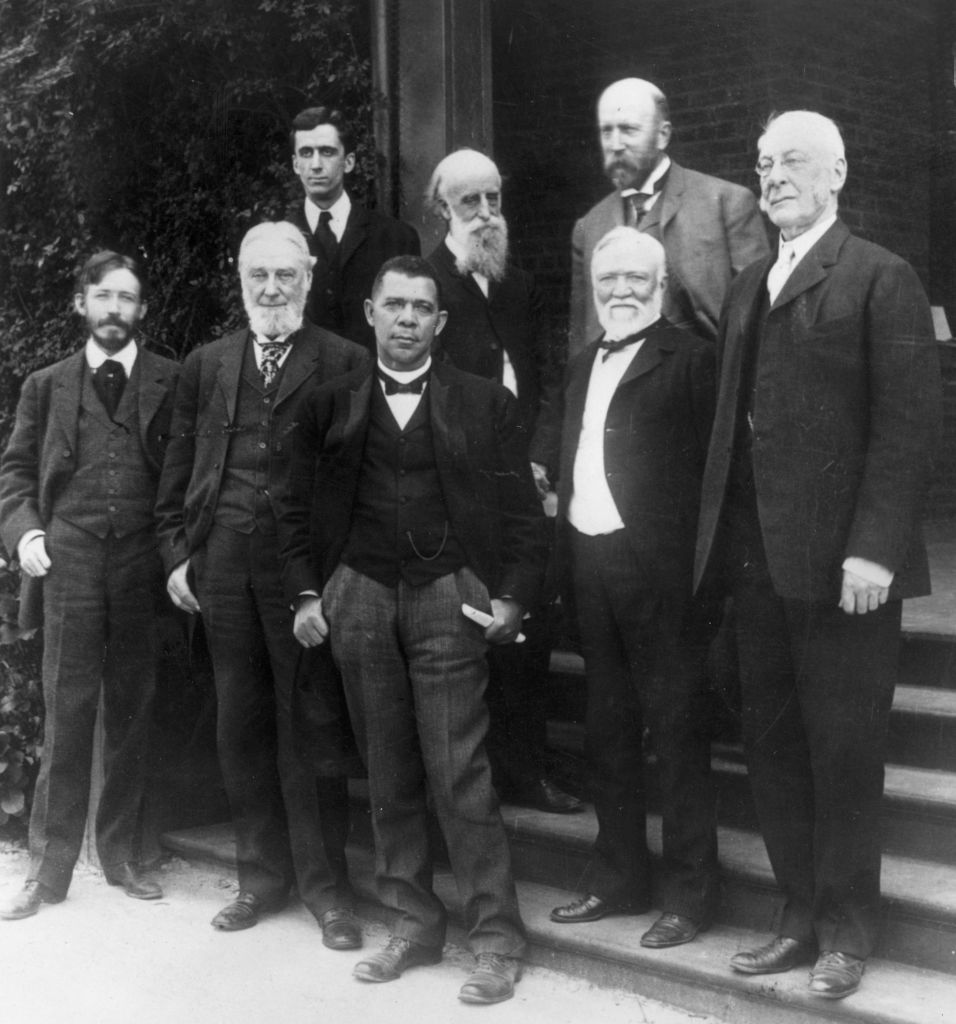 American educators and philanthropists gather on the steps of the Tuskegee Institute to mark the 25th anniversary of its founding, in Tuskegee, Ala., on April 5, 1906. Front row (L–R): New York City politician and journalist George McAneny, president of the Hampton Institute (now University) Robert Ogden, founder of the Tuskegee Institute Booker T. Washington, steel baron and philanthropist Andrew Carnegie, and president of Harvard University Charles W. Eliot. Back row (L–R): millionaire socialist and philanthropist J.G. Phelps Stokes, clergyman and author the Rev. Lyman Abbott, and H.B. Trissell. (Hulton Archive/Getty Images)
All these men, and many other philanthropists, donated considerable amounts of money to support Washington’s cause of educating southern black people.
Two presidents, William McKinley and Theodore Roosevelt, visited Washington at Tuskegee. He was invited to speak at many prestigious institutions, and spoke alongside Mark Twain at a fundraiser at Carnegie Hall in New York. He was also invited to speak at some of the most prominent universities in the country and was awarded honorary degrees from both Harvard and Dartmouth.
5. Love, Not Hate
As a child, Washington listened to his mother praying to be released from the bonds of slavery, and eventually he saw her prayers answered.
He was a lifelong Christian, and although he attended Wayland Seminary shortly before starting the Tuskegee Institute, he spent far more time teaching than preaching. However, he always sought to embody his Christian values, and his many accomplishments serve as a testament to those values.
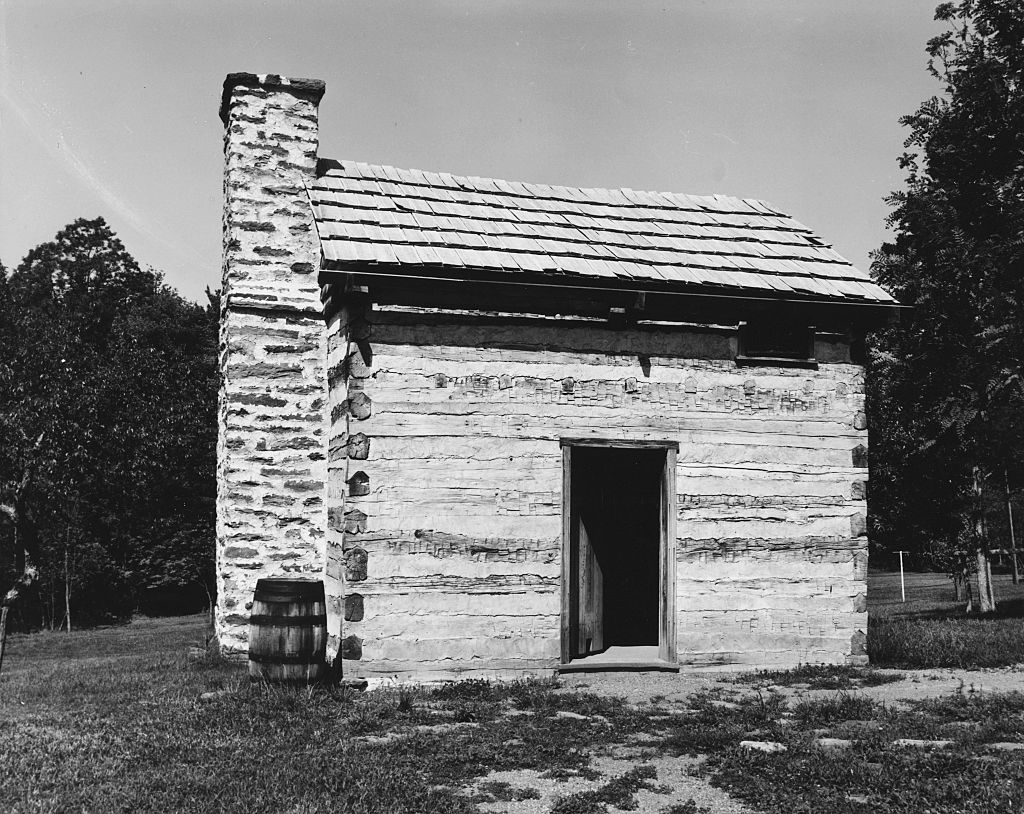 View of a reconstruction of Booker T. Washington’s childhood home, a log cabin on the Burroughs’ Plantation in the Blue Ridge Mountains, now a national monument, Virginia, circa 1956. (Authenticated News/Archive Photos/Getty Images)
Throughout his speeches and writings, he frequently expounded on teachings of the Gospels.
Jesus counseled his disciples to love their enemies and pray for those who persecute them, Washington said, “I would permit no man, no matter what his color might be, to narrow and degrade my soul by making me hate him.”
