



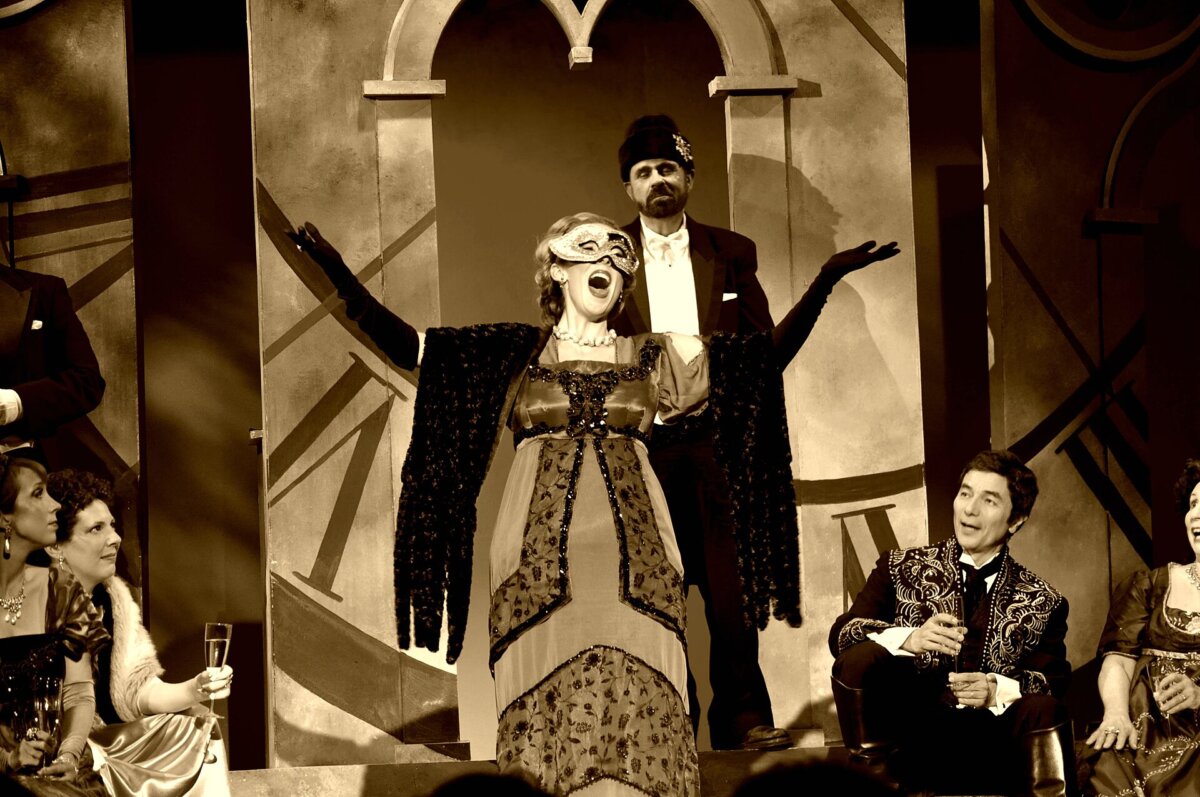
Secretly, however, Rosalinde is delighted—she has promised to meet her former lover, Alfred, after her husband leaves. Yet when Alfred arrives at the house, the warden also arrives to take Gabriel to prison. To prevent a scandal, Rosalinde convinces Alfred to pretend to be her husband and go with the warden instead.
At the party, Falke sends a letter to Rosalinde revealing that Gabriel is at the ball. When Rosalinde receives the note, having just dealt with the drama of the warden, she is furious and heads to the party disguised as a countess.
It turns out Doctor Falke is not taking Gabriel to the party out of goodwill, but as part of a scheme called “The Revenge of the Bat.” Falke is seeking revenge on Gabriel for having once abandoned him after a party: Gabriel left a drunk Falke wandering the streets in a bat costume, turning the doctor into the laughingstock of the entire town.
At the party, Rosalinde sees her husband and approaches him. Maybe it’s the champagne, maybe it’s the disguise, but Gabriel does not recognize her. As he courts the mysterious “countess,” Rosalinde steals his watch as proof of his infidelity.
When the party ends, Gabriel leaves for prison.
Upon arrival, Gabriel bumps into Alfred, and the entire facade collapses. When Rosalinde comes to arrange her former lover’s release, she encounters her husband. As their quarrel escalates, both realize that neither wants to take responsibility for their actions.
So what better way than to blame it all on the champagne?
This could be the tabloids; this could be a rom-com. This is “Die Fledermaus.”
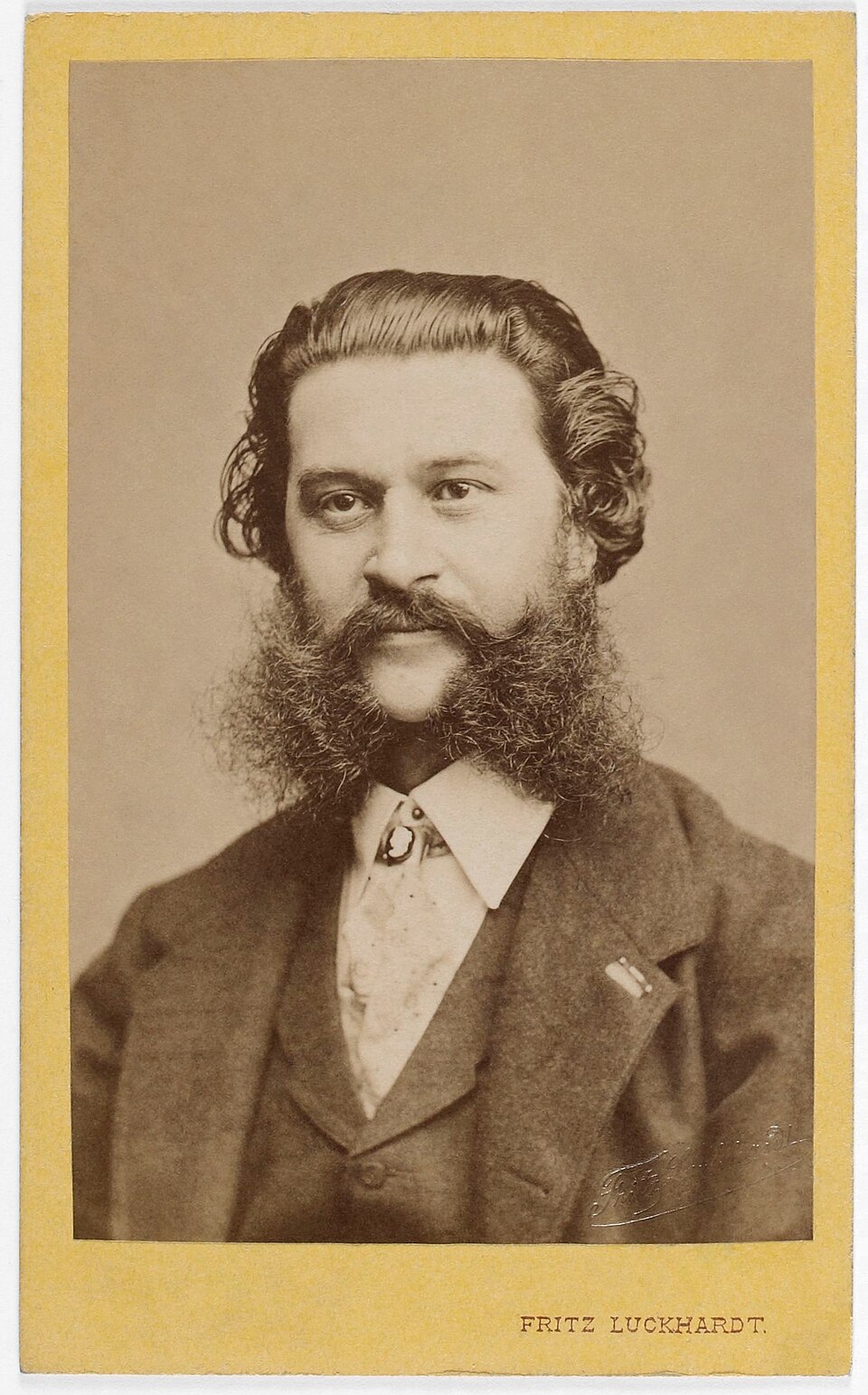 Johann Strauss II by Fritz Luckhardt. (Public Domain)
The Waltz King
“Die Fledermaus” (translated as “The Bat”) was an operetta composed by Johann Strauss II in 1874. He was denied musical training as a child despite having a composer as a father. In the hopes of being spared the melodrama of artistic life, he was pushed into the far more sensible world of finance.
However, Strauss II secretly studied the violin and composition. He became well-known for his ballroom dances and earned the nickname “The Waltz King.”
Encouraged by his first wife, Jetty Treffz, Strauss II expanded into operettas. “Die Fledermaus” was his third operetta and would become one of the most celebrated works in the genre. “Die Fledermaus” was based on the French play “Le Réveillon” by Henri Meilac and Ludovic Halévy. Strauss II brought his gift for ballroom music into the operetta, and filled it with waltzes and polkas.
The combination of sophistication with mischief is perhaps nowhere more apparent than in the overture. Filled with frivolous extravagance and an effervescence, it has been featured multiple times in the Vienna Philharmonic New Year’s Concerts.
“Die Fledermaus” Overture
Today’s recording is conducted by Carlos Kleiber with the Bavarian State Orchestra. (Listen)
The overture begins with three massive chords played by the orchestra. The chords repeat twice before turning into a series of bubbling triplet figures.
Like a camera panning from scene to scene, various character changes appear: an oboe plays a lilting motif (00:25), and violins play a tipsy melody over a polka-like rhythm (01:41). After a boisterous waltz (02:40), comes an almost sarcastically sentimental melody (03:48).
The music then becomes increasingly caricature-like: Earlier melodies return, but each time grander and tackier than before. Finally at 07:00, the opening theme returns and skyrockets in tempo. It repeats itself into a frenzy before a rapid three note declaration, reminiscent of the opening figure, brings the festivities to a close.
What arts and culture topics would you like us to cover? Please email ideas or feedback to features@epochtimes.nyc.
