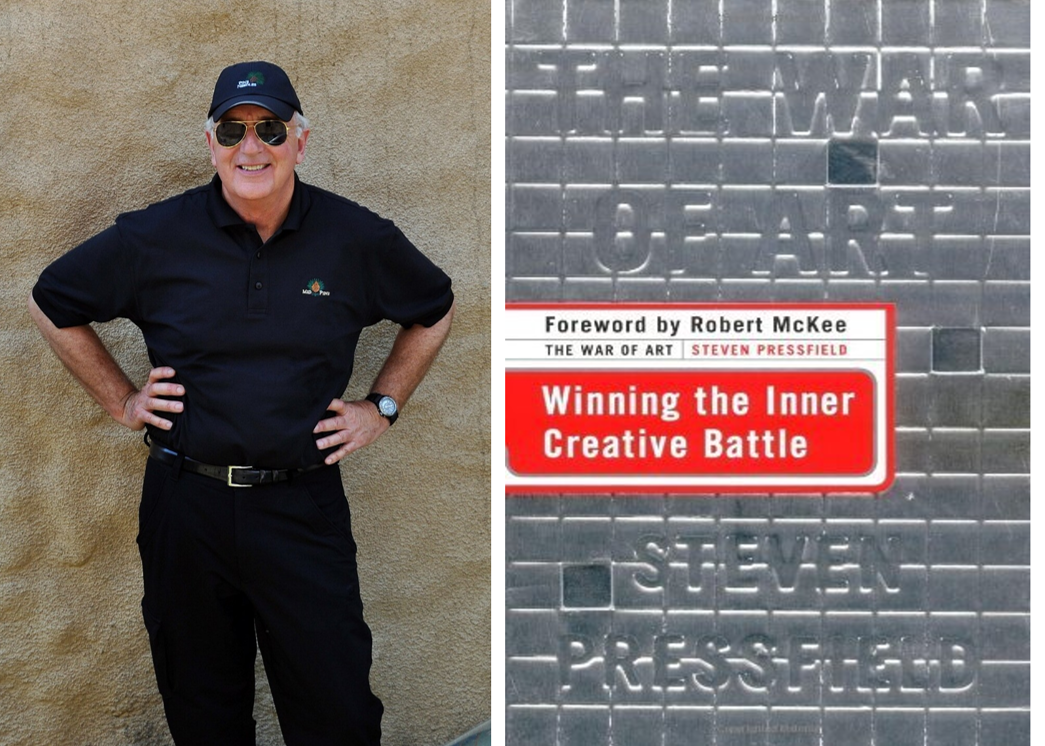
The ancient Chinese tactician Sun Tzu used his landmark treatise “The Art of War” to describe the most effective strategies for defeating external military enemies.
Steven Pressfield took the opposite approach in his 2002 book, “The War of Art: Winning the Creative Inner Battle.” He theorized that the greatest conflicts are not out in the vastness of a battlefield, but within the emotions of the individual.
Pressfield’s book dissects the internal conflicts that prevent people from fully deploying their creative skills in achieving professional and personal goals. He identifies a state of mind called “Resistance,” which creates endless obstacles, distractions, and doubts to thwart progress.

“Resistance is the most toxic force on the planet,” Pressfield wrote. “It is the root of more unhappiness than poverty, disease, and erectile dysfunction.”
It has been nearly a quarter-century since Pressfield released “The Art of War,” and that raises the question of whether it stands the test of time as being among the classics of the self-help genre. The answer is complex.
The Positive Aspects
Pressfield is a vigorous writer who made bold and forceful statements about the human condition and the multiple neuroses that result in unfulfilled greatness. He deftly catalogued everything that can trip up a person, especially character flaws: gnawing jealousy of successful peers, chronic procrastination, unhealthy obsessions, and crippling self-doubt.
Resistance, in the author’s view, is a quasi-satanic force. Much of that power is fueled from inner turmoil. But Pressfield also identified toxic domestic environments that encourage Resistance thought processes.
Pressfield admits that he nearly fell victim to Resistance when planning the book. The author gained fame with novels including “The Legend of Bagger Vance” (1995) and “Gates of Fire” (1998). He also details how Resistance unsuccessfully tried to convince him that he lacked the ability to create an advice-driven nonfiction book.
The author shares autobiographic mishaps on how he overcame Resistance while stumbling down a long and bumpy road to success. This included a series of dreary odd jobs plus a forced residence in his car when money was in short supply.
He recalls that success was never guaranteed, even when the proverbial brass ring seemed within reach. The best segment of the book has the author humorously recalling how his first produced screenplay, for “King Kong Lives” (1986), resulted in an emotional rollercoaster culminating in the film’s significant box office failure. Still, he pushed on and never let Resistance triumph.
Some Shaky Considerations
On the other hand, there aren’t many insightful observations in “The War of Art” that are unique to Pressfield’s analysis. There are plenty of well-known anecdotes involving prominent people overcoming doubt and fear to score professional success.
Some of the examples cited include two references to Henry Fonda vomiting out of nervous fear in his dressing room before going out on a Broadway stage to captivate audiences. Pressfield’s point is that fear is a natural emotion and no person is truly fearless, although it is unclear why the Fonda example needed to be told twice.
Elsewhere in the book, Pressfield drops odd comments that he doesn’t support. He claims that personal life is not connected to work, noting how Leo Tolstoy had 13 children and still had the time and energy to write “War and Peace.” True, but Tolstoy was also a wealthy count who had the financial wherewithal to compose books without anxiety over who was paying his bills, and a wife who was basically his editor.
The author also claims that writing workshops are “colleges of Resistance” because they provide the individual with supposedly worthless support from participants seeking the same goals. That argument is never properly fleshed out and feels like a personal prejudice rather than relevant self-help advice.
He insists that getting into trouble is “a cheap way to get attention.” But he never expands on that curious idea, especially when one considers that very few people intentionally want to get into trouble.
The most bizarre section recalls Tom Laughlin, the star and creator of the Billy Jack films in the 1970s. The actor used Jungian psychology later in his life, when he counseled cancer patients, to question if their disease manifested “as a consequence of actions taken (or not taken).”
The author has a wide slate of quotes from thought leaders ranging from Socrates to John Lennon, but curiously there is no input from Sun Tzu. The omission is peculiar, since “The Art of War” certainly inspired Pressfield’s title. One sentence attributed to Sun Tzu would have fit perfectly into Pressfield’s presentation: “Can you imagine what I would do if I could do all I can?”
Still, “The War of Art” raises interesting ideas about taking charge of one’s life and not falling into the traps that keep us from achieving greatness. Readers are encouraged to look up this 2002 book, albeit with the cautions over its shaky passages.
‘The War of Art: Break Through the Blocks and Win Your Inner Creative Battles’
By Steven Pressfield
Rugged Land: May 1, 2002
Hardcover, 224 pages
What arts and culture topics would you like us to cover? Please email ideas or feedback to features@epochtimes.nyc