It may start with a video that looks completely legitimate. Or a supposed friend you met online came across a great way to make money. The platform looks real, the numbers look great, and there are people who say they’ve already gotten paid. You might easily believe it’s a safe investment. The problem is, these are often the first steps to the latest investment scams of 2026.
According to the North American Securities Administrators Association (NASAA), these and other types of fraud are spreading rapidly across social media and messaging apps. In 2024, state securities regulators opened more than 8,800 active investigations and secured more than $259 million in fines and restitution. However, that figure reflects only what was reported and investigated. The actual damage runs far deeper.
Here’s how to protect yourself before you lose any money.
Is This Investment Safe? The Quick Answer
To determine whether an investment is safe, start by verifying it through official sources before committing any money. One way is to search the person or firm on FINRA BrokerCheck (brokercheck.finra.org) or the SEC’s investor.gov database. If they are unregistered, can’t explain how the investment produces returns, or promise guaranteed profits, stop the conversation, do some deeper due diligence, or seriously consider walking away.
Biggest Scams Right Now, According to NASSA
NASAA tracks threats to investors through its annual enforcement data and a separate survey of state securities regulators. Based on both sources, these are the top scams targeting investors in 2025 and 2026:
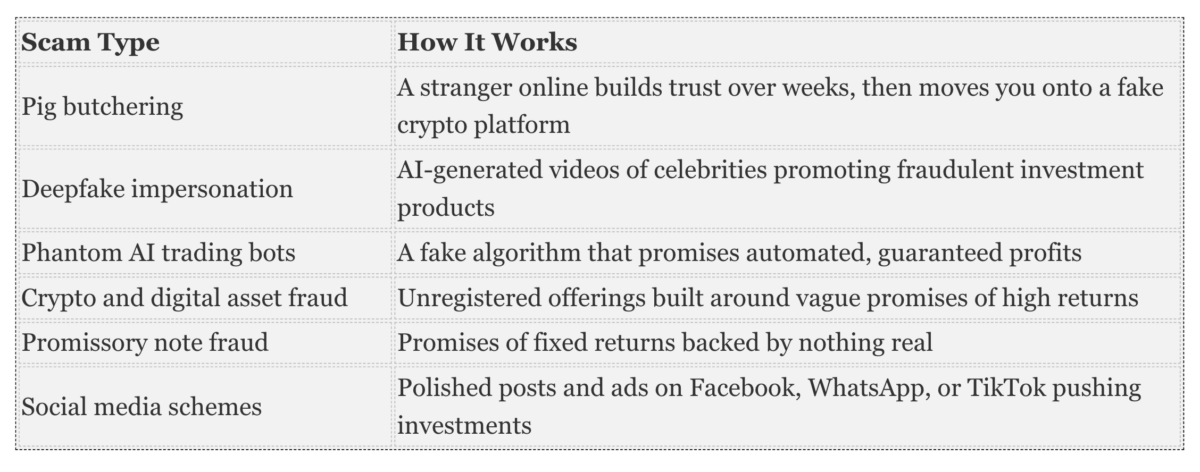
In 2024, NASAA opened 463 investigations involving digital assets, along with large numbers of social-media, impersonation, and pig-butchering cases, underscoring the rapid spread of online investment fraud.
How AI Is Making Fraud Harder to Spot
AI agents have given fraudsters a new level of perceived credibility. According to NASAA’s annual investor threats survey, 22.2 percent of state regulators expect the use of deepfake videos and cloned voices of celebrities promoting fake investments to continue to rise. Another 38.9 percent anticipate more AI-generated professional content designed to make fraudulent offerings look legitimate.
The results are increasingly convincing. Scammers create realistic videos of well-known public figures, often tech executives or financial personalities, endorsing platforms with guaranteed returns. The audio syncs, the faces track naturally—but it is entirely fabricated.
Two rules help cut through the technology every time:
- If a video from a legitimate public figure pitching an investment suddenly shows up on your social media, be extremely skeptical.
- Guaranteed returns do not exist in any real investment.
And there are some specific signs to look for.
5 Signs an Investment Is Likely Safe
- The person or firm is registered with FINRA, the SEC, or your state securities regulator.
- Their licensing history and any disciplinary records are available on BrokerCheck or Electronic Data Gathering, Analysis, and Retrieval (EDGAR).
- Risks are explained clearly and in writing, not glossed over or buried in fine print.
- There is no pressure to act immediately or to keep the opportunity private.
- Returns are described as potential outcomes or projections, never as certainties.
5 Red Flags That Signal a Scam
- You were contacted out of nowhere by text, on a dating app, or through a social media message.
- A celebrity or influencer is pushing a financial product that sounds too good or too easy to be true.
- Returns are “guaranteed” or described as risk-free under any circumstances.
- The platform is accessible only through a private link or an unfamiliar app.
- You’re told to pay a fee or a tax before you can withdraw your money.
Your Verify-Before-You-Invest Checklist
Before sending money to any investment opportunity, work through these seven steps:
- FINRA BrokerCheck (brokercheck.finra.org): Confirm the person or firm is licensed and check their disciplinary history.
- SEC investor.gov: Verify the company and look up any registered offerings in the EDGAR database.
- Your state securities regulator: Use NASAA’s Contact Your Regulator tool to find yours.
- SEC investor alert database: Search for any warnings or complaints tied to the platform or name.
- Ask for a written prospectus or disclosure document: No document means no accountability.
- Search the company name plus “scam” or “complaint” in a search engine before investing a cent.
- Talk to a licensed professional you already trust before committing any money.
If a step can’t be completed because the information simply isn’t available, you likely have your answer.
Where to Report a Suspicious Investment
Reporting early matters. A single complaint can trigger an investigation that protects other investors.
- Your state securities regulator (NASAA’s Contact Your Regulator)
- FINRA: finra.org/investors/have-problem
- SEC: sec.gov/tcr
- FBI Internet Crime Complaint Center: ic3.gov
If someone is targeting an elderly family member, contact your state’s adult protective services and your state securities regulator at the same time.
In 2024, NASAA received more than 6,500 reports of suspected vulnerable adult financial exploitation, a 52 percent increase from the prior year, and a 492 percent change from 2020.
FAQs About Investment Safety and Fraud
What Is Pig Butchering, and How Does It Work?
Pig butchering is a long-con investment fraud that begins when a stranger reaches out through a dating app, social media, or an apparently accidental text message. The fraudster builds a relationship over days or weeks, then introduces a fake platform (often crypto) that shows impressive, growing returns. When you try to withdraw your money, fees are demanded or the site disappears entirely.
What Should I Do if I Already Sent Money to a Suspected Scam?
Stop sending money immediately, even if the platform shows a positive balance or demands a fee to release your funds. That balance is almost certainly fabricated, and additional payments will not unlock it. Document everything: screenshots, messages, transaction records, and any contact details you have. Report to the SEC at sec.gov/tcr, the FBI’s IC3 at ic3.gov, and your state securities regulator. Recovery from crypto-based fraud is difficult, but reporting quickly gives authorities their best opportunity to investigate.
How Do I Check Whether a Financial Adviser Is Legitimate?
Use FINRA BrokerCheck at brokercheck.finra.org to search any broker or investment adviser by name. The database shows their registration status, licensing, employment history, and any past complaints or disciplinary actions. For advisers registered with the SEC, also check the Investment Adviser Public Disclosure database at adviserinfo.sec.gov. If the person offering you an investment does not appear in either database, decline the offer and report the contact to your state securities regulator without delay.
The Epoch Times copyright © 2026. The views and opinions expressed are those of the authors. They are meant for general informational purposes only and should not be construed or interpreted as a recommendation or solicitation. The Epoch Times does not provide investment, tax, legal, financial planning, estate planning, or any other personal finance advice. The Epoch Times holds no liability for the accuracy or timeliness of the information provided.