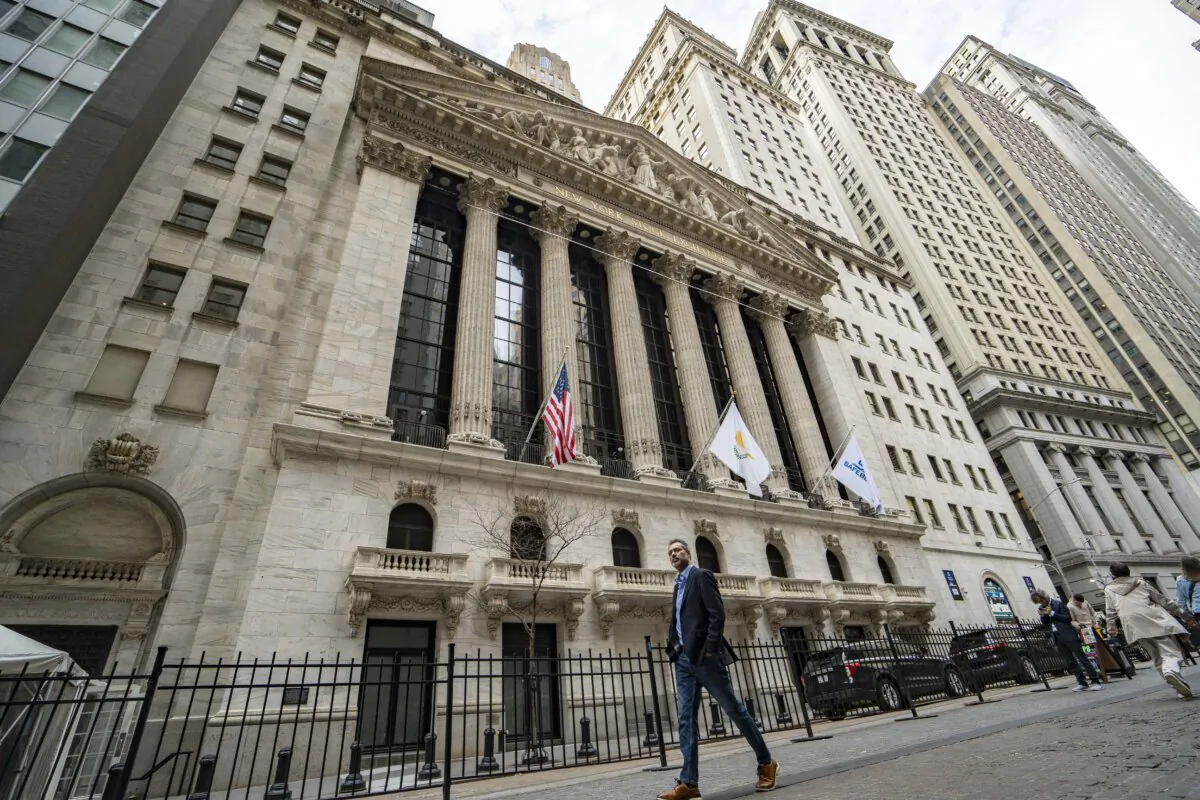

The S&P 500 crossed 7,400 for the first time, powered by a fresh surge in tech stocks, leading to questions of how sustainable this is for Wall Street.
Investors have shrugged off major headwinds, including the Iranian conflict, rising energy costs, private credit headaches, and a potential Federal Reserve interest rate hike.
Despite the 9 percent decline in March, the broad market index has had a solid 2026, rallying more than 8 percent year-to-date—or 27 percent over the last 12 months.
While the upward movement has been broad-based, tech has carried the stock market.
Several names—Alphabet, Amazon, Apple, Broadcom, and Nvidia—have accounted for approximately 50 percent of the index’s total gains since April 1.
“With hostilities easing in the Middle East and earnings estimates ticking higher, investors turned their focus back to the leading market tailwind, artificial intelligence, and how its transformation and buildout are impacting the broader economy,” Jeff Buchbinder, chief equity strategist at LPL Financial, said in a note emailed to The Epoch Times.
Scores of AI hyperscalers updated their capital spending plans during earnings calls with analysts, with the total price tag as high as $1 trillion by sometime next year.
Semiconductors have also been the major contributors to this rally, Buchbinder adds.
In addition to Broadcom and Nvidia, shares of Advanced Micro Devices (AMD), Intel, and Micron Technology have surged 90 percent over the past month.
Market watchers have highlighted the tech concentration of the leading indexes in recent years.
Today, just 10 companies account for 34 percent of profits in the S&P 500, says Torsten Slok, chief economist at Apollo.
“The S&P 500 is not a diversified index anymore; it is dominated by a small number of extraordinarily profitable tech companies,” Slok told The Epoch Times in a note.
“The 10 biggest companies in the S&P 500 make up almost 40% of the index, and if Anthropic, OpenAI, and SpaceX are added later this year, the concentration could approach 50%.”
Although the increase has broadened to include energy, industrials, and materials, the stock market is mainly fueled by tech.
With mega-initial public offerings—SpaceX, Anthropic, and OpenAI—possibly on the horizon, the tech-fueled concentration could intensify.
Sign of the Times
Proponents say markets reflect the times, while critics warn that a market centered on a single sector presents risks, particularly for retail investors.
Both sides of the debate have their merits.
“While concentration can raise questions about diversification and volatility, it may also reflect long-term structural shifts toward technology-enabled business models,” Invesco said in a January research note.
Concentrations have happened before.

In the 19th century, railroads represented about two-thirds of the U.S. stock market. The so-called Nifty Fifty—large-cap companies like 3M, American Express, and Johnson & Johnson, considered immune to economic cycles—accounted for 40 percent of the S&P 500 in the 1960s. Japanese firms dominated the U.S. stock market in the 1980s.
A chorus of observers will compare today’s market environment to the dot-com bubble in the late 1990s and early 2000s. But the current crop of tech juggernauts maintains large cash reserves and low leverage and has various global revenue streams.
At the same time, narrow market breadth can produce fragility in the equities arena. Volatility can arise when a handful of firms control the board, and wider sentiment turns sour.
This can also pose a risk to passive investors who hold index funds. While they may expect to be exposed to a diverse array of stocks, their portfolios are more focused on a single sector.
But some believe conditions are starting to widen and embrace other industries.
‘Momentum Is a Funny Thing’
Experts say that the market is broadening, with the AI buildout extending even to non-tech firms.
“We’re at almost all-time highs right now, but some sectors are only starting to participate,” Kevin Dreyer, co-CIO of value at Gabelli Funds, said in a note emailed to The Epoch Times.
He pointed to industrial activity, whether manufacturing or aerospace defense, as an example of others joining the economic boom and market rally.
Factory activity registered its strongest expansion since May 2022, according to the S&P Global U.S. Manufacturing Purchasing Managers’ Index, released on May 1.
March’s new orders for factory goods also surged by the most since November.
The AI investment boom, such as the data center buildout, is fueling this expansion, Dreyer notes.
“This is how secular bull markets take legs higher,” Jay Woods, chief market strategist at Freedom Capital Markets, said in a note emailed to The Epoch Times.
At first, tech will lift the market to fresh highs, and then others hop on the bandwagon.
“Watch for industrials, financials, and communications names to take the baton to keep this momentum going,” Woods said.
Many corners of the financial markets are doing well.
The blue-chip Dow Jones Industrial Average—up almost 4 percent this year—is targeting 50,000 again.
The tech-heavy Nasdaq Composite Index has climbed more than 13 percent to all-time highs.
The Russell 2000 Index—a small-cap stock index of 2,000 companies—has jumped 16 percent year-to-date to a record high.
“Momentum is a funny thing and doesn’t have to make sense all the time,” Woods said.
 Friends Read Free
Copy
Facebook
Tweet
Friends Read Free
Copy
Facebook
Tweet