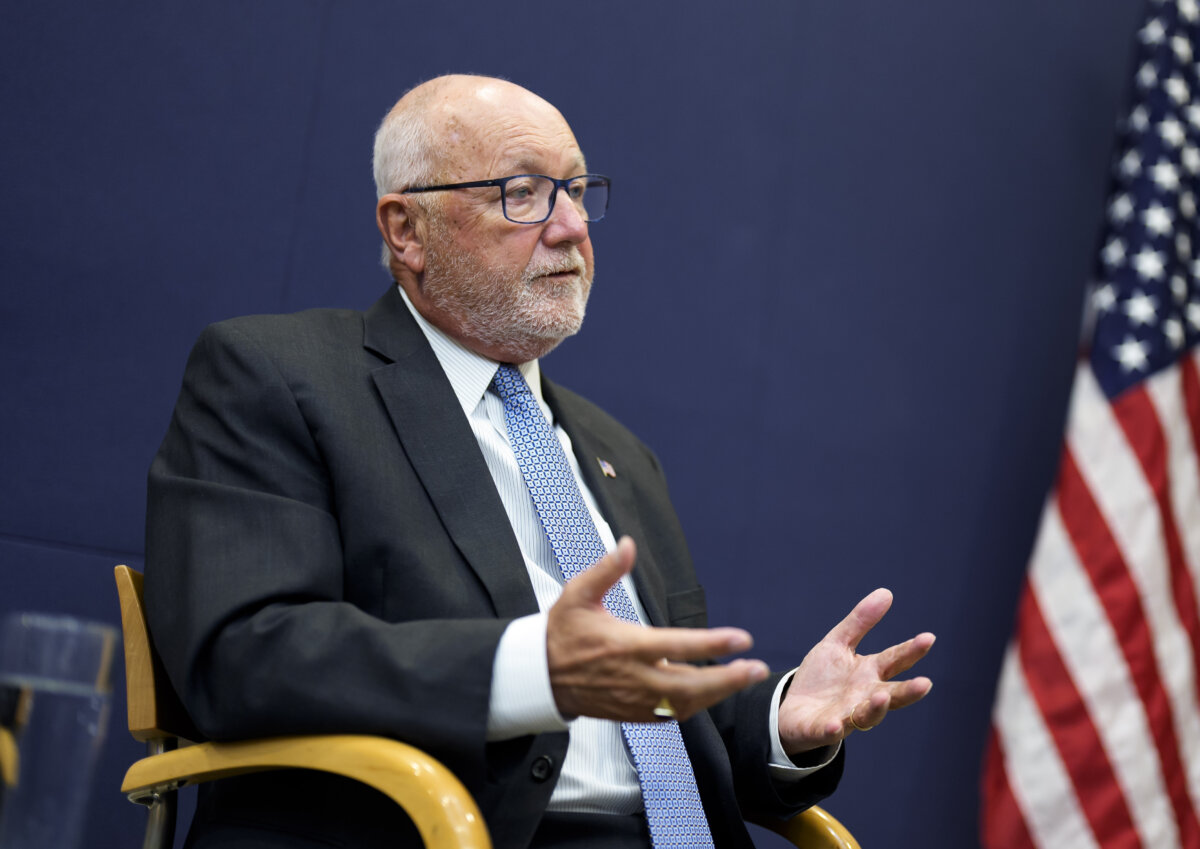

U.S. Ambassador to Canada Pete Hoekstra says the U.S. president’s repeated statements that the country doesn’t “need” Canada’s exports are his way of urging Ottawa to make a satisfactory deal.
“You maybe don’t like the way the president says it, but taken in the tone of what he’s saying, is ‘we’re open to offers, make your case,” Hoekstra said during a U.S.-Canada Summit in Toronto on June 11.
Hoekstra’s comments come a day after U.S. President Donald Trump told reporters he was considering not renewing the Canada-United States-Mexico Agreement (CUSMA) and repeated the argument that his country does not “need anything that Canada has.”
Trump has repeatedly said during his second term in office that the United States does not need Canadian automobiles, lumber, or oil. But Hoekstra said there is a “tremendous amount of things” that the United States does need from Canada. He cited potash fertilizer from Saskatchewan-based Nutrien as an example.
Canada is the world’s top exporter of potash, and while Russia and Belarus are the second and third largest, they are under sanctions from the U.S. government.
Hoekstra said that the United States is not in need of Canadian vehicles, as it can import them from allies like Mexico, Japan, and South Korea. But he said that if Ottawa “puts on their sales hat, they can make a very, very compelling case” that the United States needs Canadian vehicles by promoting how the two countries have integrated labour forces and similar working and environmental standards.
“Same thing on oil: ‘We got the pipelines, we got the infrastructure. If you need more oil, the best place to get it from is Alberta.’ That’s a pretty compelling case,” Hoekstra said.
Hoekstra encouraged Ottawa to go into CUSMA negotiations “very aggressively and say ‘we know America has needs across the board, and we’re here to partner with America and fill those needs.’” He added that, during or toward the end of every meeting between Trump and Canadian officials, the U.S. president has said “make us an offer.”
LeBlanc Says July Deadline ‘Not a Cliff’
Canada-U.S. Trade Minister Dominic LeBlanc also spoke at the conference, saying he’d recently had a lengthy conversation with U.S. Trade Representative Jamieson Greer. LeBlanc said they discussed many specific items the U.S. flagged in its National Trade Estimate Report on Foreign Trade Barriers.
LeBlanc said he had a “sense that Ambassador Greer and his colleagues saw the progress that they have been looking for” when it came to trade talks. LeBlanc said he also talked about the items Canada would like to see addressed in CUSMA talks.
While a review of CUSMA is slated for July, LeBlanc said that deadline is “not a cliff.” He added that if the countries fail to reach an agreement, they would move to annual reviews of CUSMA for the next ten years.
LeBlanc also said he was “not surprised” that Greer recently said it was unlikely that Trump would approve a trilateral agreement on July 1 given that he prefers a “certain level of uncertainty” for negotiations. LeBlanc said he expects there will be both bilateral arrangements between Canada and the United States and between Mexico and the United States, as well as an “adjacent” trilateral framework.
Canadian Ambassador to the U.S. Mark Wiseman said at the conference that he regularly communicates with Hoekstra to ensure there are no “surprises” that could reduce trust.
Wiseman also said Ottawa’s stated goal of doubling non-U.S. exports over the next decade does not mean reducing trade with the United States.
“If we do both well, not only is that great and important for Canada, and allows us to be more self-reliant … but it also makes us a better partner and a better customer,” he said.
 Friends Read Free
Copy
Facebook
Tweet
Friends Read Free
Copy
Facebook
Tweet