



You know you’re getting older when you can hurt yourself just trying to get out of bed in the morning. As I’ve aged, I’ve noticed an emerging trend in my morning routine: When I first get up, I have to do so carefully. Once upon a time, I’d just bound out of bed and launch myself into the day without a second thought. If I try that now, I risk provoking morning-stiff muscles into either a cramp that can get me dancing for a few seconds or a small strain that can potentially result in pain for hours.
To counter this, I’ve taken to stretching every morning. At first, the goal was simply to avoid injury and to keep myself from “working around” stiffness as I moved through my morning routines. That very thing—the tendency to accept morning stiffness as normal and to develop habits to work around it rather than address it directly—is often the start of maladaptive and even pathological postural and movement strategies.
Starting your day stiff doesn’t have to be your norm, and moving through the rest of your day with unnecessary stiffness is the last thing you should be willing to do.
7 Exercises to Eliminate Morning Stiffness
The following exercises can go a long way toward helping you work through morning stiffness. They work well for my patients, and I’m a big fan, but I suggest that you consult with your medical provider to ensure that they are right for you.
1. Open Book Stretch
You can do this stretch from the comfort of your own bed, provided you don’t have to work around pets, spouses, children, or large piles of money. It focuses directly on your spinal rotation and also serves an excellent secondary role in stretching your chest musculature.
Step 1: Lie on your left side with your legs side-by-side and your hips and knees bent to 90 degrees. Flex your shoulders to 90 degrees, extend your elbows until your arms are straight, and place your palms together.
Step 2: Slowly swing your right arm up toward the ceiling while keeping your elbow straight, then continue until you move it as far behind you as you can, ideally touching the bed behind you. Rotate your trunk to follow the movement, keeping your hand, eyes, and head aligned. Move slowly and don’t push into pain.
Step 3: Once you’ve moved all the way over (as far as you can), hold for five seconds before returning to the starting position.
Step 4: Moving as far as you can, then back, counts as one repetition. Try to perform 15 repetitions on each side.
Modifications: If you can’t move your arm all the way over to the surface behind you, just move it over as far as you can. You will get better over time.
Why I Like It: This is a big, full stretch for your pectoral muscles and is great for spinal mobility.
2. Single Leg Knee-to-Chest Stretch
The single-leg knee-to-chest exercise is one of my favorites. This unassuming and fairly comfortable exercise provides a nice stretch for your lower body that doesn’t focus on a single muscle group or joint movement, but rather on multiple muscles and joints at the same time.
Step 1: Lie on your back and bring your right knee toward your chest. Interlace your fingers across your right leg just below your knee and pull your leg into your chest. Hold the position for approximately 10 seconds, then lower it back down to the starting position. Repeat the movement on your left side.
Step 2: Bringing your leg up, holding it, and then lowering it back down counts as one repetition. Try to perform 10 repetitions per side.
Modifications: Move your leg only as far up as you can at first, knowing you will get better over time. Want to intensify the stretch? Turn it into a double-leg knee-to-chest stretch by bringing both legs up at the same time.
Why I Like It: This exercise is great for stretching your glutes and hip joints, and for providing some flexion and extension to your lower back.
3. Figure 4 Stretch
The figure 4 is another stretch I perform every day. It provides a deep, intense stretch that can escalate quickly but is easy to control. Figure 4 targets the deep layers of your piriformis muscles and is a great way to reduce piriformis pain.
Step 1: Lie on your back on a firm surface. Cross your right leg over your left, with your right ankle just above your left knee. Use your arms to help if you need to. Next, allow your right knee to relax away as far as it will go while keeping your right ankle in place.
Step 2: Interlace your fingers behind your left leg and gently pull your leg toward your shoulder. You will feel the stretch rapidly intensify. Hold the stretch for one minute, or as long as you comfortably can, then return to the starting position.
Step 3: Repeat the movement on the other side. Try three one-minute stretches for each side, alternating sides as you go.
Modifications: If you can’t move very far into the stretch, just move as far as you can and hold it there. You will likely be able to access greater flexibility with practice. Even if not, the figure 4 stretch is wonderful at reduced levels.
Why I Like It: I love how limber my hips feel afterward, and I know that you will love how it feels too. You can’t go wrong with this stretch—intense up front and mellow afterward.
4. Cat-Cow Stretch
This exercise strikes many folks as a little funny-looking or a little unconventional, but it is, in fact, a highly effective spinal mobility exercise that also works your hips reciprocally.
Step 1: Start on your hands and knees on a firm, supportive surface. Your mattress can fit the bill perfectly, but you can also perform it on the floor.
Step 2: Roll the spine under, starting with your tailbone all the way through to tucking your chin deep in toward the back of your throat. You’ll look like a cat hunching upward. Take approximately two seconds to move into position. Hold for five seconds before returning to the starting position.
Step 3: Starting again from your tailbone, unfurl until your chest is open, your head is reaching upward, and you’re looking forward. Be careful not to overextend your cervical spine. This is the “cow” phase, which some refer to as the “camel” phase. Take approximately one to two seconds to move into position and then hold for approximately five seconds before rolling through in the other direction again.
Step 4: Moving through the cat and cow phases is considered one repetition. Try to perform three sets of 12 repetitions.
Modifications: If you can’t move very far in either direction, just move as far as you can—you’ll still reap ample benefits. Place a cushion under your knees if needed to reduce discomfort from pressure on your knees.
Why I Like It: The cat-cow stretch is great at revealing tight spots in your spine and helping you work through them.
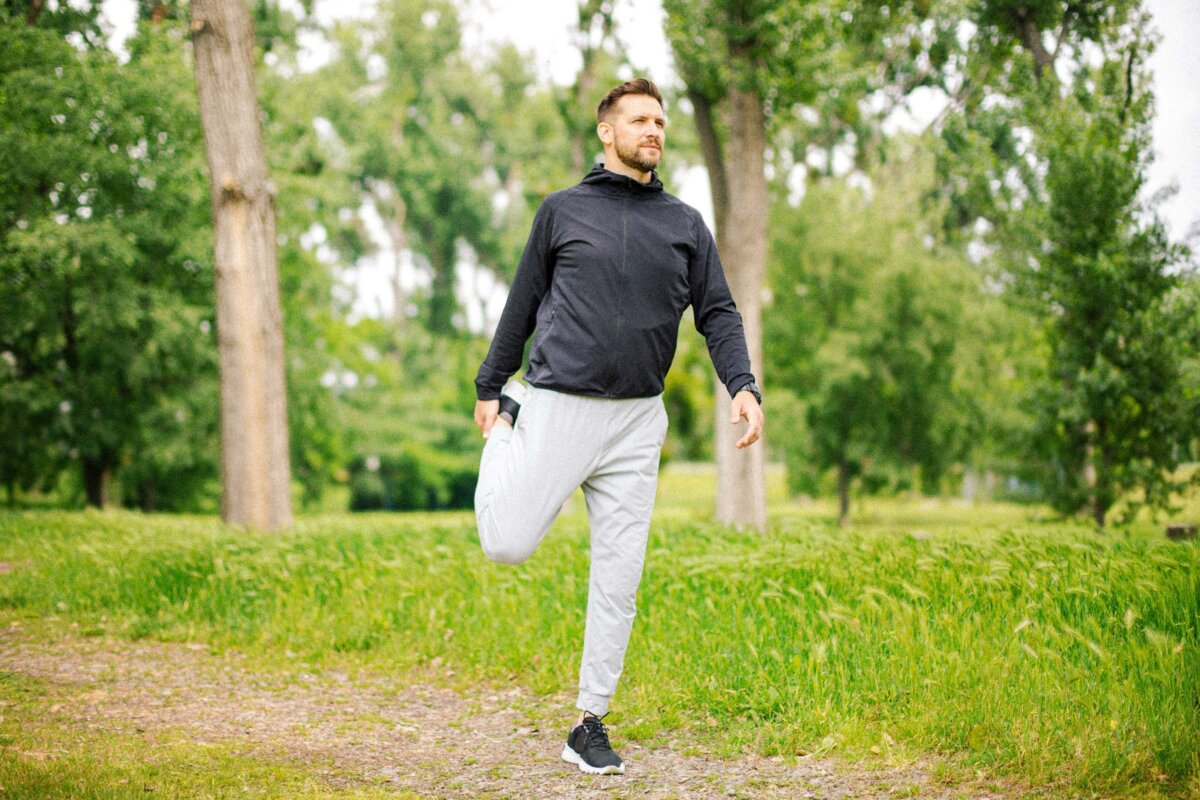
5. Standing Quad Stretch
Your quadriceps muscles are large, and your knees are big joints. When these are stiff, you know it, and it pays to mobilize them in the morning to ensure that they are stretched out, warmed up, and ready to work for you.
Step 1: Stand near a chair or wall for balance, bend your right knee, and catch your right ankle with your right hand.
Step 2: Simultaneously pull your leg back while pushing your hips forward, feeling a nice stretch along the front of your right leg and hip. Be sure to keep your knee pointing straight down and resist the urge to pull your leg out to the side. Hold the stretch for approximately 10 seconds. Return to the starting position and repeat the movement on your other side.
Step 3: Bringing your leg up into a stretch and then lowering it back down counts as one repetition. Try to perform four 10-second stretches per side. You can perform all stretches on one side, then the other, or alternate exercise sets between your right and left legs.
Modifications: If you can’t get your leg all the way up to your hand, you can place it on a chair, armrest, or other elevated surface in standing. If you struggle with balance during this activity, perform it next to a counter, wall, or piece of furniture to help maintain your balance.
Why I Like It: This is just a nice, direct stretch to the quads and knees. It’s simple, straightforward, and deeply effective. Tangentially, it also works on your balance, which is music to any therapist’s ears.
6. Standing Hamstring Stretch
Tight hamstrings can lead to back and knee pain, because the overly tight muscles can pull on the knee joints and back. Let’s see if we can get those hammies a little more pliable.
Step 1: Place your right leg on a bench or chair, with your knee fully extended.
Step 2: Keeping your knee straight, slowly bend forward at your hips while keeping your back straight until you feel a deep stretch on the back of your thigh. Push into a good stretch, but avoid pushing into pain.
Step 3: Hold the stretch for 10 to 15 seconds, then slowly release it, then change legs and repeat on your left side.
Modifications: Stand next to something you can use for stabilization if this stretch challenges your balance.
Why I Like It: This exercise has a long reach and can loosen those hamstrings up nicely—along with alleviating pain. In this circumstance, you can get a lot of functional gains out of a simple stretch.
7. Standing Calf Stretch
My calves have a great affinity for tightness, and it feels like I’m in a never-ending war for flexibility with them. Thankfully, I’ve discovered a fantastic weapon to help fight this war, and it’s the standing calf stretch.
Step 1: Stand facing a wall or the back of a chair from approximately two feet away.
Step 2: Step back approximately two feet with your right leg and place your foot flat on the floor. Keep your left foot flat on the floor as well.
Step 3: Slowly bend your left knee forward, allowing a stretch to build in your right calf. Move as far as you comfortably can and then hold for approximately 10 seconds. Return to the start position and repeat the movement on the other side.
Step 4: Try to perform three 10-second sets per side. You can perform all stretches on one side, then the other, or perform all sets on one side before moving to the other.
Modifications: Push into the calf stretch only as far as you comfortably can. If you don’t feel like you’re getting enough of a calf stretch, stand a little farther from the wall so you can place a little greater stretch on your calf.
Why I Like It: I find this to be one of the single best stretches on the planet for tight calf muscles and use it daily.
Together, these exercises can help you win the struggle for better morning flexibility. It takes a scant bit of time to reap lasting benefits, and most people will be successful with these exercises. For the best overall efficacy, I suggest you perform them every day. Although you can do them at any time, I feel that morning times, right after you get up, are by far the best and yield the greatest benefits.
About the Fitness Model: Aerowenn Hunter is a health editor for The Epoch Times. She’s an accredited yoga therapist with more than three decades of teaching experience.
Views expressed in this article are the opinions of the author and do not necessarily reflect the views of The Epoch Times. Epoch Health welcomes professional discussion and friendly debate. To submit an opinion piece, please follow these guidelines and submit through our form here.