
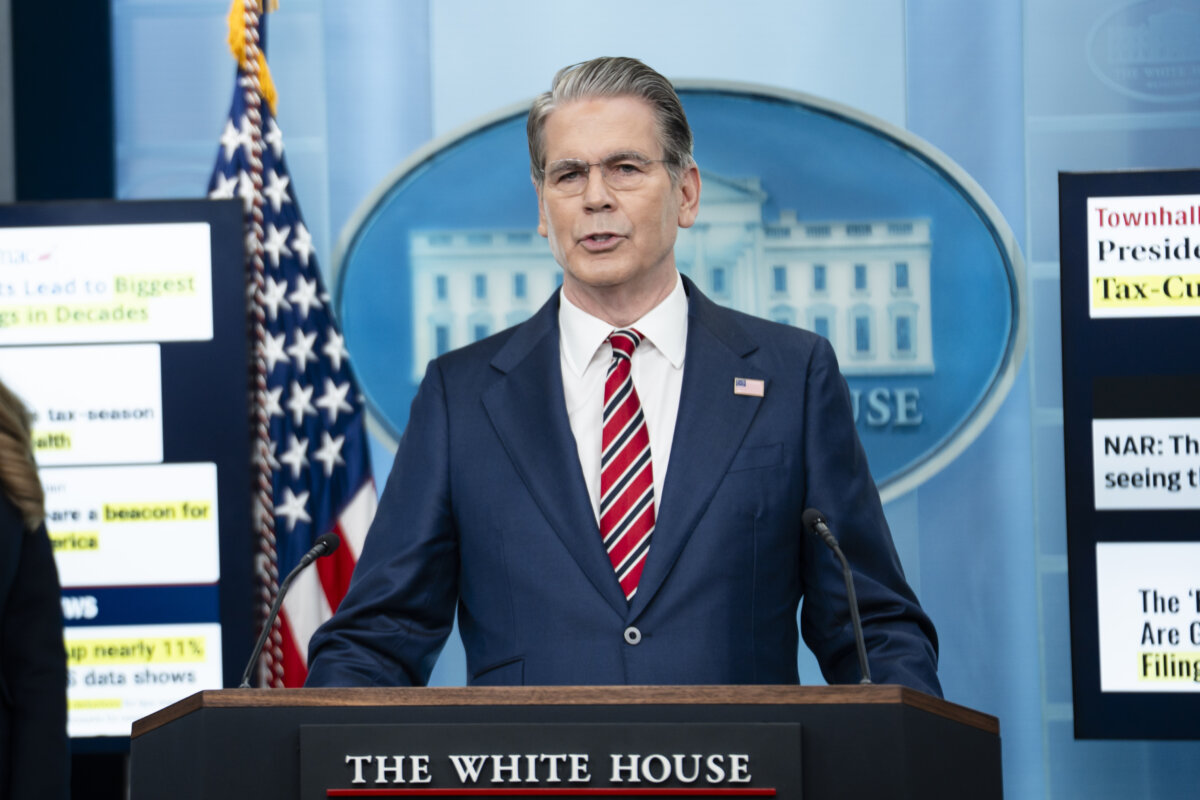
Treasury Secretary Scott Bessent said on April 22 that several U.S. allies in the Gulf region and Asia have approached Washington seeking dollar swap lines to address currency issues.
Over the years, the United States has facilitated currency swaps to maintain liquidity and stabilize global funding markets during times of stress.
With the war in Iran—approaching its ninth week—triggering energy shocks and creating other economic challenges, countries are facing pressures.
President Donald Trump confirmed a day earlier that the United States and the United Arab Emirates were working on a currency swap to assist the Gulf nation financially.
While Bessent did not name specific countries, the senior administration official stated a U.S.–UAE swap would be beneficial.
“Swap lines, whether it’s from the Federal Reserve or the Treasury, are to maintain order in the dollar funding markets and to prevent the sale of the U.S. assets in a disorderly way,” Bessent told a Senate Appropriations subcommittee budget hearing.
“So, the swap line would benefit both the UAE and the United States, and as I said, numerous other countries, including some of our Asian allies, have also requested them.”
Maintaining dollar supremacy has been one of the chief objectives of Bessent’s tenure.
In an exchange with Sen. John Boozman (R-Ark.), Bessent advocated that both banking and digital assets are critical areas the United States needs to lead for the long term.
“U.S. leadership over the long term secures the primacy of the dollar as a reserve currency,” he said.
Currency swaps are typically conducted by central banks—similar to what the Federal Reserve did at the onset of the pandemic—but the Treasury Department has also used this tool recently.
Washington employed currency swaps last year to address Argentina’s cash crunch.
To stabilize the country’s currency ahead of the national election, the administration issued a $20 billion backstop through a currency-swap facility that bolstered the Argentine peso.
Months later, the $20 billion swap line was repaid.
The president stated that he would be willing to follow through on a currency swap because the United Arab Emirates has “been a good ally of ours.”
“So, if I could help them, I would. I mean, we’re helping them much more with what we’re doing with the war because, you know, the bully of the Middle East was Iran,” he said in an April 21 interview with CNBC’s “Squawk Box.”
‘Perfect Storm’ for Dollar Supremacy
Concerns that the Iranian conflict could ignite a deeper economic downturn in the region have been widespread. But a U.S.-led swap line could also support currencies such as the UAE dirham and bolster foreign-exchange reserves should a liquidity event unfold.
Yousef Al Otaiba, Emirati ambassador to the United States, pushed back on the reporting.
“Any suggestion that the UAE requires external financial backing misreads the fact,” the ambassador said in an April 21 post on X.
Market watchers have warned that Middle East tensions could be the catalyst that erodes the global dollar hegemony.
Deutsche Bank, writing in a March 24 research note, stated that the legacy of the Iranian conflict could be the pivot away from the petrodollar.
In the 1970s, Saudi Arabia established an arrangement with Washington. Riyadh agreed to price oil exclusively in dollars in exchange for U.S. security guarantees. Regional oil exporters emulated this strategy.
This has become a crucial facet of U.S. economic and geopolitical dominance: cheaper domestic borrowing, petrodollar recycling, and international leverage.
However, as countries pursue de-dollarization and the Middle East sells its oil to Asia, some say the king dollar status could eventually be dethroned.
“If fault lines are further exposed, there could be significant downstream effects of the dollar’s use in global trade and savings, and the dollar’s role as the world’s reserve currency,” Mallika Sachdeva, strategist at Deutsche Bank, said in the note.
“The current conflict may be the perfect storm for the petrodollar.”
Guy Birchall contributed to this report.
 Friends Read Free
Copy
Facebook
Tweet
Friends Read Free
Copy
Facebook
Tweet