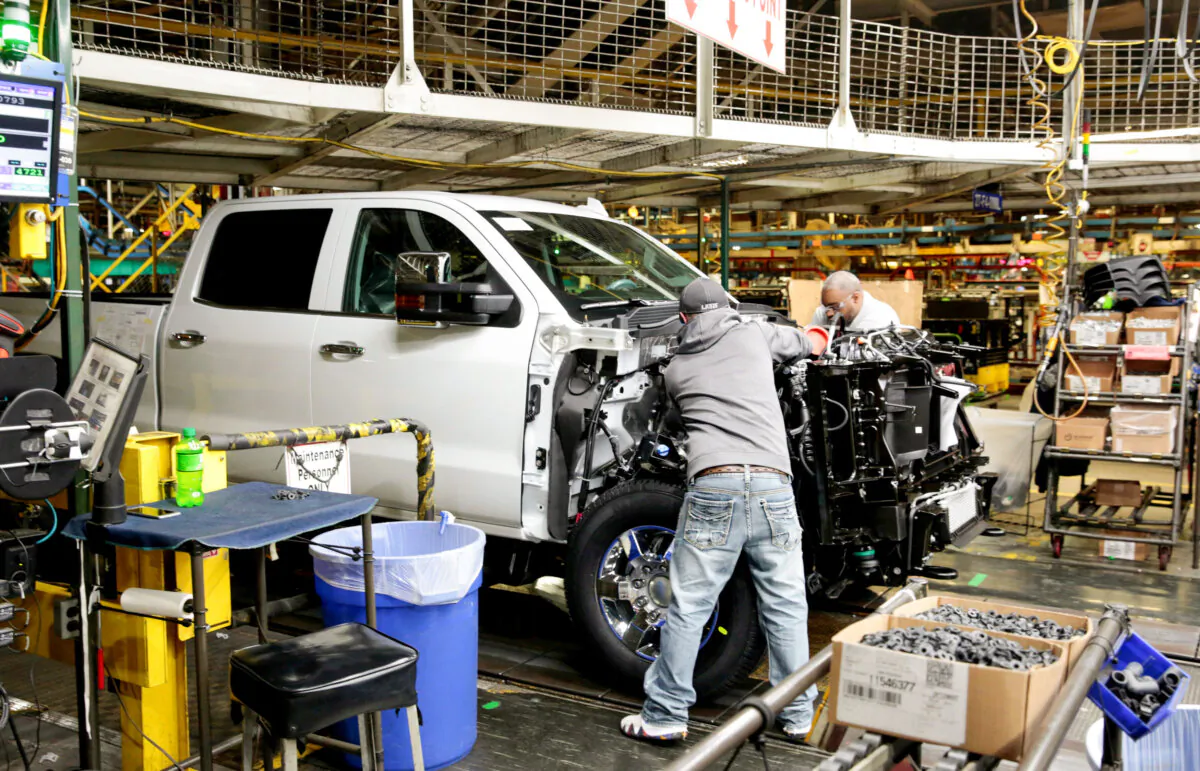

General Motors is investing about $4 billion in U.S. manufacturing to expand production of internal combustion engine vehicles amid slower-than-expected electric vehicle sales.
On June 10, the Detroit automaker announced plans to expand finished vehicle production at facilities in Michigan, Kansas, and Tennessee. In a statement, GM said those upgrades will allow those three production facilities to increase their combined output by about 2 million vehicles annually.
“Today’s announcement demonstrates our ongoing commitment to build vehicles in the U.S and to support American jobs,” CEO Mary Barra said in a statement.
The spending plan is the second time in less than a month that GM has announced a significant capital expenditure on gas-powered vehicle production. On May 27, the company said it would spend $888 million on upgrades to support production of engines for its full-size trucks and SUVs.
The spending also reflects a shift in priorities for the company. GM plans to begin producing gas-powered, full-size SUVs and light-duty pickup trucks at the Orion Assembly plant in Orion Township, Michigan, in early 2027 to “help meet continued strong demand.”
The Orion plant had been designated previously for electric truck production starting in 2026. In a statement, GM said its Factory ZERO plant in Detroit-Hamtramck, Michigan, will now serve as the dedicated site for electric pickups and SUVs, including the Chevrolet Silverado EV and the GMC Hummer EV.
As for the Fairfax Assembly plant in Kansas City, Kansas, GM said it will begin building the gas-powered Chevrolet Equinox in mid-2027. Production of the all-electric Chevrolet Bolt is still expected to begin there by the end of 2025, it said.
In Spring Hill, Tennessee, GM plans to add production of the gas-powered Chevrolet Blazer in 2027, alongside its existing assembly of the electric Cadillac Lyriq and other models.
The announcement came as the U.S. auto industry faces a shifting regulatory and political landscape. While significant moves are expected on U.S. tariff policy, the auto industry still faces challenges associated with steep new levies assessed on finished automobiles, automotive components, and inputs like steel.
Additionally, the Trump administration is repealing or rescinding broad incentives designed to speed up electric vehicle adoption. On June 12, President Donald Trump is expected to sign legislation that will slash California’s state-level mandate on zero-emission vehicles.
In April, according to a report published by Cox Automotive, sales of new electric vehicles fell compared with both March 2025 and April 2024. Used vehicle sales, on the other hand, grew significantly when compared with both the prior month and the prior year, Stephanie Valdez Streaty, Cox Automotive’s director of industry insights, said in a release.
Electric vehicle sales accounted for only about 7 percent of overall new sales and about 2 percent of overall used sales in April, the Cox report said.
 Friends Read Free
Copy
Facebook
Tweet
Friends Read Free
Copy
Facebook
Tweet