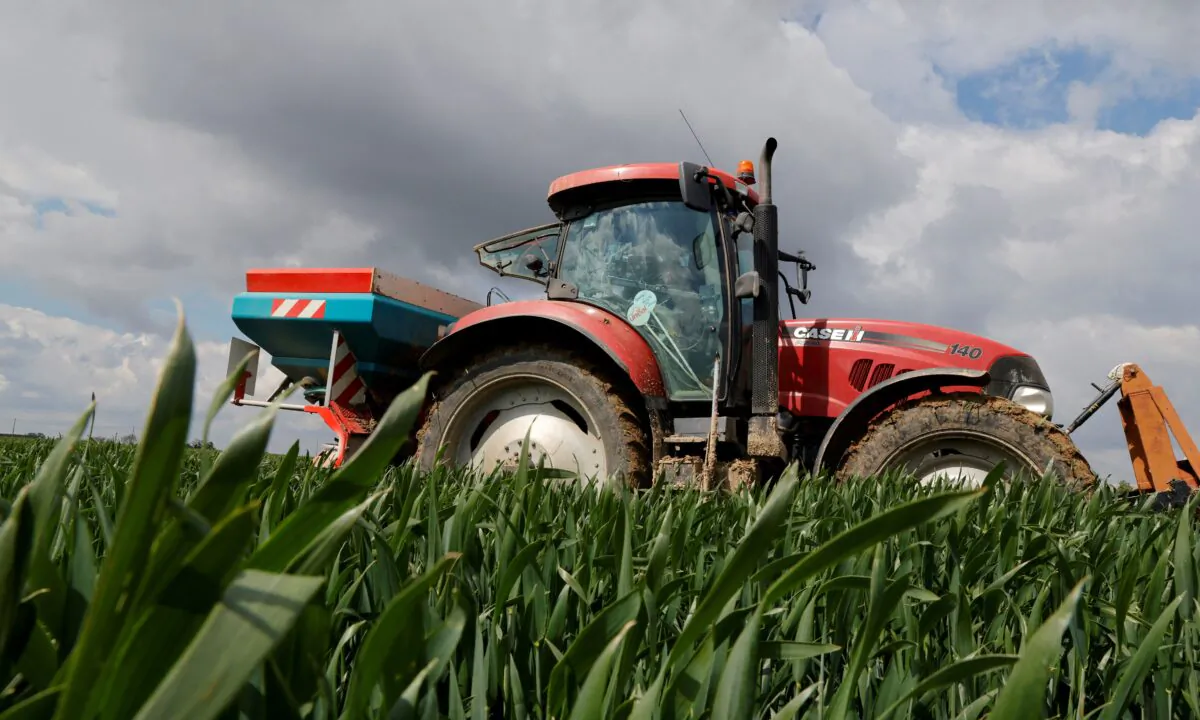

Much of the economic focus during the war in Iran has been on oil and gas supplies, but the interruption of an essential byproduct, fertilizer, may soon affect farmers as planting season begins.
Fertilizer that farmers use in crop production is derived from natural gas or is processed using natural gas.
About 30 percent of the world’s fertilizer product passes through the Strait of Hormuz, which Iran has constricted, according to an April 1 report by the International Food Policy Research Institute.
The United Nations reports that the rate of shipping through the strait has fallen to fewer than 10 ships daily from an average of more than 100.
Consequently, over the past month, prices rose sharply for five of the eight major fertilizer types, according to DTN, an agriculture data analytics firm. Prices for urea were up by 35 percent over the past month, jumping from $677 per ton to $826 per ton in the past week alone, and anhydrous ammonia and UAN32 fertilizers were both up by 20 percent over the previous month.
“The world is now learning just how important the Strait of Hormuz is,” Caleb Jasso, a policy expert at the Institute for Energy Research, told The Epoch Times. “A great deal of trade of all kinds goes through that choke point, including a very sizable portion of the fertilizer market for the world.”
Gulf States a Critical Source
The International Food Policy Research Institute estimates that 36 percent of all global urea exports and about 29 percent of global ammonia exports are shipped through the strait, as well as 26 percent of diammonium phosphate fertilizer and 13 percent of monoammonium phosphate fertilizer.
“A large share of globally traded urea, ammonia, sulfur, and [liquefied natural gas-linked] feedstock moves through the Gulf, so the war’s effect is being felt primarily through shipping disruption, marine insurance costs, and vessel delays, rather than outright destruction of production facilities,” Peter Earle, senior economist at the American Institute for Economic Research, told The Epoch Times.
“The conflict is coming at nearly the worst possible time, the spring planting season, when Corn Belt growers are locking in nitrogen purchases for the highest-input crop in the U.S. agricultural system. If the bottleneck were to persist for several months, a likely outcome would include renewed food inflation pressure in the second half of the year, especially in protein-heavy and grain-based categories.”
Cyndie Shearing, American Farm Bureau Federation communications director, warned that “unless the delivery of critical farm inputs such as urea, ammonia, nitrogen, phosphate, and sulfur-based products is strategically prioritized, the U.S. risks a shortfall in crops.” She called the supply interruptions “a threat to [U.S.] food security—and by extension … national security.”
American farmers are struggling with shrinking margins and say that fertilizer prices were already rising before the Iran war started, with many blaming what they say is a “duopoly” in the fertilizer supply market.
In a March 10 letter to the U.S. attorney general, leaders of 14 state corn growers associations wrote that “crop prices remain depressed, while the costs of essential nutrients continue to reflect a market distorted by excessive concentration. … Across every corn-producing region in the country, farm families are operating on razor-thin margins at best—and at a net loss in many cases.”
Citing DTN data, the associations stated that as of early March, prices for some fertilizers rose by up to $108 per ton over the past year. Since then, the conflict in Iran has made conditions for farmers even more dire.
Higher fertilizer prices will move through the entire food chain, starting with corn and feed crops; then food supplies for livestock, ethanol, cereals and processed foods, meat, dairy, and eggs; and eventually even restaurant prices, Earle stated. Higher fertilizer costs are compounding the hardships farmers are already suffering from increased prices for gasoline and diesel fuel.
Short-Term Options, Longer-Term Solutions
Since the United States is the largest producer of natural gas and gets much of its fertilizer imports from Canada, American farmers could be insulated to some extent from the impact of blockages in the Strait of Hormuz, Jasso said. They will likely see the effects more in terms of higher prices than a shortage of product.
Although there are no quick fixes, there are trade-offs that U.S. farmers can make to cope with the situation, such as “substitution, logistics rerouting, and agronomic flexibility,” Earle said.
“In the short run, the U.S. can draw more heavily from Canadian potash, North African nitrogen, Trinidad ammonia, and domestic nitrogen plants tied to U.S. natural gas versus Gulf-linked supply chains,” Earle said. “Farmers can also respond by rotating some acreage into soybeans, sorghum, or other crops that require less nitrogen, and precision agriculture tools can help reduce waste per applied pound.”
However, in the longer term, the United States should work to source more of what it needs domestically, he said.
Jasso said: “This is definitely a reminder of the importance of leveraging the extraordinary production potential the United States has across the board, whether it’s oil or gas or fertilizer. We have a very unique country that represents practically every industry on Earth, with an abundance of resources that can provide for not only our own domestic use but can be used to export to the world.”
The Biden administration had worked actively to restrict natural gas production in the United States as part of climate action, which involved limiting new leases on federal lands and waters, increasing emissions regulations, and restricting liquefied natural gas exports. However, half the world’s food supply currently relies on fertilizers derived from natural gas, and an estimated 3.5 billion people are currently being fed because of these products.
 Friends Read Free
Copy
Facebook
Tweet
Friends Read Free
Copy
Facebook
Tweet