
The number of Americans filing for first-time unemployment benefits dipped last week, diminishing concerns about the U.S. employment outlook.
According to new data from the Department of Labor, released on June 18, initial jobless claims fell by 5,000 to 245,000 for the week ending June 14. This is down from an upwardly adjusted 250,000 in the previous week.
The reading was in line with the consensus estimate and remained elevated.
Continuing jobless claims—a gauge of people out of work currently collecting unemployment benefits—tumbled by 6,000 to a seasonally adjusted 1.945 million from an upwardly adjusted 1.951 million in the previous week.
This came in slightly higher than the market forecast of 1.94 million.
Economists have been closely monitoring this measure, as it may indicate that jobless individuals are having a harder time finding employment.
In May, the number of individuals out of work for 27 weeks or longer as a percentage of total unemployment decreased to 20.4 percent from 23.5 percent in April.
But Americans are optimistic about labor conditions.
Last month, the Federal Reserve Bank of New York’s Survey of Consumer Expectations found that the mean probability of finding a job in the next three months if employment were terminated today ticked up to 50.7 percent from 49.2 percent in April.
Meanwhile, the four-week average, which strips out week-to-week volatility, edged up to 245,500 from 240,750.
Claims by jobless federal workers—another metric that market watchers are observing—declined by 26 to 535.
The report was released earlier than usual because of the Juneteenth National Independence Day holiday on June 19.
Observing Deterioration or Stability
Over the past few months, the U.S. labor market has been in a wait-and-see mode. While companies are not reducing headcount at an immense pace, employers are also not expanding their workforces.
“While we haven’t experienced mass layoffs, we are seeing fewer job openings, fewer new hires, and longer unemployment spells,” Jay Woods, the chief global strategist at Freedom Capital Markets, wrote in a note emailed to The Epoch Times.
“Just ask this year’s graduating class, they’ll tell you how challenging the job market has become.”
According to the April Job Openings and Labor Turnover Summary (JOLTS) released by the Bureau of Labor Statistics, the number and rate of hires remained flat.
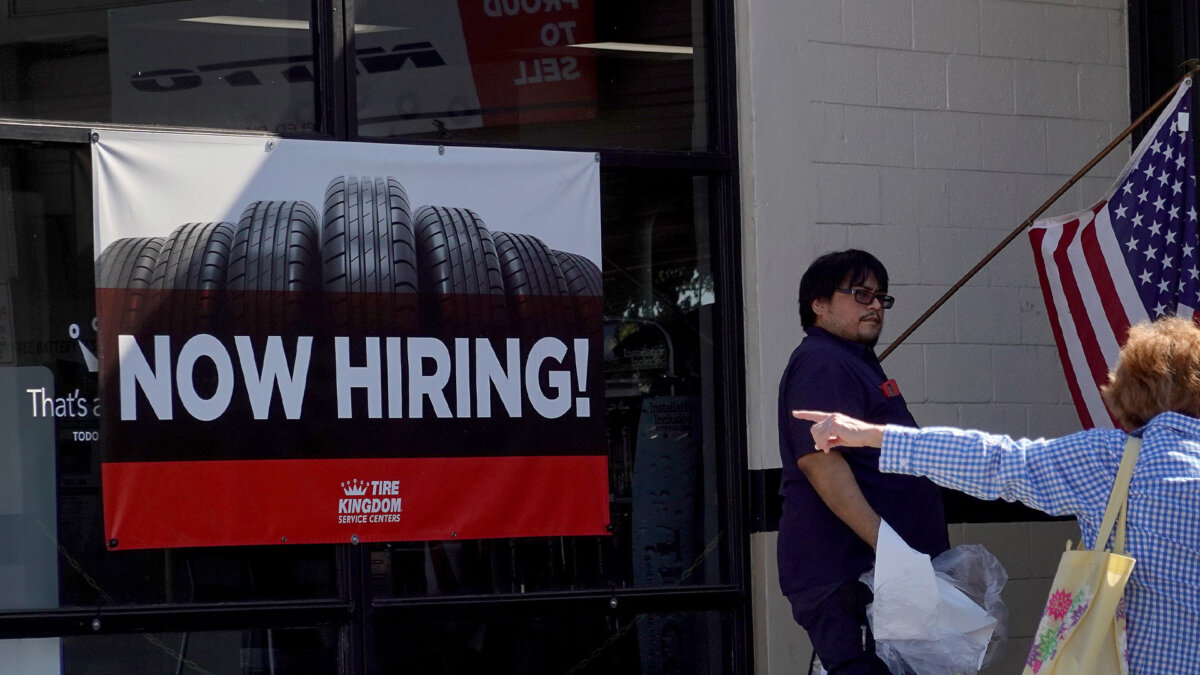
Data from global outplacement firm Challenger, Gray, and Christmas show that businesses have announced more hiring plans this year than in 2024, but the number is historically low compared to previous years.
“The current 2025 hiring pace is more aligned with 2012 (50,194 YTD) and 2013 (180,012 YTD) than with the rebound years of 2021–2022, suggesting that, while companies are adding workers, they are doing so cautiously,” said Andrew Challenger, the firm’s senior vice president.
A recent Atlanta Fed Survey of Business Uncertainty found that 40 percent of business executives plan to scale back hiring over the next six months “due to policy uncertainty.”
“To paraphrase Chair [Jerome] Powell, businesses are in wait-and-see mode at the moment,” Atlanta Federal Reserve strategists said in the report. “Should uncertainty over trade policy continue to go unresolved, its dampening effect will continue to weigh on the near-term growth trajectory of the U.S. economy.”
Looking at the Federal Reserve
Monetary policymakers have repeatedly stated that the U.S. labor market, which is one part of the central bank’s dual mandate, is in better balance, with the unemployment rate hanging slightly above 4 percent.
A positive assessment of employment conditions could enable the Fed to maintain higher interest rates for a longer period.
The Fed will complete its two-day Federal Open Market Committee policy meeting on June 18. Investors overwhelmingly expect the institution to leave interest rates unchanged for the fourth consecutive meeting at a range of 4.25 to 4.5 percent.
“The odds for a cut at this meeting are near zero,” Woods said.
CME FedWatch Tool figures indicate that the futures market is penciling in the next quarter-point interest rate cut at the September meeting.
Investors will also receive an update to the Summary of Economic Projections, a quarterly survey that provides officials’ projections for the economy and policy. The March dot-plot pointed to two 50-basis-point cuts this year, with the median policy rate finishing the year at 3.9 percent.
Fed Gov. Christopher Waller still believes that there is a path for multiple rate cuts this year.
“Assuming that the effective tariff rate settles close to my lower tariff scenario, that underlying inflation continues to make progress to our 2 percent goal, and that the labor market remains solid, I would be supporting ‘good news’ rate cuts later this year,” Waller said in a speech at a central bank conference in South Korea earlier this month.
President Donald Trump has been pushing Powell to lower interest rates, demanding a full point reduction in the benchmark federal funds rate.
 Friends Read Free
Copy
Facebook
Tweet
Friends Read Free
Copy
Facebook
Tweet