
Commentary
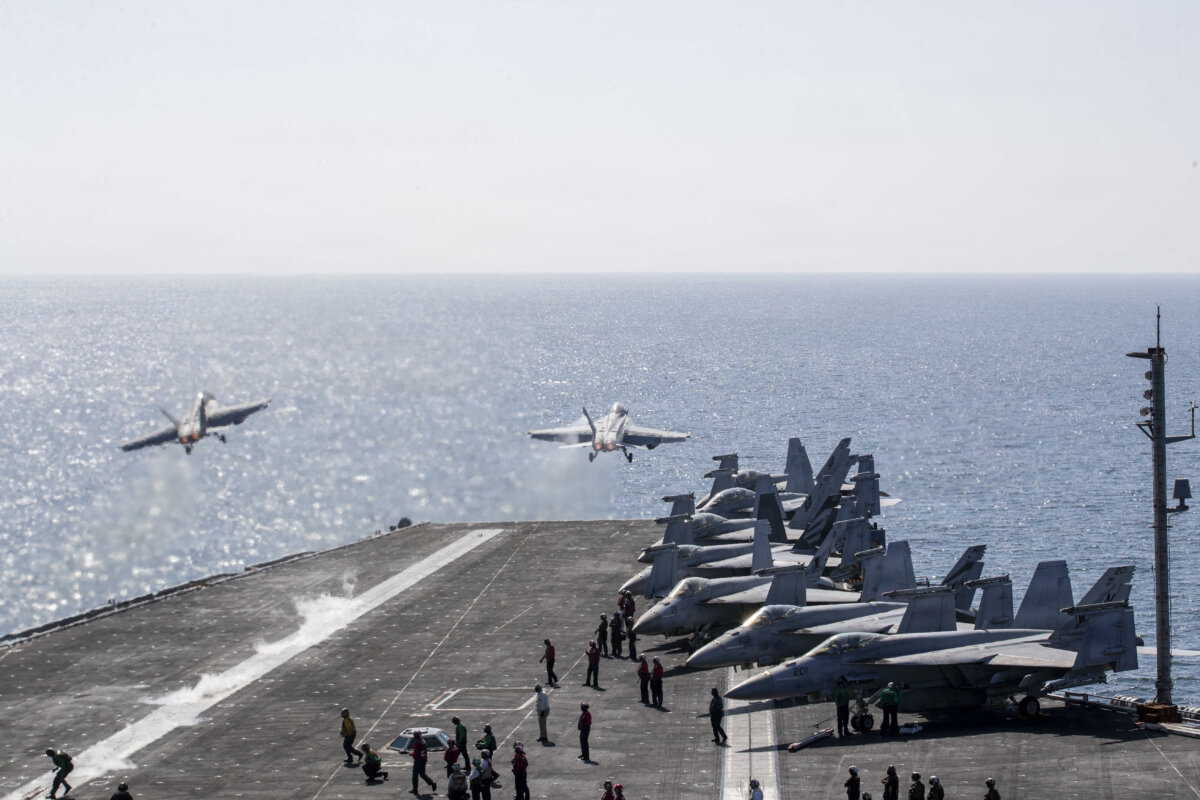
Going into the second week of the Iran War, General Dan Caine, Chairman of the Joint Chiefs of Staff, said additional forces are being sent to the Middle East to support the operation. In a press conference with Caine, Defense Secretary Pete Hegseth said Tehran wasn’t interested in making “a peaceful and sensible deal,” but hopefully this new military action will wind down quickly in the upcoming weeks.
The immediate winners from this military action would be the U.S. dollar, gold, oil stocks, and defense-related stocks like Elbit Systems Ltd. (ESLT), Howmet Aerospace Inc. (HWN) and Palantir (PLTR).
The U.S. State Department has closed its embassies in Kuwait and Saudi Arabia and told U.S. citizens to leave most countries in the Middle East. An intense bombing campaign of Iran’s Revolutionary Guard facilities is apparently underway. When this bombing campaign is completed, Iran will likely have no navy, missiles or drones. This should limit new attacks on energy infrastructure, and energy prices would then stabilize.
Any further speculation depends on whether Iran’s leadership changes for the better.
Here are the most important developments recently and what they mean:
– G-7 finance ministers met this week to discuss releasing crude oil reserves and said they “stand ready” to release crude oil reserves if necessary. When Israel hit some crude oil tanks in Iran, the fear spread that Iran may not immediately come back online after the fighting stops. The Trump Administration was not happy with the IDF strike on crude oil tanks, so hopefully, there will not be more attacks on Iran’s oil infrastructure. China, India, South Korea, Japan, Germany, Italy and Spain are called big importers of crude oil, so their economies are especially sensitive to price shocks.
– Crude oil prices have had a dramatic reversal after President Donald Trump said the U.S. and Israel are making significant progress in the war on Iran and could end the conflict “very soon.” The perception that since the Ayatollah’s son, Mojtaba Khamenei, was named the new Supreme Leader, means that hardliners in Iran remain in charge, so no surrender is anticipated. However, Mojtaba Khamenei has spent a lot of time in London due to medical issues, so he may not be as hardline as some perceive. So, it will be interesting if Iran wants to continue fighting, since it seems futile.
– The chaos in the Middle East is not boosting gold prices, which have consolidated somewhat. The U.S. dollar remains super strong, and that should help U.S. financial markets be much more resilient. Also, since gold is priced in U.S. dollars, I am expecting gold to reemerge as an oasis for nervous investors.
– Bloomberg has been reporting that Ed Yardeni raised the probability of a market meltdown to 35% for the rest of the year, up from 20% previously. Yardeni also slashed the odds of a meltup, namely a rally driven more by investor enthusiasm than underlying fundamentals, to just 5% from 20%. Specifically, Yardeni said, “If the oil shock persists, the Fed’s dual mandate would be stuck between the increasing risk of higher inflation and rising unemployment.” Obviously, I highly respect Ed Yardeni and believe he is stating the obvious. The good news is Ed Yardeni has assigned an 85% chance of a continuation of the Roaring 2020s.
– Speaking of nervous investors, BlackRock has limited withdrawals from one of its flagship private credit funds after a surge of redemption requests. Specifically, the $26 billion HPS Corporate Lending Fund received $1.2 billion in withdrawal requests in the first quarter and will allow $620 million redemptions, which represents 5% of the fund. As the panic in private credit spreads, it will drag the Fed into fixing this mess with further key interest rate cuts, since it will impede leading and curtail economic growth.
– The good news is that Nvidia will be hosting a GPU Tech Conference next week that is expected to provide insight into its next-generation chip architecture, which helped semiconductor and memory stocks rally this week. Additionally, this conference is also expected to highlight optical connections, which should bode well for Corning (GPW) and Ubiquiti (UI).
In summary, the key to getting crude oil prices to subside is to reopen the Strait of Hormuz after Iran’s missile and drone facilities are destroyed. This military action should remove much of the major uncertainty in the world, and the stock market should stage a relief rally if a new, pro-Western leadership emerges and oil exports resume.
 Friends Read Free
Copy
Facebook
Tweet
Friends Read Free
Copy
Facebook
Tweet