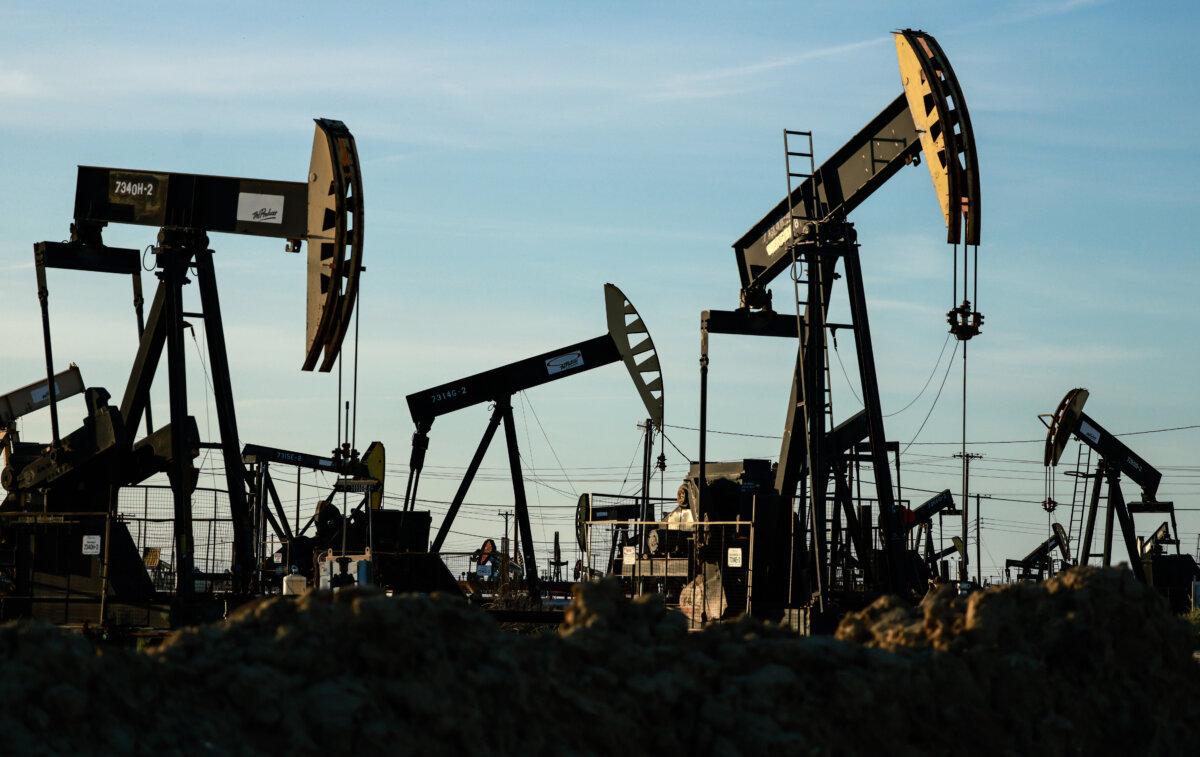

Brent crude oil futures prices broke through the $115 per barrel level during late March 29 trading, as the Iran conflict continues without signs of abating.
Oil was trading at $115.89 per barrel as of 9:50 p.m. ET on March 29 after earlier hitting a high of $116.75. Roughly a month ago, on Feb. 27, a day before the United States and Israel launched coordinated strikes against the Iranian regime, oil had closed at about $72 per barrel.
Over the weekend, new concerns popped up that have further shaken investor confidence—the possibility of a U.S. ground invasion in Iran and the Houthi terrorist group joining Tehran in the conflict.
U.S. Central Command said on March 28 that more than 3,500 U.S. sailors and Marines aboard the USS Tripoli had arrived in the Middle East. In addition to the soldiers, the vessel brings amphibious assault capabilities, strike fighters, and transport aircraft to the region. Another amphibious assault ship, USS Boxer, together with the 11th Marine Expeditionary Unit, has been ordered to the Middle East from San Diego.
Although U.S. forces are being stationed in the Middle East, there is no guarantee that a ground invasion will happen. Secretary of State Marco Rubio said on March 27 that the military deployment was a precautionary measure aimed at preparing for unforeseen contingencies.
A key concern is Iran’s ongoing chokehold on the narrow Strait of Hormuz, a waterway through which one-fifth of the world’s oil and gas is transported. The head of the U.S. oil and natural gas industry’s top lobbying group recently said the strait needs to be reopened quickly.
U.S. President Donald Trump has threatened to strike Iranian energy sites if the Strait of Hormuz is not fully reopened, setting the strike deadline at April 6.
Meanwhile, the Iran-aligned Houthi terrorist group in Yemen announced on March 28 that it has entered the conflict, launching a missile attack against Israel. The group had earlier threatened to potentially block the Bab el-Mandeb Strait, another critical oil and trade shipping passageway linking the Red Sea to the Gulf of Aden.
These factors have weighed on investor minds and contributed to pushing up oil prices.
In a March 27 post, ING Bank highlighted the upside risks to oil prices.
“The scale of supply at risk remains significant—around 8 million barrels per day are already offline, and a much larger volume of flows through the Gulf remains vulnerable—so the geopolitical premium is unlikely to fade meaningfully,” the bank said.
Although Trump has extended the deadline for Iran to reopen the Strait of Hormuz, he has also been weighing whether to use ground forces to seize Kharg Island, a hub for about 90 percent of Iran’s oil exports.
An escalation in the conflict that damaged export facilities at Kharg Island would lift prices higher than $120, with some analysts forecasting levels as high as $200. The average forecast for this scenario is $153.85.
If the United States and Israel were to declare an end to the war soon, but Iran’s threats to shipping operations through the Strait of Hormuz were to persist, analysts believe that we would see prices anywhere between $50 and $150, reflecting the uncertainty over how long or severe disruptions to oil flows through the strait would be in the aftermath of the war.
The Iran conflict has pushed up gasoline prices at the pump for everyday Americans.
The national average price of regular gas as of March 29 was $3.98 per gallon, up by almost $1 from a month back, according to data from the American Automobile Association.
California had the highest gas price at $5.86 per gallon, followed by Hawaii and Washington, both with prices higher than $5 per gallon.
In a March 29 post on X, Patrick De Haan, head of petroleum analysis at GasBuddy, said, “Rough calculations show Americans collectively have spent [approximately] $8 billion more on gasoline in the last month since the U.S. attacked Iran, a number that will surpass $10 billion in the days ahead.”
Reuters contributed to this report.
 Friends Read Free
Copy
Facebook
Tweet
Friends Read Free
Copy
Facebook
Tweet