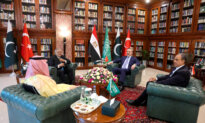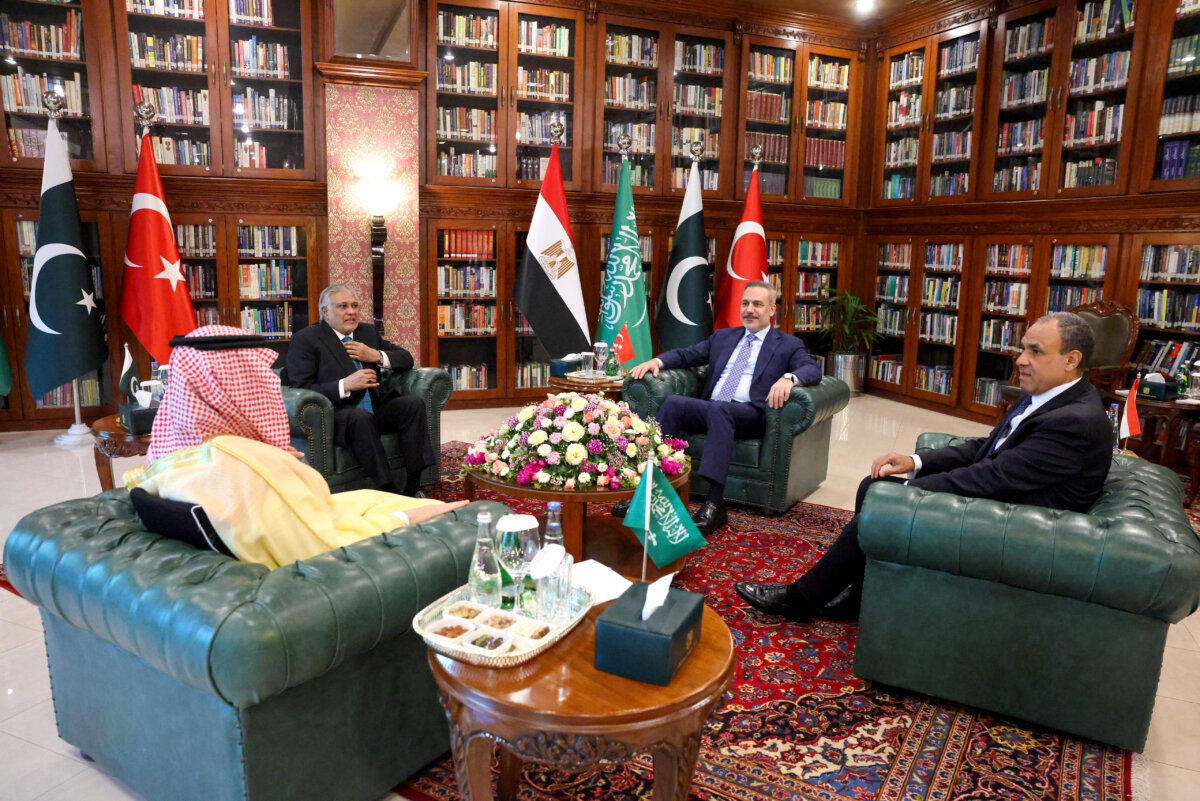
Pakistan said it is preparing to host and facilitate deescalation talks between the United States and Iran after foreign ministers of Pakistan, Saudi Arabia, Turkey, and Egypt met in Islamabad on March 29 to discuss how to end the conflict in the Middle East.
“Pakistan is very happy that both Iran and the US have expressed their confidence in Pakistan to facilitate the talks,” Pakistani Deputy Prime Minister and Foreign Minister Mohammad Ishaq Dar wrote in a statement on March 29.
“Pakistan will be honoured to host and facilitate meaningful talks between the two sides in [the] coming days, for a comprehensive and lasting settlement of the ongoing conflict.”
The White House and U.S. Central Command did not respond to requests for comment by publication time.
The United States and Israel did not participate in the March 29 talks in Islamabad.
Ahead of Pakistan’s offer for peace talks, Speaker of the Parliament of Iran Mohammad Bagher Qalibaf warned on March 29 that forces are “waiting for the arrival of American troops on the ground to set them on fire and punish their regional partners forever.”
Qalibaf’s comments in a translation of an open letter to the people of Iran came as more than 3,500 U.S. sailors and Marines aboard the USS Tripoli arrived in the Middle East on March 28.
Secretary of State Marco Rubio said the United States is not planning a ground invasion of Iran but suggested that the latest troop movements are a precautionary measure to prepare for unforeseen circumstances.
The war against the Iranian regime started on Feb. 28 when the United States and Israel killed dozens of senior Iranian leaders, including Iranian leader Ali Khamenei, in a series of strikes.
The Iranian regime retaliated and has since closed the Strait of Hormuz for the United States and its allies. Iran allowed 20 Pakistani-flagged ships to pass through the Strait of Hormuz unharmed on March 28.
The Strait of Hormuz is a crucial passageway used to transport one-fifth of the world’s oil and gas. After weeks of the war, the head of the U.S. oil and natural gas industry’s top lobbying group demanded that it needed to “be reopened and fast.”
“The longer this goes on, the higher prices are going to go,” Mike Sommers, president and CEO of the American Petroleum Institute, said on Fox News’ “The Sunday Briefing.”
The average price for a gallon of regular gas in the United States is $3.98, which is $1 higher than before the war started, according to the American Automobile Association.
The Associated Press contributed to this report.
 Friends Read Free
Copy
Facebook
Tweet
Friends Read Free
Copy
Facebook
Tweet