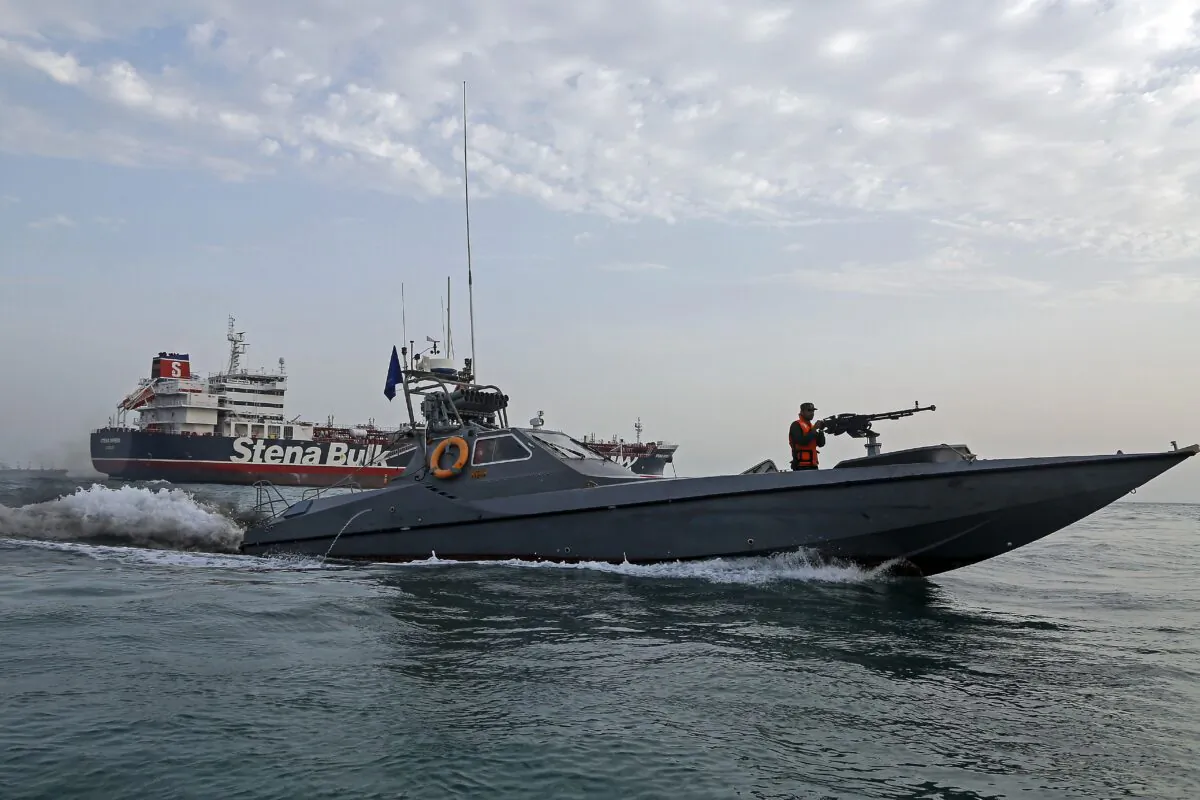

Iran’s military command warned the world to prepare for oil prices to double as it struck three commercial vessels near the Strait of Hormuz.
“Get ready for oil to be $200 a barrel, because the oil price depends on regional security which you have destabilized,” Ebrahim Zolfaqari, spokesperson for Iran’s military command, said on March 11.
The United Kingdom Maritime Trade Operations (UKMTO), which monitors shipping security in the region, said unknown projectiles targeted a bulk carrier, cargo vessel, and container ship overnight on Wednesday.
Since the conflict began on Feb. 28, UKMTO said there have been 17 reports of incidents affecting vessels operating in the Arabian Gulf, the Strait of Hormuz, and the Gulf of Oman.
Military operations in the region have significantly impacted the global oil trade, particularly in the Strait of Hormuz, a crucial passageway used to transport a fifth of the world’s oil and gas.
Iran’s Revolutionary Guards have warned that any ship passing through the narrow Strait, which is just south of the country, will be targeted.
President Donald Trump suggested on Wednesday that oil companies should still use the Strait of Hormuz despite the Iran war.
“We took out just about all of their mines,” Trump told reporters as he left the White House.
The price of a barrel of crude oil jumped to more than $110 on March 9 but dropped to around $85 as of Wednesday morning.
On March 11, the average price for a regular gallon of gas was $3.58, reflecting a sudden rise from $2.98 on Feb. 26, just two days before Israel and the U.S. launched Operation Epic Fury against the Iranian regime.
There has been a global effort to stabilize oil and gas prices amid the war.
The surging rates have caused the European Union to consider capping gas prices, European Commission President Ursula von der Leyen said on Wednesday.
Members of the International Energy Agency (IEA) have revealed that they will release 400 million barrels of oil from reserves.
Military operations around the Strait of Hormuz remain very active.
U.S. forces eliminated multiple Iranian naval vessels and 16 minelayers in the area on March 10, according to U.S. Central Command (CENTCOM).
CENTCOM warned that the Iranian regime may start conducting military operations at its civilian ports along the Strait of Hormuz and warned people to stay away from those areas.
“This dangerous action risks the lives of innocent people,” CENTCOM wrote in an X post. “Civilian ports used for military purposes lose protected status and become legitimate military targets under international law.”
The warning is aimed at Iranian dockworkers, administrative personnel, and commercial vessel crews.
“American forces will continue taking every feasible precaution to minimize harm to civilians,” CENTCOM added.
 Friends Read Free
Copy
Facebook
Tweet
Friends Read Free
Copy
Facebook
Tweet