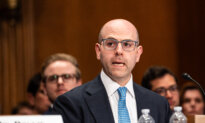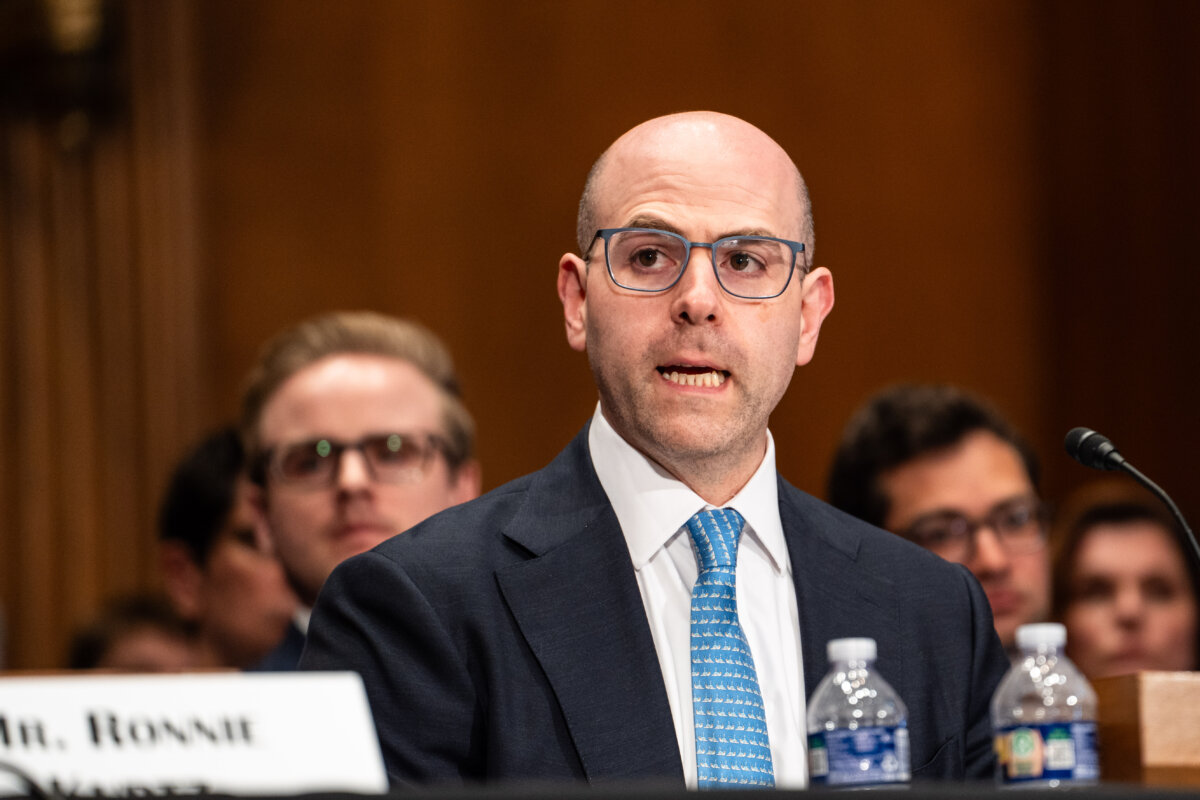

Stephen Miran, head of the White House Council of Economic Advisers, inched one step closer to joining the Federal Reserve Board of Governors on Sept. 10.
Members of the Senate Banking Committee voted 13–11 to advance Miran’s nomination to a full Senate vote. All Republicans supported him, while all Democrats opposed the nomination.
With a 53–47 Republican majority in the Senate, his path to becoming a Fed governor is more certain.
Last month, President Donald Trump nominated Miran to temporarily replace Fed Governor Adriana Kugler, who abruptly resigned and returned to teaching. If confirmed, Miran will hold the position until the end of January, meaning the president will either renominate him for a full 14-year term or select somebody else.
It is unclear whether Miran’s confirmation process will be completed ahead of next week’s Federal Open Market Committee (FOMC) two-day policy meeting.
The top White House economic adviser has advocated that the central bank should lower interest rates, arguing that tariffs do not bolster inflation.
He told CNBC last month that there has been no evidence of tariff-driven inflation.
“Lots of folks who were predicting … doom and gloom, it just hasn’t panned out, and it continues to not pan out for them,” Miran said.
During his Sept. 4 confirmation hearing, Miran told lawmakers that he would remain an independent voice and make his own decisions based on the economic data.
“In my view, the most important job of the central bank is to prevent depressions and hyperinflations,” he said in his opening statement last week. “Independence of monetary policy is a critical element for its success.”
Senate Banking Committee Chair Tim Scott (R-S.C.) said Miran is prepared to step into a position that is crucial to “advancing opportunity, holding accountability, and protecting American prosperity.”
“Dr. Miran brings deep experience, proven leadership, and a clear commitment to ensuring that the American economy remains strong and competitive,” Scott said. “He has also guided policies that strengthen domestic production, reduce trade imbalances, and bolster economic resilience.”
Senate Democrats have expressed concern that Miran will serve as a proxy for the president.
In her prepared remarks, Sen. Elizabeth Warren (D-Mass.) said Miran “has already spectacularly failed every independence that we could think of.”
“This nomination sets up an obvious Trump loyalty test for Dr. Miran,” Warren said. “He notes that every vote he takes determines whether he can go back to his White House job. That is not independence, that is servitude. He will have zero credibility with markets, zero credibility with businesses, and zero credibility with the public.”
Following the vote, Sen. Jack Reed (D-R.I.) noted that lawmakers have yet to receive a written legal document from Miran stating that he can hold a dual position at the White House Council of Economic Advisers and the Federal Reserve.
“We requested in writing that legal opinion, and he’s refused to give it to us. So, we are still completely uncertain about his legal status and his independence,” Reed said.
Miran told senators last week that he will take an unpaid leave of absence from the administration if he is confirmed to the Fed post and does not intend to leave his current occupation permanently.
In a Sept. 5 letter, committee Democrats called these actions “ludicrous,” adding that he should resign from his present job before accepting a role at the Federal Reserve.
“This arrangement would not serve the best interest of the American people,” they wrote.
In March 2024, Miran called into question the Federal Reserve’s independence, writing in a Manhattan Institute paper that the central bank’s record in recent years has raised questions about whether its policies have aligned with the objective of independence.
“The Fed’s current governance has facilitated groupthink that has led to significant monetary-policy errors while allowing the Fed the flexibility to unwisely expand its remit into inherently political areas such as credit rationing and banking regulation,” he wrote in a co-authored paper.
 Friends Read Free
Copy
Facebook
Tweet
Friends Read Free
Copy
Facebook
Tweet