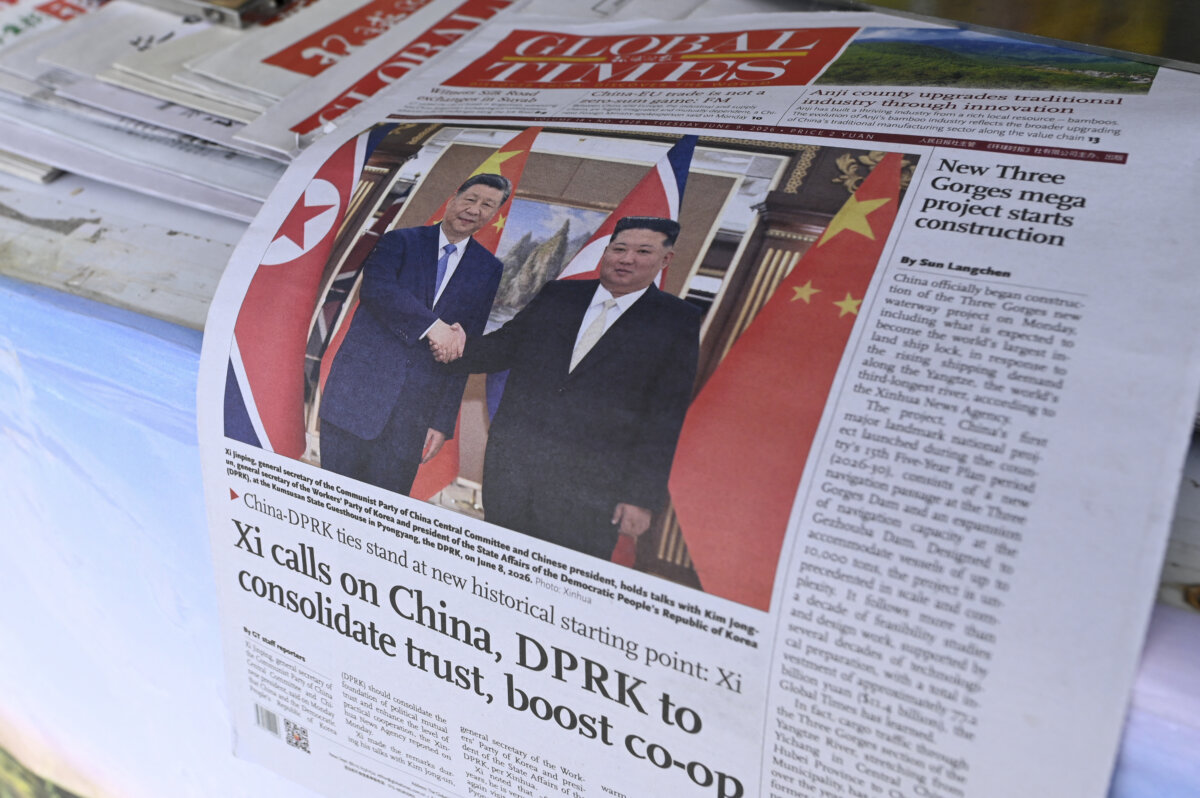

Chinese leader Xi Jinping returned to Beijing on June 9 after a two-day visit to Pyongyang. Xi made no mention of North Korea’s denuclearization during the trip, a sharp contrast to his previous visit seven years ago. Instead, he publicly emphasized military exchanges between China and North Korea.
Analysts who spoke to The Epoch Times say Xi’s silence on denuclearization may reflect deeper strategic calculations, while the renewed focus on military ties could have significant implications for South Korea’s security and serve as a warning to Seoul’s current leadership.
Xi’s Likely Goal: Reclaiming Influence in Pyongyang
The trip marked Xi’s first overseas visit of the year. On June 8, North Korean leader Kim Jong Un hosted a grand welcoming ceremony for Xi at Kim Il Sung Square, where giant portraits of both leaders were prominently displayed.
Members of North Korea’s military honor guard were heard chanting wishes for “Comrade Xi Jinping’s good health,” an unusual gesture not seen during previous visits.
Kim and his wife personally greeted Xi and his wife at the airport and accompanied them to the Kumsusan State Guesthouse. The reception appeared even more elaborate than the one Xi received during his last visit to North Korea seven years ago.
According to China’s state-run Xinhua News Agency, Xi called for stronger exchanges in diplomacy, law enforcement, and military affairs.
He also proposed expanding cooperation in trade, agriculture, construction, technology, healthcare, and other sectors, while using the full reopening of border crossings and the resumption of flights and international passenger rail service to increase cross-border travel.
Sheng Xue, a prominent Chinese Canadian author and democracy activist, told The Epoch Times that Xi may have effectively “paid” for the lavish welcome through economic incentives and assistance. However, beneath the display of friendship, the mutual distrust between Beijing and Pyongyang may be deeper than ever.
Kim has moved significantly closer to Russian President Vladimir Putin in recent years and sent North Korean troops to support Russia’s war effort in Ukraine.
According to Sheng, by doing so, Kim is signaling to Xi that he has alternative partners and greater leverage, while also positioning himself to extract additional concessions from Beijing.
For decades, China has served as North Korea’s economic lifeline and principal diplomatic backer, giving Beijing the dominant position in the bilateral relationship.
A 2024 report by U.S.-based nonprofit National Committee on North Korea estimated that approximately 95 percent of North Korea’s legal trade depends on China.
That dynamic, however, has shifted since Russia’s invasion of Ukraine in 2022.
South Korea’s state-funded Institute for National Security Strategy estimated in a March 2026 report that North Korea was paid between $7.67 billion and $14.4 billion by Russia for its troop deployments and export of an estimated 4 million to 6 million artillery shells and missiles between August 2023 and December 2025.
If troop deployments continue, North Korea could generate roughly $560 million annually from that activity alone. Researchers estimate that the compensation North Korea has received so far represents only a fraction of the revenue generated.
In June 2024, Kim and Putin signed a Comprehensive Strategic Partnership Treaty in Pyongyang, further deepening ties between the two countries.
China Seeks Stronger Relationship
At the same time, China has been working to repair and strengthen its relationship with North Korea.
In March, the two countries resumed their international passenger rail service. The following month, Chinese Foreign Minister Wang Yi visited Pyongyang.
Sheng believes Xi likely offered substantial aid and renewed trade incentives during the visit to keep North Korea aligned with Beijing and prevent it from drifting further toward Moscow.
But in her view, Kim has become increasingly adept at playing the major powers against one another.
According to Sheng, the more urgently Xi seeks to secure North Korea’s loyalty through economic support, the more he reveals Beijing’s growing dependence on Pyongyang as a strategic partner.
“Kim is likely aware of that dependence,” Sheng said.
“Rather than fully aligning with Beijing, he may seek to use China as a bargaining chip in future negotiations, whether in the context of U.S.–China competition or potential pressure from the Trump administration.”
U.S.-based political commentator Tang Jingyuan shared Sheng’s perspective.
“Xi’s primary goal in this visit was to draw North Korea more firmly back into China’s orbit and restore Pyongyang to the role of a dependable strategic partner,” Tang told The Epoch Times.
“But Xi is unlikely to achieve this goal, because North Korea’s possession of nuclear weapons has fundamentally changed its position.”
Pyongyang conducted its first nuclear weapons test in 2006, demonstrating its nuclear capability.
He explained that with a credible nuclear deterrent, Kim now has far greater confidence and room to maneuver. Instead of relying solely on Beijing, Pyongyang is increasingly balancing among China, Russia, and even the United States to maximize its leverage.
Silence on Denuclearization Reflects a New Reality
Xi made no mention of North Korea’s nuclear weapons program during the trip, unlike his visit seven years ago, when he publicly endorsed the goal of “denuclearizing the Korean Peninsula.”
Sheng noted that Beijing has long sought to portray itself as a responsible player in addressing the North Korean issue. The regime encouraged the international community, particularly the United States, to view China as an indispensable partner capable of maintaining stability on the Korean Peninsula and persuading Pyongyang to abandon its nuclear ambitions.
In Sheng’s view, that posture was always more tactical than genuine.
“North Korea’s nuclear capability has long served China’s strategic interests,” she said. “Today, Xi sees North Korea’s nuclear arsenal as a useful tool to challenge the coordination among the United States, Japan, and South Korea.”
Sheng said that Beijing may no longer see much value in maintaining the facade of working toward North Korean denuclearization. As strategic competition between China and the United States intensifies, a nuclear-armed North Korea provides Beijing with additional leverage in Northeast Asia.
Following the recent Trump–Xi meeting, the U.S. government released an update to its list of Chinese companies linked to military-civil fusion activities, including major firms such as Alibaba, Baidu, and BYD.
Against this backdrop, Sheng believes Xi likely views North Korea as a useful strategic asset capable of distracting U.S. attention, complicating alliance coordination, and increasing pressure along the first island chain.
“Beijing cannot openly endorse North Korea’s nuclear weapons program,” she said. “But it may no longer feel compelled to emphasize denuclearization.”
Tang said that Xi’s decision not to raise the denuclearization issue was itself part of a bargain with Kim.
Recognizing that North Korea’s status as a nuclear-armed state is now a reality that cannot be reversed, Beijing has chosen to adopt a largely acquiescent stance. In return, Beijing hopes to improve relations with Pyongyang, expand bilateral cooperation, and maintain some influence over Kim’s future decisions, Tang said.
Military Ties Raise Concerns in South Korea
Another development during Xi’s visit was the public discussion of military exchanges between China and North Korea, with Chinese Defense Minister Dong Jun participating in the talks.
The visit coincided with the 65th anniversary of the Sino-North Korean Treaty of Friendship, Cooperation, and Mutual Assistance, which is China’s only active military alliance treaty.
While past interactions between Chinese and North Korean leaders have typically emphasized party-to-party ties, military cooperation has rarely been explicitly highlighted.
Sheng said that North Korea’s growing military cooperation with Russia has provided Pyongyang with not only foreign currency but also valuable battlefield experience through its involvement in the war in Ukraine.
She noted Beijing may now be seeking a larger role in North Korea’s military development. Closer military ties would allow China to better understand North Korean capabilities while strengthening a partnership that could serve as a strategic counterweight to both South Korea and Japan.
This development comes at a sensitive moment for Seoul.
South Korean President Lee Jae-myung recently signaled reluctance to deepen military cooperation with Japan, citing unresolved historical issues. His administration is also more open to engagement and exchange with Pyongyang than his predecessor, Yoon Suk-yeol, whose conservative government sought denuclearization first.
According to Tang, concerns about potential Chinese economic retaliation may still influence South Korean decision-making, given Beijing’s previous economic pressure campaign following Seoul’s deployment of the U.S.-operated THAAD missile defense system in 2017.
Nevertheless, he noted that China’s rapid move to strengthen military ties with North Korea will likely increase security pressure on South Korea, regardless of Seoul’s efforts to avoid confrontation.[series_posts_list][/series_posts_list]
Looking ahead, Sheng believes military cooperation between China and North Korea could become increasingly institutionalized, potentially including more frequent high-level exchanges, intelligence sharing, and joint military activities.
In her view, Xi was effectively making Beijing’s position clear. If the United States, Japan, and South Korea continue to increase pressure on China in the East China Sea, South China Sea, and Taiwan Strait, then Beijing may rely more heavily on North Korea as a strategic partner capable of creating military—and potentially nuclear—crises elsewhere in the region.
Tang Bing and Luo Ya contributed to this report.
 Friends Read Free
Copy
Facebook
Tweet
Friends Read Free
Copy
Facebook
Tweet