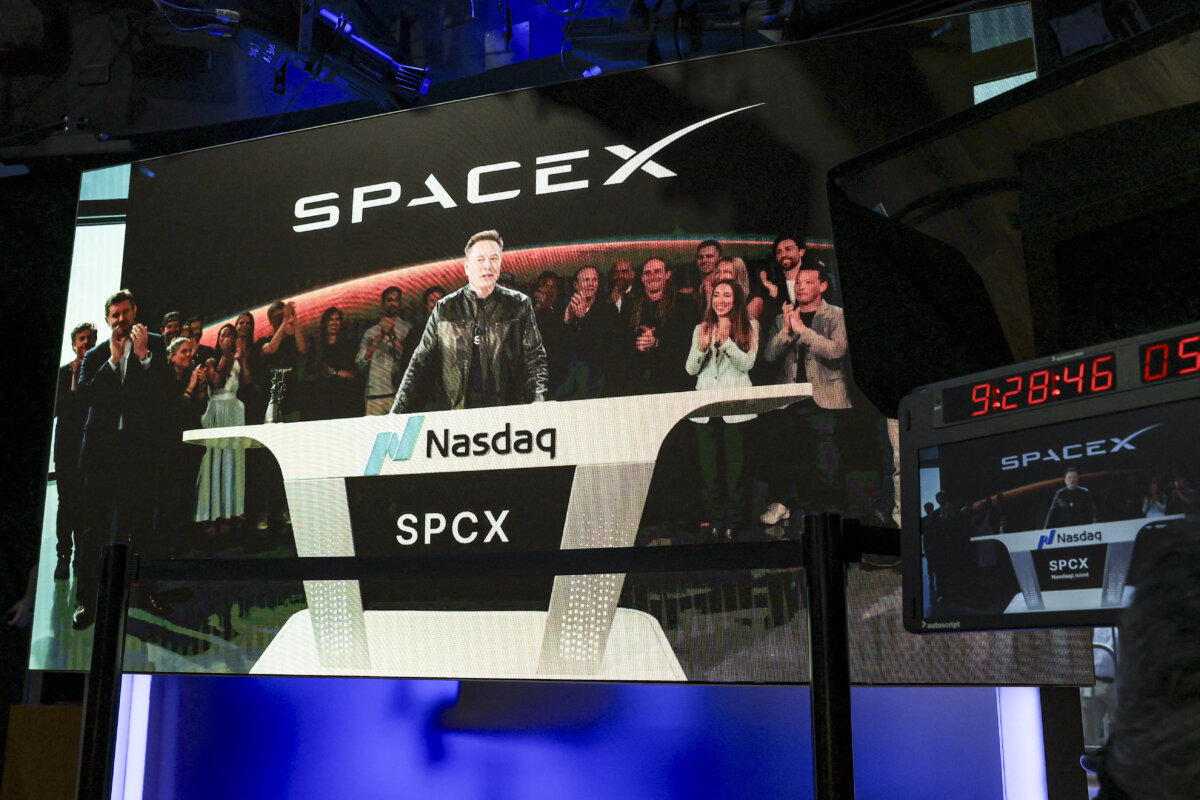

Elon Musk, the world’s richest man, has become the first trillionaire on the planet after his shares in SpaceX jumped in its blockbuster Wall Street debut on June 12.
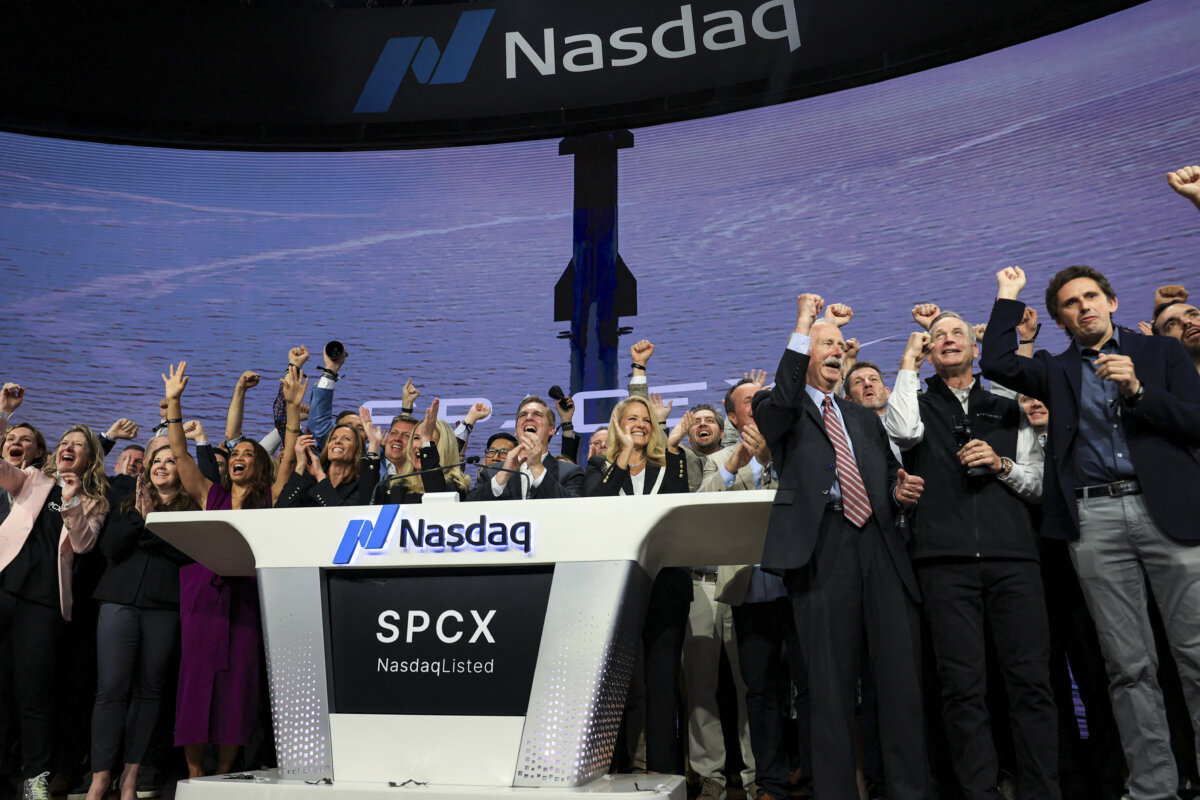
SpaceX shares gained 19 percent on its first day of trading in the largest initial public offering (IPO) in history. Its stocks opened at about $150 per share, then shot to $168 before ending the day at about $161.
Based on his combined stakes in SpaceX and Tesla Motors, Musk has attained trillionaire status.
Before the opening bell, Forbes estimated Musk’s net worth at $981 billion.
Musk has already widened the gap between himself and the next wealthiest people, including Google’s Larry Page ($296 billion), Google’s Sergey Brin ($273 billion), Amazon’s Jeff Bezos ($247 billion), and Oracle’s Larry Ellison ($227 billion).
Strong demand for SpaceX stock—driven by investors betting that he could replicate the success seen at other ventures through his lofty ambitions—pushed the company’s valuation to $2 trillion shortly after its debut.
Musk first made his money by helping create PayPal and Zip2. He used the proceeds from these sales to invest in Tesla and start SpaceX. The former helped transform the electric vehicle market and delivered a 31,000 percent return for shareholders since its debut in 2010. The latter has developed a method of reusing rockets. This is in addition to the prospects of The Boring Company and Neuralink.
According to its filing with the Securities and Exchange Commission earlier this month, SpaceX plans to reach for the stars and make life multi-planetary. This begins by establishing a presence on the moon and Mars, which could spur the emergence of other industries.
“We want to be able to take anyone who wants to go to the moon, anyone who wants to go to Mars or anywhere in the solar system, and maybe beyond the solar system,” Musk said at a ceremonial bell ringing from Starbase, the company’s headquarters, in South Texas.
“At some point, we want to be able to take you there, not just a few astronauts—I mean you, literally you.
“Whoever you are watching this, SpaceX wants to be able to take you to the moon, take you to Mars, and ultimately beyond.”
But SpaceX also wants to launch data centers into orbit and outperform Anthropic and OpenAI in the AI arms race. The company acquired xAI—a startup of Musk’s—in February.
The Elon Musk Premium
His vision is what market watchers say delivers the Elon Musk premium for stocks.
The IPO prospectus essentially stated that everything hinges on the billionaire entrepreneur, which is why the company granted him 85 percent of voting power.
Additionally, if Musk were to sell his stake and another shareholder were to obtain enough shares to control the company, then “any such change in control could result in changes to [the company’s] strategic direction, management, business plans or policies” and harm the business.
Cumulative deficits have exceeded $41 billion, and revenues totaled about $20 billion last year. The company stated that it does not plan to focus on quarterly earnings.
Despite these factors, SpaceX has justified its $1.77 trillion debut valuation, and investors are excited about SpaceX’s future.
“SpaceX is the ultimate growth stock,” John Belton, portfolio manager at Gabelli Funds, said in a note emailed to The Epoch Times.
“I think this is a company with significant growth potential ahead of it. It’s definitely going to be a long-term story, and I think it will take time for the stock to find its footing in the public markets. But there are a lot of exciting opportunities ahead.”
For now, SpaceX may be carrying the Musk premium, he said. Tesla does as well, but it also maintains long-term earnings power and potential.
The same could eventually apply to SpaceX, particularly because of Starlink.
“It’s not hard to see why that business alone could command a very high valuation,” Belton said.
SpaceX’s prospectus showed that Starlink generated more than $11 billion in revenue, accounting for about 61 percent of the company’s total revenue.
Ultimately, everything will depend on Musk, since both SpaceX and Tesla have offered him exorbitant compensation packages.
At Tesla, Musk could earn up to $1 trillion by unlocking milestones, including reaching an $8.5 trillion market cap by 2035, selling 1 million Optimus robots, and deploying 1 million robotaxis commercially.
At SpaceX, Musk could have a $1.1 trillion payday if he accomplishes a $7.5 trillion market cap, a permanent human colony on Mars, and 100 terawatts of compute capacity from space-based data centers.
Correction: A previous version of this article misstated SpaceX’s debut valuation. The Epoch Times regrets the error.
 Friends Read Free
Copy
Facebook
Tweet
Friends Read Free
Copy
Facebook
Tweet