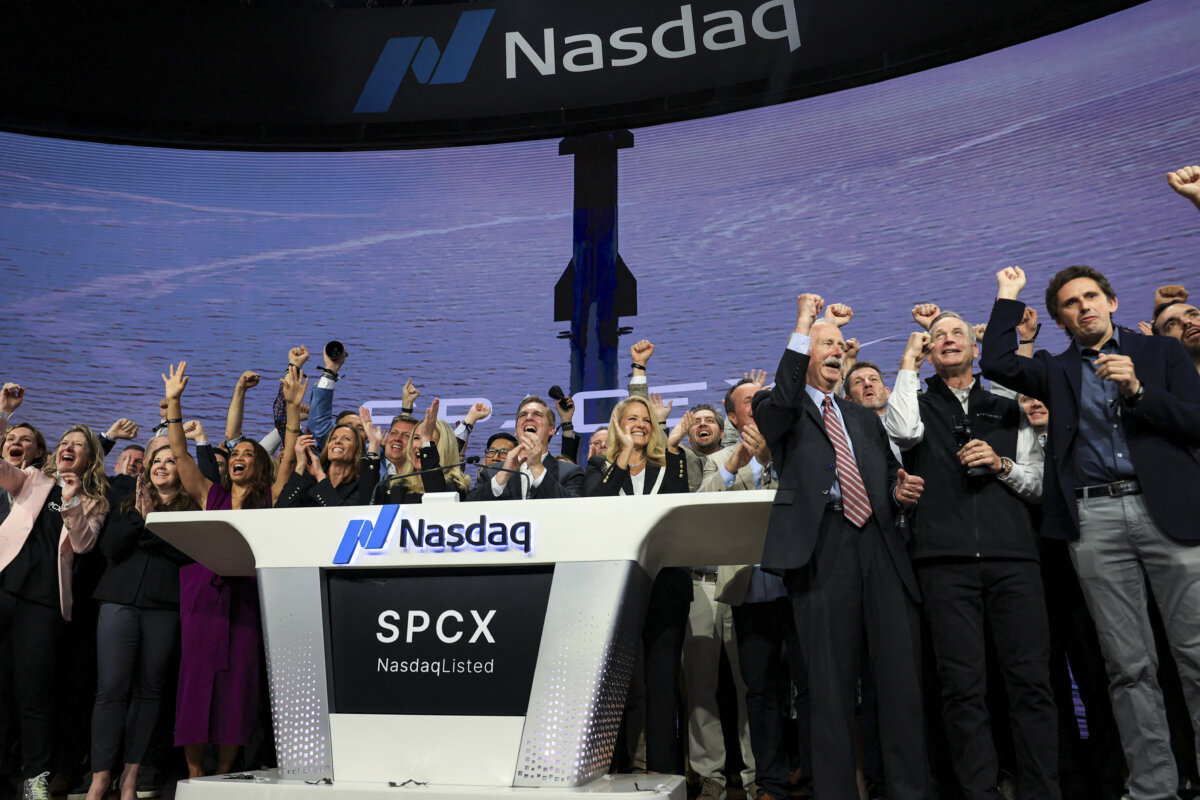

Elon Musk’s SpaceX began trading on June 12 at 10 a.m. under the SPCX ticker on the Nasdaq in what is the largest initial public offering (IPO) in history.
Shares gained more than 20 percent, trading above $165 at 12 p.m. The double-digit gain brought the company’s value to $2.2 trillion.
It has been looking to raise $75 billion by selling 555.6 million shares at $135 apiece.
By the end of the trading session, Musk could become the world’s first trillionaire.
“The IPO parade, which now looks like it’s turning into a stampede, has been coming for a while,” Mark Klein, president and CEO at SuRo Capital, said in a note emailed to The Epoch Times.
“SpaceX is going to be the bellwether. From our perspective, we’re excited.”
Investors will next set their sights on two other mega-IPOs: Anthropic and OpenAI.
Both companies—aiming for trillion-dollar valuations—have confidentially filed for IPOs with federal regulators in the past month.
Several space-related stocks were tanking at the opening bell.
AST SpaceMobile Inc, a Texas-based satellite designer and manufacturer, declined 8 percent. Spaceflight company Virgin Galactic Holdings fell 25 percent. EchoStar, which owns a 3 percent stake in SpaceX, dropped 7 percent.
The tech-driven Nasdaq Composite Index declined about 0.3 percent. The broad-market index S&P 500 was little changed, while the blue-chip Dow Jones Industrial Average picked up more than 100 points, or nearly 0.3 percent.
$1.77 Trillion and Beyond
Market watchers have questioned whether the $1.77 trillion valuation is justified.
Based on its filing with the Securities and Exchange Commission, the company has defended the lofty valuation goal. It cited the Starlink satellite internet service, xAI, and reusable rockets.
Additionally, SpaceX believes its space endeavors will have a spillover effect into the broader marketplace.
“We believe that our current space efforts will catalyze transformative breakthroughs that could reshape terrestrial industries and lead to the emergence of new trillion-dollar markets on the Moon, Mars, and beyond,” the company said in its regulatory filing.
Building a sustained presence on the moon, for example, will unlock terawatt‑scale annual growth in AI computing, enable more ambitious deep‑space missions and industrial activity, and ultimately act as a bridge toward creating a permanent society on Mars, the company added.
Musk’s track record and the fact that SpaceX is the only vertically integrated AI company are reasons enough to believe it can succeed, says Nancy Tengler, CEO and chief investment officer at Laffer Tengler Investments.
“They’ve got the capital, the data, the large language models, the hardware, manufacturing capabilities, and engineering talent,” Tengler told The Epoch Times in an emailed note.
“There are a lot of Elon haters. I don’t really get it. As a result, I think you often hear more of the bear case than the bull case in the media. But this is a narrative stock. You’re buying it for the vision and the excitement.”
SpaceX stressed that it is focused on accomplishing its aims in the years ahead.
In an interview with CNBC published on June 12, SpaceX Chief Operating Officer Gwynne Shotwell said the company is not concentrating on earnings every three months.
“I do not want to focus on quarterly earnings,” Shotwell stated. “I’m not saying we’re not going to do right by our investors, but what folks who invest in SpaceX need to know is that what we’re doing is very futuristic.”
Road to IPO
SpaceX’s path to going public has been marred by controversy, from Musk’s vast control to questions about its inclusion in the index.
The rocket, satellite, and AI company’s IPO filing revealed that the world’s richest man will retain about 85 percent of the voting power. Despite this, Musk will own a little less than half of SpaceX’s shares.
Musk has previously argued that he should have that kind of control at Tesla Motors.
This past fall, Musk defended his extensive compensation package as critical to protecting the electric-vehicle and robotics maker. He specifically called out research firms ISS and Glass Lewis, describing them as “corporate terrorists.”
“I just don’t feel comfortable building a robot army here and … then being ousted because of some asinine recommendations from ISS and Glass Lewis, who have no freaking clue,” he said during a call with investors in October 2025.
“They have made many terrible recommendations in the past that if those recommendations had been followed, it would have been extremely destructive to the future of the company.”
Meanwhile, market watchers have expressed concern about the fast-tracking of SpaceX’s index inclusion.
This year, the Nasdaq updated its rules to allow mega-IPOs to be added quickly. This means index funds—the QQQ exchange-traded fund (ETF), for example—would be forced to buy a stake in SpaceX.
The chief question is whether index funds should automatically purchase a large and unprofitable newcomer. Now that SpaceX will be included in major indexes, millions of people will own the trillion-dollar company, even if they choose not to.
The latest rule changes among the stock indexes prompted a query from Sen. Elizabeth Warren (D-Mass.).
In her letter to the heads of Nasdaq and other indexes, Warren asked whether they had adjusted their methodologies in response to lobbying by Elon Musk and SpaceX, as well as by AI giants Anthropic and OpenAI.
“The changes to your index rules to accommodate these large companies, however, have the potential to destabilize markets and create significant risks for American investors, especially retirees and other individuals that rely on index funds for their savings,” Warren wrote.
The Senate Banking Committee ranking member also urged the Securities and Exchange Commission to postpone SpaceX’s IPO.
Kevin Stocklin contributed to this report.
 Friends Read Free
Copy
Facebook
Tweet
Friends Read Free
Copy
Facebook
Tweet